EyeExaminationOnline.com Eye Examination Online...
Good idea or ripoff? Read on!
"Better one or better two?" Attention consumers! Proceed with caution!
The further from point-of-service providers are located,
the less likely they are to act in the consumer's interest.
Perspectives To Ponder
Optometric Physician*
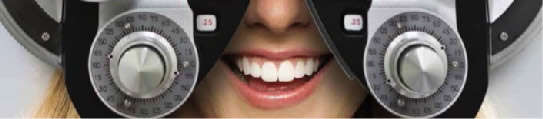
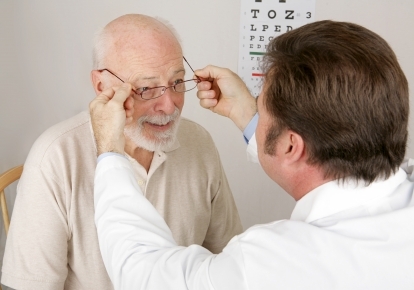
The refraction, i.e., the glasses determining Rx component of an eye examination, represents only about 20% of a comprehensive exam. Consumers do not realize that the refraction ("Which is better, one or two?") portion of the exam contributes only this percentile to the overall determination of the prescription. The remainder of the comprehensive eye health evaluation requires additional evaluation, such as:
a) an external and internal examination and analysis of the structures of both eyes;
b) assessment of the oculomotor, i.e., eye pointing and coordination of the binocular system;
c) depth perception and use of the eyes in all positions of gaze, up, down, left, right;
d) reading tracking from left to right, ability to shift efficiently from near to far and back again;
e) ability to sustain easy focus
Refractionists, e.g., Optometric Physicians (Optometrists, ODs) and Ophthalmologists (MDs) are held accountable by individual state licensing laws and tort-malpractice attorneys to provide these services, or they can be subject to prosecution for sub-standard care or neglect.
And let's recall that State's professional licensing laws exist to protect the consumer from profound ignorance or broad based misinformation or misconception. Yes, this is the "State" taking care of us while at the same time protecting us from opportunistic charlatans, and yes, even remote, online practitioners who conveniently carve out components solely for profit.
*An Optometric Physician, licensed in three states, who has served on both State and National Boards of Optometry and lectures on Optometry Licensing laws while practicing in both private and hospital based settings.
Many eye and vision problems have no obvious signs or symptoms. As a result,
individuals are often unaware that problems exist. Early diagnosis and treatment of
eye and vision problems are important for maintaining good vision and eye health,
and when possible, preventing vision loss. --American Optometric Association
Opticians
Here's my 'two sense' regarding the looming threat to the optical industry by emerging Internet eyewear dispensers and medical insurance providers.
This is another example of 'Gee whiz' technology that separates the healthcare provider from the healthcare consumer. It's time for independent Opticians to have the kahunas to finally organize themselves in order to challenge unskilled eyewear dispensing and medical insurance monopolies, which perpetuate our decades old drift away from point-of-service contact with consumers. It's time to stop discussing the issues sans meaningful action, and act on behalf of consumers and the profession. If Opticians push back, making it 'our game', there are no ways unskilled dispensers and medical insurance behemoths can get away with their monopolistic practices. See ReachOutAndTouchSomebody.com. See 1plus1equals11.com.
Think about it. If a critical mass of point-of-service skilled, value-adding Opticians push back in concert, unskilled dispensing and medical insurance monopolies must change course. 'Value-adding' means adhering to the following axiom.
Eyewear consumers need and deserve the following:
a) Optician-assisted, in-depth lifestyle interview;
b) Optician-assisted, design and selection;
c) Handcrafted, form-fitting eyewear;
d) Free lifetime adjustments and minor repair services, none of which are available online. See Optician's Pledge.
Of course resurrecting this basic standard of care anytime in the foreseeable future requires time. But now is the time to begin. See Shift Happens.
Think about it. Without access to skilled Eyewear Professionals, what can unskilled eyewear merchants and medical insurance monopolies do?
Many independent Opticians feel insecure and vulnerable. Why? Because of insufficient training and experience, and their subsequent lack of self-confidence. It's because of declining skills as Eyewear Professionals and the subsequent inability to dispense value-added service over the last 4-5 decades (How many latter day Opticians know how to adequately hand craft and custom fit eyewear?), and the fractious history of the profession that Opticians are facing today's point-of-service challenges. "Divided we stand, united we fall."
Independent Opticians must man up now, to take back their unique hands-on the consumer craft. (And speaking of craft, whatever happened to craftsmanship? See TimeForCraftsmanship.com.)
Finally, think about this. "Capitalism practiced in this the Age of Aquarius is hopelessly flawed. Today's capitalists have it all backwards. The new paradigm is, serve consumers and profit will follow, i.e., service trumps the dollar. Those who fail to put serving consumers first will become irrelevant. See To Serve Is To Succeed.
"All Opticianry is local."
Opticians must assume responsibility for the current market. Our separation from "point of service" over the last few decades is what has contributed directly to our loss of market share, today. (We can't be anymore separated from point of service than the Internet.) The Consumer didn't demand or cause this separation. Opticians abdicated this direct connection, vis-a-vis insufficient practical, hands-on training. Opticians traded away direct personal contact as providers of healthcare service to Patients for marketing merchandise to customers. Our focus is now more on selling than it is on serving. Opticians must regain this lost balance. The future of Opticianry is quite literally and figuratively in the hands of Opticians. It is incumbent on those skilled Opticians who know, to teach those who do not know.--OpticiansForChange.com
For the last few decades our collective
mindset has manifested as, 'Divided we stand...
united we fall.' We must shift to, 'United we stand...
divided we fall,’ as our paradigm. -- See 1Plus1Equals11.com.
Researchers
Death by medicine is a 21st-century epidemic, and America's "war on drugs" is clearly directed at the wrong enemy! Prescription drugs are now killing far more people than illegal drugs, and while most major causes of preventable deaths are declining, those from prescription drug use are increasing, an analysis of recently released data from the U.S. Centers for Disease Control and Prevention (CDC) by the Los Angeles Times revealed.
Pharmageddon is "the prospect of a world in which medicines and Medicine produce more ill-health than health, and when medical progress does more harm than good" -- and it is no longer a prospect, but fully upon us. Those most at risk from dying from this new drug crisis are people you would least expect; the analysis revealed the death toll is highest among people in their 40s, but all ages, from teenagers to the elderly, and all walks of life are being affected. In fact, prescription drugs are now the preferred "high" for many, especially teens, as they are typically used legally, which eliminates the stigma of being a "junkie.-- Dr. Joseph Mercola
For over a decade, Americans have believed that far too many deaths occur as a result of medical errors in U.S. hospitals. A report issued by the Institute of Medicine in 1999 put the number at 98,000 premature deaths per year. Now that number seems to be rising. A new study published in the Journal of Patient Safety states that the true number of premature deaths associated with preventable harm to patients was estimated at more than 400,000 per year. -- John T. James, Chief scientist of space toxicology at NASA.
"The further from point-of-service providers are located,
the less likely they are to act in the consumer's interest."
*Consultation
with a health care professional should occur before applying
adjustments or treatments to the body, consuming medications
or nutritional supplements and before dieting, fasting or exercising.
None of these activities are herein presented as substitutes
for competent medical treatment. See
Disclaimer.


 The refraction, i.e., the glasses determining Rx component of an eye examination, represents only about 20% of a comprehensive exam. Consumers do not realize that the refraction ("Which is better, one or two?") portion of the exam contributes only this percentile to the overall determination of the prescription. The remainder of the comprehensive eye health evaluation requires additional evaluation, such as:







 *Consultation
with a health care professional should occur before applying
adjustments or treatments to the body, consuming medications
or nutritional supplements and before dieting, fasting or exercising.
None of these activities are herein presented as substitutes
for competent medical treatment.
*Consultation
with a health care professional should occur before applying
adjustments or treatments to the body, consuming medications
or nutritional supplements and before dieting, fasting or exercising.
None of these activities are herein presented as substitutes
for competent medical treatment.