HariSingh.com
Tips
For Parenting


TIPS FOR FIRST TEACHERS
Give
the needs of your mate priority. One parent
put it this way: 'A husband and wife are apt to be
successful parents when they put their marriage
first. Don't worry about the children getting second
best. Child-centered households produce neither
happy marriages nor happy children.' -- Ann Landers
I challenge you to recognize what the world scoffs at, that
your greatest role in your life will be that of wife and mother.
The greatest impact you could ever contribute to our world is a
loving investment in the lives of your precious children. To solve
the problems plaguing our society, we don't need more women
CEOs. We need more women as invested mothers. -- Peter Heck
All you have taught your children is, "Get 'A' grades and become
a great taker." You have never taught them to be Givers. Those
who are not Givers know nothing about God. -- Yogi Bhajan
Create dependable
children, not dependent children.
Give your children the basic values to face their own
tomorrows, not be blinded by yours. Make them to be proper
personalities, not helpless puppets. Position them for success; don't
paralyze them with the commotion of your emotions. -- Yogi Bhajan
Your children can never be grateful to you if you are not graceful parents.
You will never have graceful children if you are not graceful, because
watermelons don't grow on banana trees. Children are always victims of
parental misbehavior. Don't blame anybody else. Mothers are sometimes
poisonous; they ruin children. Sometimes fathers take the children's entire
strength away from them. But if both parents understand that children are
their and they are at their mercy; and that they need values and grace; and
if the parents don't fight between themselves for control and authority over
who wears the pants and runs the home; and if they behave as parents towards
their children then the children can be perfect. Children don't need anything.
They are intelligent, they are born saints and they are very powerful. It is the
goof of the one parent, which messes up the whole game. -- Yogi Bhajan
Children are full-fledged people with high potency antennae, which record
every vibration within their vicinity completely and very deeply. -- Yogi Bhajan
Your children born of you do not understand you. Do not understand your values.
All they understand is their rights and the privilege you provide, that's why give
children not the rights and the privilege, give them the values and the technology
to have those values. Give children the biggest gift, a value of life. When you give
children a technology of life in which you say these are your privileges and every
privilege you give, becomes his right, they are asking more and more, you give in
more and more, finally you reach a point where you cannot give in and the war starts.
War starts that way the day the child will do a drama and wars get to the height when
he starts throwing tantrums and trauma and the war is in the worst when he leaves, he
is out the door, but you caused it. You did not give him life and its values, which is your responsibility as parents. You got blinded by the love and forgot your duty. -- Yogi Bhajan
You are the first teacher. You are the first introduction. Can you deny it?
What a mother teaches a child in the womb cannot be learned on the Earth.
That's why I ask you, after 120 days, just to meditate. Soul has entered. Walk
and meditate, Charan Japa Kriya. (Meditation recommended for expectant parents.)
Walk 3 miles together daily, chanting, ‘Wha Hay Guru,’ one step per syllable. -- Yogi Bhajan
When we give too many choices to our children, they become confused.
When they get older they can’t commit to anything, they lose their focus
and find it difficult to commit to anything for very long. Its really best
to start at an early age being firm but fair. -- Hari Singh Khalsa
Children are born with intrinsic leadership traits that prepare them for life.
These must translate positively into the lives they lead as citizens of the world.
These are: Service, Justice, Courage, Compassion, Decisiveness, Reliability,
Integrity, Initiative, Knowledge, Loyalty, Enthusiasm, Endurance. -- Hari Singh Khalsa
FIRST TEACHERS ARE WOMEN
More Tips For First Teachers
According to Yogi Bhajan
 .) Love them
 .) Build their self-esteem
 .) Challenge them
 .) Listen to
them
.) Listen to
them
 .) Expect respect
 .) Limit them
 .) Make God a part of their lives
 .) Develop
their love of learning
.) Develop
their love of learning
 .) Help them to be community-minded
 .) Let
them go
.) Let
them go
See FirstTeachersAreWomen.com.
THE TEN COMMANDMENTS OF GOOD PARENTING
According to WebMD.com
 What you do matters. "This is one of the most important principles," Steinberg tells WebMD. "What you do makes a difference. Your kids are watching you. Don't just react on the spur of the moment. Ask yourself, 'What do I want to accomplish, and is this likely to produce that result?'"
 You cannot be too loving. "It is simply not possible to spoil a child with love," he writes. "What we often think of as the product of spoiling a child is never the result of showing a child too much love. It is usually the consequence of giving a child things in place of love -- things like leniency, lowered expectations, or material possessions."
 Be involved in your child's life. "Being an involved parent takes time and is hard work, and it often means rethinking and rearranging your priorities. It frequently means sacrificing what you want to do for what your child needs to do. Be there mentally as well as physically."
Being involved does not mean doing a child's homework -- or reading it over or correcting it. "Homework is a tool for teachers to know whether the child is learning or not," Steinberg tells WebMD. "If you do the homework, you're not letting the teacher know what the child is learning."
 Adapt your parenting to fit your child. Keep pace with your child's development. Your child is growing up. Consider how age is affecting the child's behavior.
"The same drive for independence that is making your three-year-old say 'no' all the time is what's motivating them to be toilet trained," writes Steinberg. "The same intellectual growth spurt that is making your 13-year-old curious and inquisitive in the classroom also is making them argumentative at the dinner table."
For example: An eighth grader is easily distracted, irritable. Their grades in school are suffering. They are argumentative. Should parents push them more, or should they be understanding so their self-esteem doesn't suffer?
"With a 13-year-old, the problem could be a number of things," Steinberg says. "They may be depressed. They could be getting too little sleep. Are they staying up too late? It could be they simply need some help in structuring time to allow time for studying. They may have a learning problem. Pushing them to do better is not the answer. The problem may need to be diagnosed by a professional."
 Establish and set rules. "If you don't manage your children's behavior when they are young, they will have a hard time learning how to manage themselves when they are older and you aren't around. Any time of the day or night, you should always be able to answer these three questions: Where is my child? Who is with my child? What is my child doing? The rules your children have learned from you are going to shape the rules they apply to themselves."
"But you can't micromanage your child," Steinberg tells WebMD. "Once they're in middle school, you need to let the child do their own homework, make their own choices, and not intervene."
 Foster your child's independence. "Setting limits helps your child develop a sense of self-control. Encouraging independence helps them develop a sense of self-direction. To be successful in life, they're going to need both."
It is normal for children to push for autonomy, says Steinberg. "Many parents mistakenly equate their child's independence with rebelliousness or disobedience. Children push for independence because it is part of human nature to want to be in control rather than to be controlled by someone else." (Children are born to leave the nest.)
 Be consistent. "If your rules vary from day to day in an unpredictable fashion or if you enforce them only intermittently, your child's misbehavior is your fault, not his. Your most important disciplinary tool is consistency. Identify your non-negotiables. The more your authority is based on wisdom and not on power, the less your child will challenge it."
 Avoid harsh discipline. Parents should never hit a child, under any circumstances. "Children who are spanked, hit, or slapped are more prone to fight with other children," he writes. "They are more likely to be bullies and more likely to use aggression to solve disputes with others."
"There is a lot of evidence that spanking causes aggression in children, which can lead to relationship problems with other kids," Steinberg tells WebMD. "There are many other ways to discipline a child, including 'time out,' which work better and do not involve aggression."
 Explain your rules and decisions. "Good parents have expectations they want their children to live up to," he writes. "Generally, parents overexplain to young children, and underexplain to adolescents. What is obvious to you may not be evident to a 12-year-old. They don't have the priorities, judgment or experience that you have."
Example: A 6-year-old is very active and very smart -- but blurts out answers in class, doesn't give other kids a chance, and talks too much in class. The teacher needs to address this child's behavior problem. He/she needs to talk to the child about it, says Steinberg. "Parents might want to meet with the teacher and develop a joint strategy. The child needs to learn to give other children a chance to answer questions."
 Treat your child with respect. "The best way to get respectful treatment from your children is to treat them respectfully," Steinberg writes. "You should give your children the same courtesies you would give to anyone else. Speak to them politely. Respect their opinion. Pay attention when they are speaking to you. Treat them kindly. Try to please them when you can. Children treat others the way their parents treat them. Your relationship with your children is the foundation for their relationships with others."
For example, if your child is a picky eater: "I personally don't think parents should make a big deal about eating," Steinberg tells WebMD. "Children develop food preferences. They often go through them in stages. You don't want turn mealtimes into unpleasant occasions. Just don't make the mistake of substituting unhealthy foods. If you don't keep junk food in the house, they won't eat it." (See Sugar Is A Four Letter Word.)
Likewise, the checkout line tantrum can be avoided, says Natale. "Children respond very well to structure. You can't go shopping without preparing them for it. Tell them, 'We will be there 45 minutes. Mommy needs to buy this. Show them the list. If you don't prepare them, they will get bored, tired, upset by the crowds of people."
"Parents forget to consider the child, to respect the child," Natale tells WebMD. "You work on your relationships with other adults, your friendships, your marriage, dating. But what about your relationship with your child? If you have a good relationship, and you're really in tune with your child, that's what really matters. Then none of this will be an issue." --

FIVE
PROVEN TECHNIQUES FOR DEALING WITH DEFIANT CHILDREN

"You can't make me!" Remove her/him
 This
is the gold standard of defiance busting. When your child reaches
the limit, simply swoop in and physically leave the store, take
her out of the sandbox, end the playdate, and head home. There must
be no hesitation on your part. Don't cajole, beg, or convince. Your
child's banking on an emotional reaction from you -- if there isn't
one, she gets no payoff. Explain your action in very clear language:
"You didn't stop throwing sand when I told you to, so now I'm
taking you out of the sandbox." This is bottom-line, no-nonsense
discipline, and it works best when used with obviously egregious
behaviors.
This
is the gold standard of defiance busting. When your child reaches
the limit, simply swoop in and physically leave the store, take
her out of the sandbox, end the playdate, and head home. There must
be no hesitation on your part. Don't cajole, beg, or convince. Your
child's banking on an emotional reaction from you -- if there isn't
one, she gets no payoff. Explain your action in very clear language:
"You didn't stop throwing sand when I told you to, so now I'm
taking you out of the sandbox." This is bottom-line, no-nonsense
discipline, and it works best when used with obviously egregious
behaviors.
CREATE CONSEQUENCES
 When
the misbehavior isn't site-specific, or you can't just leave, or
you're at home, you've got to find a threat that matters to your
child. After all, one child's time-out is another child's excuse
to daydream. Consequences tied to the misbehavior are best: "The
longer you delay going to bed, the fewer stories I'll have time
to read you." The lesson that Mom doesn't forget bad behavior
can also pack a wallop. Try this: When your child acts out at a
party, tell her she'll have to miss the next one -- and photograph
her misbehaving. When the next invite comes, bring out the picture
to remind her of why she won't be going.
When
the misbehavior isn't site-specific, or you can't just leave, or
you're at home, you've got to find a threat that matters to your
child. After all, one child's time-out is another child's excuse
to daydream. Consequences tied to the misbehavior are best: "The
longer you delay going to bed, the fewer stories I'll have time
to read you." The lesson that Mom doesn't forget bad behavior
can also pack a wallop. Try this: When your child acts out at a
party, tell her she'll have to miss the next one -- and photograph
her misbehaving. When the next invite comes, bring out the picture
to remind her of why she won't be going.

Empathy
 Currently
in vogue is the notion of letting the child know that you understand
how she feels. "I know how frustrated you are. I wish we could
stay at the park all day, too, but..." This is a good choice
when you suspect something besides outright defiance is causing
the problem. Next time your child has a meltdown at the five-and-dime,
ask yourself: Has she missed a nap? Has she eaten lunch? Is there
a new baby brother at home getting all the attention? Sometimes
all that's needed is a little extra loving from Mom.
Currently
in vogue is the notion of letting the child know that you understand
how she feels. "I know how frustrated you are. I wish we could
stay at the park all day, too, but..." This is a good choice
when you suspect something besides outright defiance is causing
the problem. Next time your child has a meltdown at the five-and-dime,
ask yourself: Has she missed a nap? Has she eaten lunch? Is there
a new baby brother at home getting all the attention? Sometimes
all that's needed is a little extra loving from Mom.

Count down
 "I
want you in here by the time I count to five!" This tells your
child that you're done asking and his time is nigh. It's an effective
method if you're prepared to follow through (and have done so in
the past). It's when you reach the magic number and then continue
to plead that you've lost the battle. You've got to show your kids
you mean business, every time -- whether it's picking them up and
carrying them to the car or putting them into bed fully clothed.
Some parents swear by counting backward: Zero is more final than
five, which is so tempting to stretch into siiiiixxxxxx or even
sevvvvvennn.
"I
want you in here by the time I count to five!" This tells your
child that you're done asking and his time is nigh. It's an effective
method if you're prepared to follow through (and have done so in
the past). It's when you reach the magic number and then continue
to plead that you've lost the battle. You've got to show your kids
you mean business, every time -- whether it's picking them up and
carrying them to the car or putting them into bed fully clothed.
Some parents swear by counting backward: Zero is more final than
five, which is so tempting to stretch into siiiiixxxxxx or even
sevvvvvennn.

Do nothing
 Unfortunately,
hunger and exhaustion (or, worse, both) can render your child immune
to any discipline technique. What do you do then? Sometimes, not
a thing. One mom was stuck in traffic when her 3-year-old demanded
a lollipop to top off his snow cone. He hadn't slept well the night
before, and it was a sweltering 100-degree day. Mom said no, and
it sent him over the edge. She realized the best she could do was
stay calm and get home safely. Once there, she plopped her thrashing,
shrieking child in the time-out chair. Within minutes, her little
monster had fallen sound asleep where he sat. Sometimes, it seems,
kids deal with their defiance all by themselves.
Unfortunately,
hunger and exhaustion (or, worse, both) can render your child immune
to any discipline technique. What do you do then? Sometimes, not
a thing. One mom was stuck in traffic when her 3-year-old demanded
a lollipop to top off his snow cone. He hadn't slept well the night
before, and it was a sweltering 100-degree day. Mom said no, and
it sent him over the edge. She realized the best she could do was
stay calm and get home safely. Once there, she plopped her thrashing,
shrieking child in the time-out chair. Within minutes, her little
monster had fallen sound asleep where he sat. Sometimes, it seems,
kids deal with their defiance all by themselves.
TWELVE
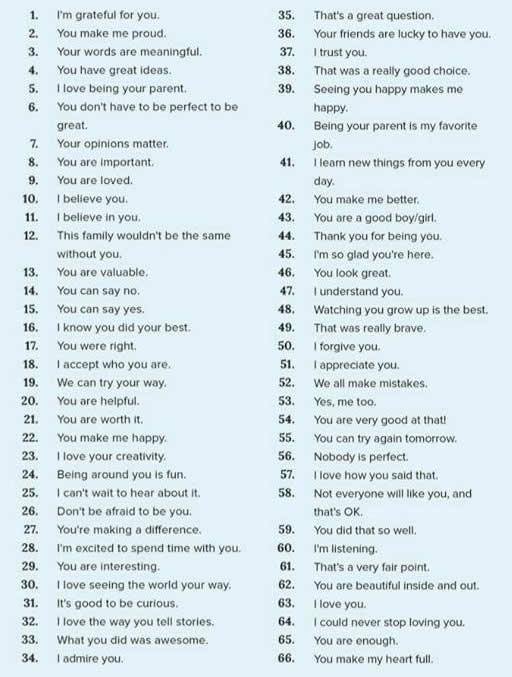
DO'S AND DON'T'S TO SAY TO YOUR CHILD

FIVE
DO'S
.) "Please"
and "Thank you." Politeness starts at the top.
Not only will you model good manners for your child, but when you're
mad, saying "please" can help you feel more in control
of your emotions.
.) "The
rule is..." A good way to avoid many conflicts --
or at least nip them in the bud: Make your expectations clear. Kids
need to know what the rules are. And remind them as often as necessary.
.) "I
forgive you." When your child trips up and then makes
amends, let him know right away that it's over and forgotten.
.) "I'm
sorry." While you shouldn't apologize for being the
person in charge and therefore being the one making the rules ("I'm
sorry -- it's your bedtime"), empathy has its place. Use it
when you make a mistake: "I was late getting to the ball game,
and I missed seeing you score. That's disappointing. I'm sorry."
.) "I
love you." Express this not just in words but through
your actions too. Giving a high five or thumbs-up or tousling your
child's hair can let him know that you love and value him -- no
matter what happened an hour before.




SEVEN
DON'T'S
.) "Hurry
up!"
There's a tendency to make kids feel guilty for causing us to
rush. The guilt may make him feel bad, but it won't get him moving
faster.
.) "Great
job!"
What could be wrong with praise? Tossing out a compliment for
every task becomes meaningless. Save it for accomplishments that
require real effort, such as:
 Praise
only those accomplishments that require real effort. Finishing
a glass of milk doesn't cut it. Neither does drawing a picture,
if your child is the kind who makes dozens of them every day.
Praise
only those accomplishments that require real effort. Finishing
a glass of milk doesn't cut it. Neither does drawing a picture,
if your child is the kind who makes dozens of them every day.
Be
specific. Instead of "Beautiful job," say, "What
bright, happy colors you picked for the dog's spots." Or
"I see you drew a picture of the story that we read this
morning."
Praise
the behavior rather than the child: "You were so quiet with
your puzzle while I was finishing that paperwork, just like I
asked."
.) "I'll
give you something to cry about!"
Threats rarely get results. It's more effective to use constructive
tactics, such as redirection or time-outs.
.) "Leave
me alone!"
When you routinely say that you're too busy, kids internalize
the message. Give them some parameters: "When I'm done, then
we'll play."
.) "Don't
cry!"
Rather than deny your child's feelings, talk about her emotions.
Give your child the words to express herself, and ultimately she'll
cry less.
.) "Wait
till Daddy gets home!"
Passing the buck undermines your authority. And by the time he
does get home, it's likely that your child will forget what he
did wrong.
.) "You're
so..."
Even labels that seem positive, like "smart," shortchange
kids' developing personalities. Talk about their specific behaviors,
not traits. --