The Sikh mission is to promote chardi kala around the world.
Our scope of service includes promoting diversity and cultural
competency as taught by Guru Nanak Dev Ji, thereby bringing to
the fore issues of gender inequality for the purpose of uplifting people
who have a history of being marginalized, using social media and other
means as platforms to inform various communities of the life experiences
and concerns of marginalized people with regard to the necessity for social
change, dialogue, inclusion, compassion, tolerance, and cultural literacy,
and growth in our human relations going forward in order to better facilitate
the current worldwide shift in global consciousness from tribalism, instability,
and extremism, to harmony, cooperation and enduring peace. And furthermore,
we welcome and support other organizations that promote the transformation of
consciousness as taught by Guru Nanak Dev Ji throughout his life and travels.
A Sikh's ultimate vision is to afford every person in the community
the opportunities to explore the sensitivities of the human spirit to
wit each person is inspired to (a) teach and interact with other people while
maintaining a keen appreciation for their longing for inclusion, the innate longing
to belong within our human nature; (b) respond with compassionate consideration
and sensitivity to those racial, cultural, religious, ethnic, economic, political, social, ethical, psychological, and philosophical differences that exist within every community.
POINTS TO PONDER
Of all religions, the highest is to remember the Name of the Lord; emulate
His attributes; and maintain purity of conduct. -- Siri Guru Granth Sahib 5-266
First, a reality-based hypothetical narrative about Sikhs
"In your office in the Federal building downtown, guarded by a national security firm, (Akal Security, owned by Sikhs), you are enjoying a cup of Yogi Tea (a brand formulated by Yogi Bhajan, a Sikh), eating Kettle Chips (a brand started by Sikhs) and a piece of fruit (grown on the country's largest fruit farm, owned by Sikhs), and you learn your grandmother is in the hospital. You jump in a cab (owned by a Sikh company, driven by a Sikh, fueled by gasoline distributed by a Sikh-owned company) and arrive at the hospital to talk with the doctor (a Sikh) and he recommends you have her tested (on a machine designed by a Sikh engineer, and with parts assembled in a factory, by a Sikh). We are not the other, we are your neighbors."
On Sunday morning, August 5, 2012, people were praying, cooking in the kitchen and preparing for the day's kirtan (musical) program at the Sikh temple, the Gurdwara Sahib, in Oak Creek, Wisconsin. Tragically, a deranged man entered and opened fire with handguns, killing six innocent people and wounding three others, including a heroic police officer, before taking his own life.
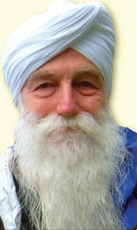
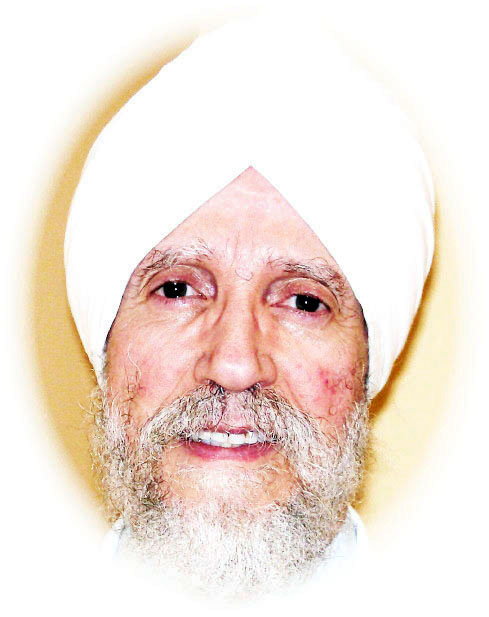
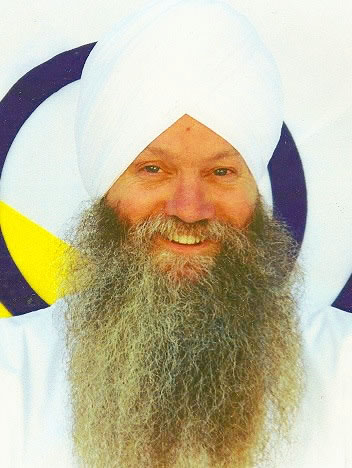
Hari Singh is a founder and former member of the Security Advisory Team. Although currently retired, he holds active
Optician licenses in Florida and Arizona, and is certified
by the American Board of Opticianry (ABO), and National Contact Lens
Examiners (NCLE). He is a passionate advocate of (a) the resurgence
of the Optician as a genuine Health Care Provider, i.e., highly skilled Eyewear Professional, as opposed to today's eyeglass dispensers, most of whom are trained only as
merchants or online clerks, (b) the resurgence of three dimensional dispensing of prescription eyewear, and (c) most importantly, the conscientious hands on the patient practical training of aspiring Opticians in the design
and delivery of handcrafted, form-fitting eyewear.
Hari Singh also has a long teaching history at numerous locations
including prisons* and other other facilities as a volunteer teacher of Kundalini Yoga and Meditation, and as a Counselor-Chaplain, which include the Federal Prison in Littleton, CO; the Colorado State Prison at Buena Vista, CO;
the Youth Detention Center, Brighton, CO; the Orange County Jail,
Orlando, FL; the Florida State Prison, Bushnell, FL; the YWCA, Orlando,
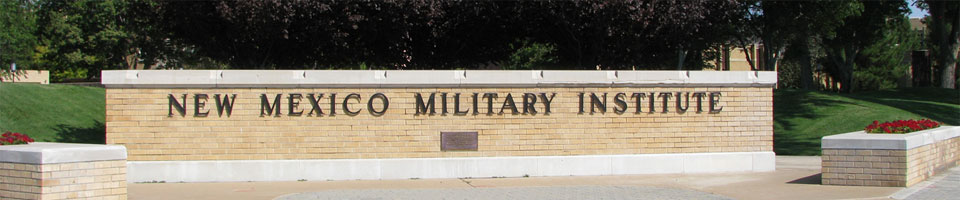
FL; Sikh chaplain at NMMI, the New
Mexico Military Institute, Roswell, NM; and several years
as the close order drill instructor for the Select
Women's Rifle Drill Team at the 3HO Women's Training Camp, formerly Khalsa Women's Training Camp (KWTC), Espanola, NM,
now known as 3HO Women's Camp. See an inspiring
account of a woman's Close Order Drill Team experience
at Khalsa Women's Training Camp.
*Note: Hari
Singh taught the first-ever Kundalini Yoga and Meditation prison classes to inmates at the Orange County jail in Orlando, Florida, 1971-1972; followed by the first-ever classes at the Florida State Prison in Bushnell, Florida; followed by, in the mid-70s, the first-ever classes at the Colorado state and federal prisons.
Sat Nam, Friends! Here's a Sikh historical timeline in the USA.
1899-1917: Sikhs begin to migrate to California from Asia working as laborers and farmers; migration was severely curtailed by Immigration Act of 1917 (aka Asiatic Barred Zone Act). Legal migration from Asia ended with the National Origins Act of 1924.
September 4, 1907: A lynch mob of several hundred attack and rob the homes of Sikh millworkers in Bellingham, Washington.
1913: The Ghadar party—an independence from British colonialism movement—was founded in Astoria, Oregon; California Alien Land Law of 1913 bars South Asians and other groups from owning property. See Ghadar Proclamation.
1920: Sikhs march in New York City’s St. Patrick’s Day Parade wearing green turbans and carrying signs that read: “300,000,000 of India with Ireland to the last” because “our cause is a common cause,” demanding unconditional independence for India and Ireland.
January 3, 1957:Dalip Singh Saund from San Joaquin, California (California’s 29th Congressional District) becomes the first Sikh American and APIA elected (in 1956) to the U.S. Congress.
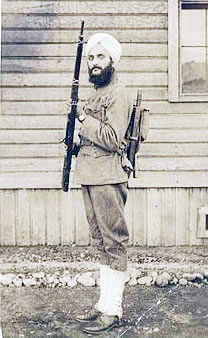
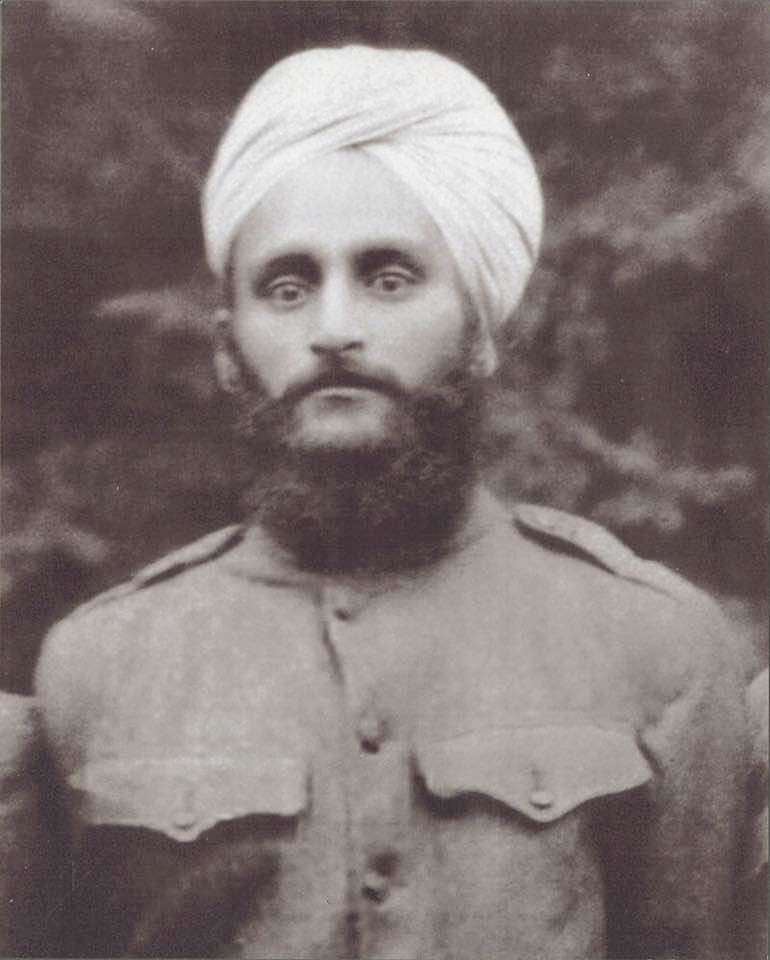
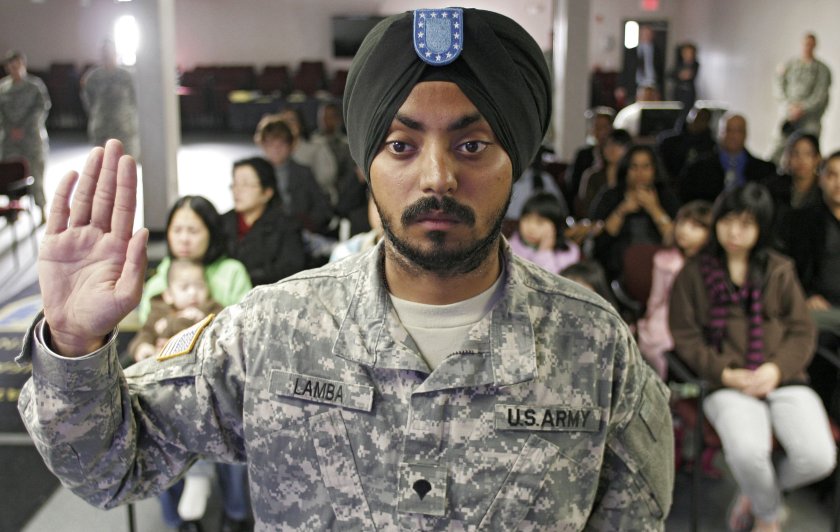
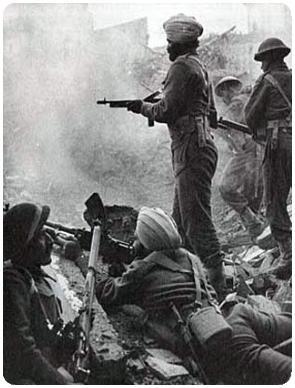
1965: The Immigration and Nationality Act of 1965 lifts restrictions and exclusions, allowing Asians to immigrate more freely to the U.S.1981: Sikhs are barred from serving with their articles of faith in the U.S. Military—despite the extensive participation of Sikhs in both World Wars— ending a long-standing religious accommodation. As of today, three Sikh American soldiers have been given exemptions to serve with their articles of faith.
List of Sikhs serving in the U.S. Army, 1917-1981.
Buried at Arlington National Cemetery (with Sikh Khanda marking the gravestone): Sergeant Uday Singh, Bronze Star, Purple Heart, killed in combat in Iraq, 2002.
September 15, 2001:Balbir Singh Sodhi, a Sikh American gas station owner, was shot five times and killed, becoming the first American to lose their life as a result of a hate crime after September 11th.
October 2008:Jaspreet Kaur Saini becomes the first Sikh American female lawyer in the Armed Services (Navy JAG).
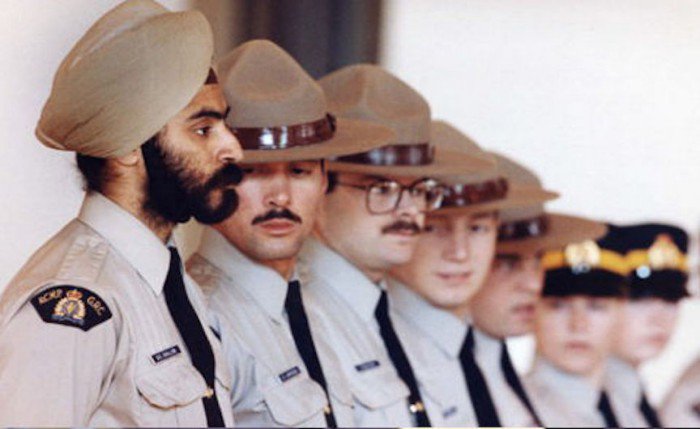
May 2012: Washington, D.C. becomes the first major city in the U.S. to allow Sikh American police officers to serve with their articles of faith.
August 5, 2012: A white supremacist gunman, Wade Michael Page, attacked a Gurdwara in Oak Creek, Wisconsin, killing six Sikh American members, and injuring four others, in the deadliest attack on a place of worship since the Jim Crow Era. --
*NOTE:MySikhSense.com is sponsored by ACT, Akal Committee Thirteen, a volunteer social action group, whose mission it is to promote diversityand cultural competency, and bring to the fore issues of color, especially to include feedback from People of Color and others, who tend to be marginalized, and whom it is hoped will utilize this forum to inform the 3HO and Sikh Dharma community and beyond of their vision with regard to cultural literacy, social justice, inclusion, compassion, tolerance, and transformational dialogue going forward in order to better facilitate the current shift in global consciousness from instability and discord to balance, cooperation and enduring peace.
**NOTE: The Nishan Sahib is the flag of Sikh Dharma. Contrary to the flag of a nation or of a state, it is the flag of a religion. The Nishan Sahib represents the sovereignty of the Sikh Dharma and the independence Sikhs.
Preface
"It is a Sikh's sacred duty, without fear or anger, to defend
the weak and protect the innocent." GurdwaraSecurity.com
"Sikhs respect and will act to protect the
free practice and the
beliefs and traditions of other religions."WhoAreTheSikhs.com
"As Ministers we are obliged to practice what we teach using only occasional
words, i.e., our actions teach louder than our words."MSS Hari Singh Bird
Every human being is the Light of the Divine in form. The human body was given to each of us so we can come to experience that Divine Light in ourself and in everything around us.
Experiencing the Divine while in the human body invokes bliss, fearlessness, and love, and a way to honestly face life with courage and grace. A society of people who are conscious of the Divine within themselves and in all around them are the foundation of a world filled with peace, prosperity, and integrity.
This is the vision and promise of Sikh Dharma. Not to be beholden to rituals and to the past, but to practice meditation and service as a way to awaken to the Divine Reality, to the Deathless Spirit of Love that is already here, inside of us, now.
Sikh simply means "seeker or student of truth." Sikh Dharma is a spiritual path for those who are looking to find themselves. Like all spiritual traditions, Sikh Dharma has its lineage and legacy, guidelines and philosophies, its Masters, its saints and history. But primarily, Sikh Dharma offers a down-to-earth spiritual path for ordinary householders, every-day people. It doesn't matter what your spiritual orientation is. Or what culture or background you belong to. Any person can do these practices to help them experience their own Divinity and Infinity.
The Aims of Sikh Dharma are:
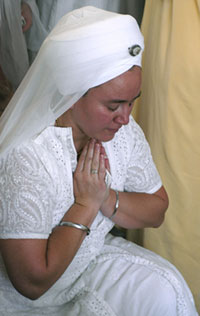
To train the mind and the senses to recognize the Divine Light within oneself and within all of creation.
To be of service to others.
The Practice of Sikh Dharma Includes:
Rise before the sun each morning in what is called the Amrit Vela, the Ambrosial Hours. In the two and half hours before the sun rises, the mind has the best chance to quietly surrender and hear the voice of the Spirit.
Take a cold shower. Do some light yoga and stretching to balance the body, mind and breath.
Meditate on and chant the Shabad Guru, the Sacred Sound Current as Divine Teacher that brings us to the experience of our Inner Divinity.
Meditate and chant at sunset and before going to bed.
During the day, a Sikh lives a normal life. Single or married. With children or without. In work life and in social life, the Sikh strives to:
Keep connected to the Divine in our heart with every breath.
Earn our living honestly and to share what we earn with others.
View the interactions of daily life as opportunities to serve.
The Triad of Sikh Dharma
Naam Japna, Kirat Karni, Vand Chhakna
. A life lived in awareness of oneness of the Creator, . A life fueled by honest earnings, . A life sharing one's earnings with the needy.
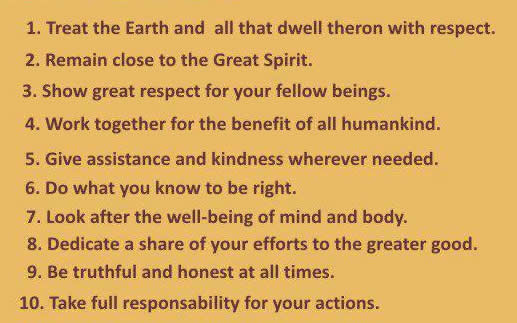
THE TEN COMMANDMENTS
Adopted from Native America's Ten Commandments
Sikhs are adherents of Sikhism. The
following narrative is presented for the purpose of making the
inquirer more familiar with the lifestyle and practices of Sikh
Dharma, a householders' spiritual path by which, with practice and
by God's grace, one may be blessed with the virtue known as humility,
and the good fortune to overcome the spiritual affliction of pride.
POINTS TO PONDER
"Sometimes
you think God is a big guy in the sky with 30 hands and 40
legs who does everything. That is not true. Whatever your known is,
that is you. Whatever your unknown is, that is God." --Yogi Bhajan
"Truth
is a pathless land, and you cannot approach it by any path
whatsoever, by any religion, by any sect. That is my point of view,
and I adhere to that absolutely and unconditionally. Truth, being
limitless, unconditioned, unapproachable by any path whatsoever,
cannot be organized; nor should any organization be formed to
lead or to coerce people along any particular path." --Krishnamurti
"All
matter originates and exists only by virtue of a force, which brings
the particles of an atom to vibration, which holds the atom together.
We must assume behind this force is the existence of a conscious, intelligent mind. This Mind is the Matrix of all matter." -- Max Planck
Think
about IT. You grew your magnificent brain, perhaps the most
complicated thing in the world. And you grew it without even thinking
about it. A supremely intelligent Life Force of unknown origin created and
sustains this wondrous miracle of life. IT is what Sikhs refer to
as GOD.
COMMENTARY
Shabad Singh Khalsa
"Dear friends, I am a Sikh who bows to the Siri Guru Granth Sahib as my spiritual teacher. I regularly read Guru's bani and I regularly sit with sangat (Sikhi congregates). I work to change my habits in life to the healthy, wise, and kind principles shared in the Guru's word. One of the ways that I help calm my mind is by sitting, controlling my breath, and with each inhale, I meditate on the word "Sat". Sat means true or truth. On the exhale, I meditate on "Nam". Nam means name or identity.
When I meditate on Sat Nam, as directed by my Guru, I also assume postures like Veer Asan, on one knee with the rear sitting on the heel, as Guru Gobind Singh Ji often sat and is depicted as sitting, or Sukh Asan, the simple cross legged position in which all the Gurus are depicted. I also stretch the body that beloved infinite Waheguru gave me. I stretch it in thanks to the Guru of Sat Nam that it may be in good mental, physical, and spiritual health, that it may serve.
Every picture you see of people doing Kundalini Yoga, they are silently or out loud doing Nam Simran of Sat Nam. Nam Simran means constant repetition of the Name of Truth. Sat Nam.
I have grown up in the community of Sikhs that was borne of Siri Singh Sahib (Yogi Bhajan) leading my parents and their peers to the feet of the Guru. He learned yoga from his teacher, Sant Hazara Singh, who was considered a saint in his time and a great warrior and Gursikh. Yogi Ji introduced yoga and meditation to my parents and their peers. Included in that yoga is breath control, posture, but above all: Nam Simran.
Kundalini Yoga, in my opinion, has been highly mis-characterized. It is meant to support the principles and practices that we work towards as Sikhs. It is meant to help us control our emotions and transform them into higher actions. It is meant to help us ward off the five thieves of lust, anger, greed, pride, and attachment by using Nam Simran, and posture, and breath control to create new, positive habits in lieu of destructive ones that come when the aforementioned factors motivate our thoughts and actions.
Sikhs from this community do not worship idols. While you may see photographs of individuals from this community bowing to statues of, say, Baba Siri Chand, I think it would be wiser to ask those individuals why they are bowing to those statues than to write off a whole community as "idol-worshipers committing beadbi, or offenses toward the Guru."
You may see photos of Sikhs from this community sitting around a haavan or hom. Again, I would ask those Sikhs, if I were you, their thoughts behind that action. They clearly do not seem embarrassed or negative representing themselves in that way. It is my guess that those individuals were invited by Hindu communities who were somehow hosting them, be it at an interfaith gathering or the like, to participate in a practice that is important to them as Hindus. Being tolerant and respectful Sikhs of the Guru, they joined in.
I have been in similar situations. I have been hosted by Muslim families on Ramadan and was present while they did namaaz. I bowed towards mecca with them, remembering that my Guru is everywhere in all things. I have sat with Zen Buddhists for meditation and discourse. When they inclined their heads towards the statue of Buddha, so did I. I did so in reverence of their ideals and principles remembering that my Guru is Truth and that in the Truth of Buddha there can be no separation from my Guru. I have walked at Mandirs before statues of Ma Durga. I, like Guru Gobind Singh Ji does in Durga Di Vaar, remembered the exellence of Ma Durga and what she represents and that all of these things, these ideas, these high principles, these strivings towards human exellence are all Waheguru.
So I bow always to my Guru in all things great and pure. Please do not get caught in the hype of one facebook page's claims. Why do you think Bhai Balbir Singh Ji, Baba Nihal Singh Ji, His Holiness the Dalai Lama, Pope John Paul II, and so many other great holy people shared such mutual respect and love with Siri Singh Sahib Ji (a title given to him by Akal Takht as well as Panth Rattan, Jewel of the Sikh Panth)?
Because they saw that his intention and action sought to bring people closer to their highest consciousness through introducing them to Sikh Dharam, Shabd Guru, and gave them the tool of Kundalini Yoga. All with his head inclined to the Guru." Shabad Singh Khalsa --
Introduction
Sikhs hold a prominent place in the history of America and India. Guru Nanak Dev founded Sikhism in the fifteen century (see Gurdwara Kartarpur Sahib in Kartarpur video) and he was followed by nine Gurus (enlightened
teachers or prophets). Guru Angad, the second Guru, developed the Gurumukhi script. Guru
Ram Das, the fourth Guru, laid the foundation for the city of
Amritsar. Guru Arjan Dev, the fifth Guru, compiled the Adi Granth,
the sacred songs of the Sikhs, later
to become known as the Siri Guru Granth Sahib. But it was Guru Gobind
Singh, the tenth Guru, who gave Sikhs a renewed sense of chardee kala,
which in turn gave Sikh Dharma its resurgent vigor and mass following
in the 17th century. Guru Gobind Singh declared himself to be the
last of the earthly Gurus. And he commanded his followers to revere
only the Guru-Word as Guru upon his death.
These are the three
major principles of Sikhism:1) Daily reflection on the One God; 2) Earn an honest living; and 3) Share one's resources with others at Guru's Langar and through community service. Everybody who contemplates the One God, lives by
these teachings, and respects the spiritual unity of mankind as servants of the One Creator are known as Khalsa. See The 12 Aspirations of the Sikhs.
THE SIKH GURDWARA
The
Sikh worship center is called a Gurdwara, meaning the doorway to
the Guru or Teacher. People of all persuasions, including atheists
and agnostics, are welcome at any Gurdwara.
NOTE: It
is NOT the purpose nor the customary practice of the adherents of Sikh Dharma to proselytize. Sikhs often express the term "Sat
Kartar," i.e., "God is the Doer." In this sense
meaning, only those with such destiny are to be Sikhs.
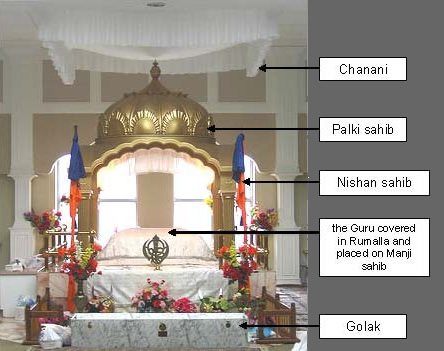
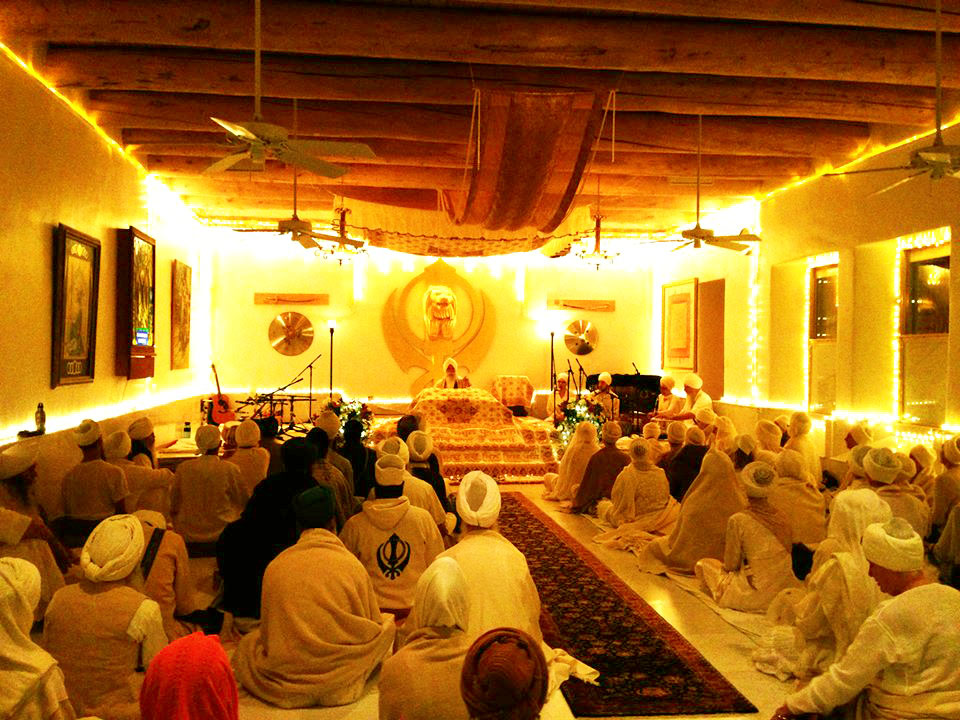
INSIDE THE SIKH GURDWARA
Men traditionally sit on the left, women on the right.
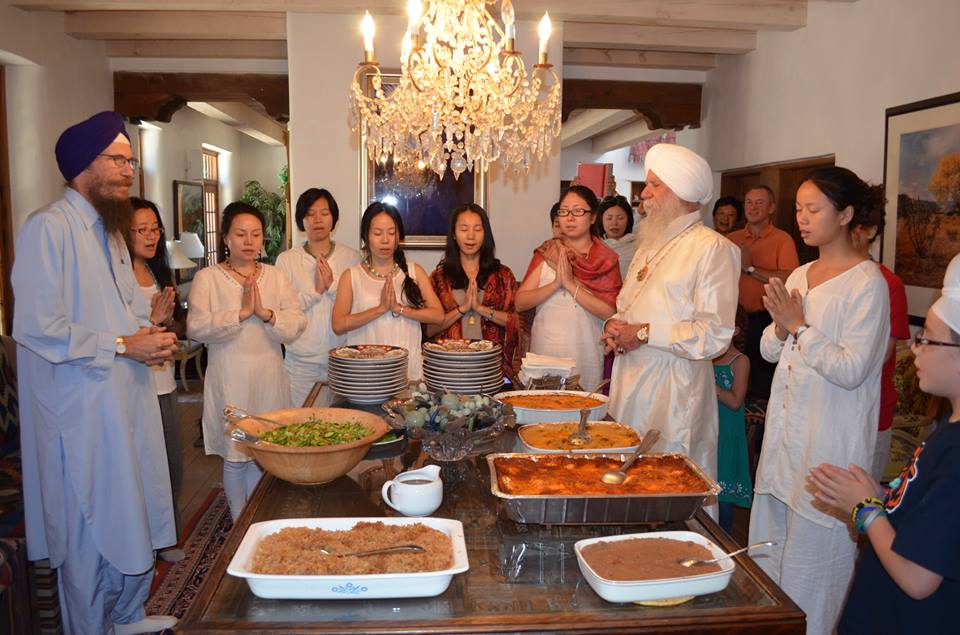
Thanks is offered over Guru's langar
An essential part of Sikh spiritual practicesis to serve langar at the Gurdwara and elsewhere in the community at free kitchens. Here the food is cooked by members of the sangat (congregation) and is served without discrimination to all. After the sangat has participated in any ceremony, they are served the Guru’s Langar. The tradition of Langar expresses the ideals of equality, sharing, and the oneness of all humankind. See What I Learned From The Sikhs. See GurdwaraSecurity.com.
In
America, the members of Sikh Dharma are the only
religious group whose practice includes the wearing
of a turban.
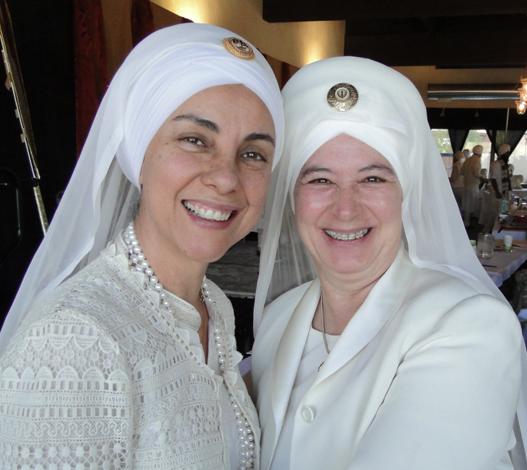
Sikhs wear a turban as a constant reminder that we are Sikhs (students).
Guru
Gobind Singh, the tenth Guru, instituted the Akalis. The Akalis are religiouswarriors -- soldiers of God. Late
in the twentieth century, 1970s and 1980s, the Akalis waged a bloody
fight against the Indian government, which led to a massive armed
offensive against them.
Today, after episodes of religious persecution in their homeland,
in 1738 by Nadir Shah, in 1748 to 1751 by Ahmed Shah Abdadi, by the
British in 1849, and in 1984, by the government militia in the aftermath
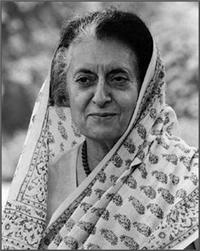
of Prime Minister Indira Gandhi's assassination, and due to their
energetic and entrepreneurial spirit, Sikhs can be found all over
the world.
Sikhs, or Sardarjis as they are known by some, have been great
patrons of art, religion and scholarship. Along with the Rajputs,
they are known as the bravest warriors in India, and their women, among India's most beautiful. The Sikhs
have participated in India's nation building for hundreds of years,
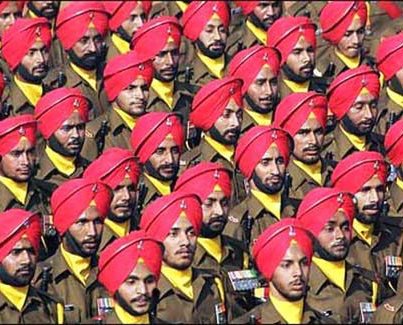
fighting the British, serving in the military (the Sikh regiment is
the most decorated regiment of the Indian army) and excelling in sports.
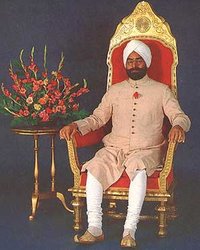
And they have served as the President (Gianni
Zail Singh, veteran freedom fighter and President of India, 1982-87)
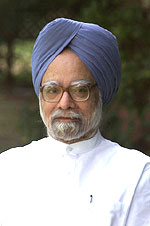
and Prime Minister (Dr.
Manmohan Singh) of India. (Dr. Singh is the first Sikh, and 14th
Prime Minister of India.)
"We
never started a war before, but we have finished many."
Gianni
Zail Singh Manmohan
Singh
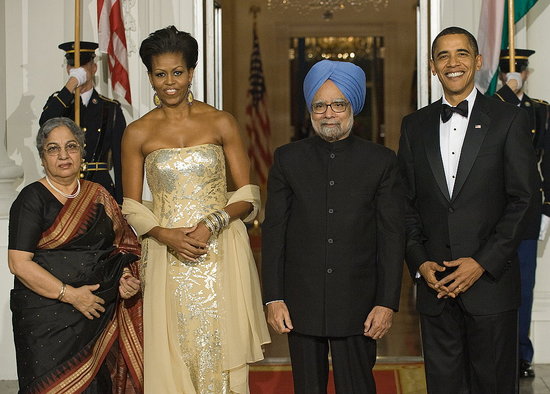
First Ladies, Gurusharon Kaur and Michelle Obama, and Indian Prime
Minister Manmohan Singh and President Barack Obama.
First State Dinner of the Obama presidency, Nov. 24, 2009.
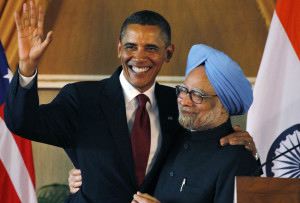
Left: Barack Obama and Manmohan Singh at the April 2009 G-20 in Europe.
Right: Obama and Singh during state visit in Delhi, India, November
2010.
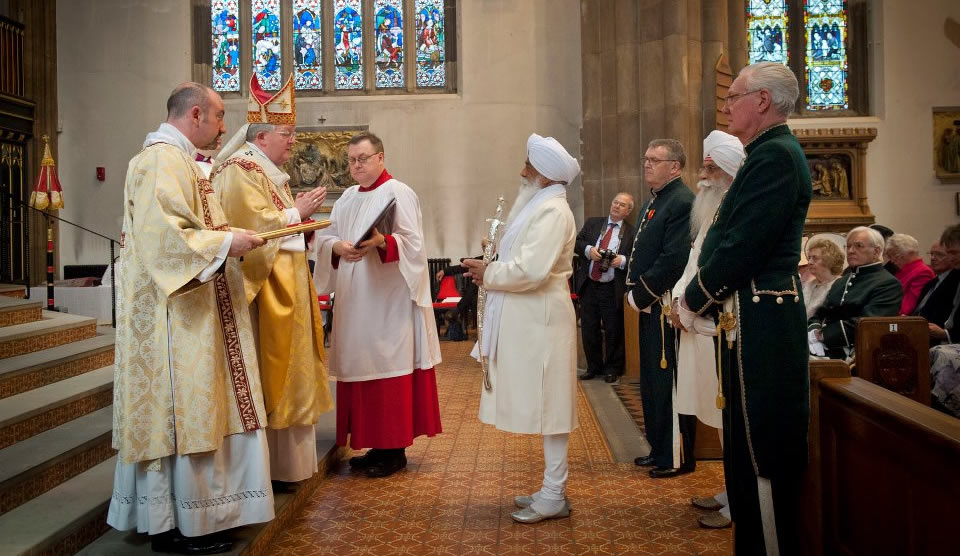
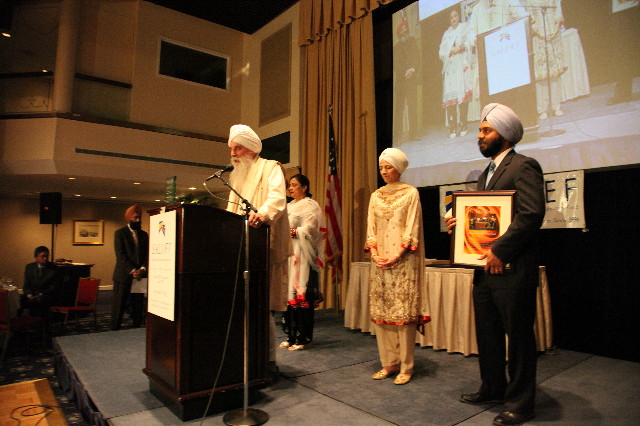
SIKH RECEIVES PAPAL HONOR
Bhai
Sahib Bhai Dr. Mohinder Singh Ahluwalia receives a Papal Knighthood
awarded
by His Holiness Pope Benedict XVI in a ceremony of investiture, April
23, 2012.
SIKHS
JOIN DC POLICE DEPARTMENT
On
May 16, 2012, the seventh largest police force in America became
the first major police department in the United States to explicitly
and
voluntarily allow Sikh Americans to serve as full-time, uniformed
police
officers while keeping their articles of faith, unshorn
hair with turban,
etc.
THE
SIKH WARRIOR'S ANTHEM
Mukhia
Singh Sahib
Livtar Singh Khalsa
In
the heart of a lion, there is no fear of dyin'.
In the heat of battle, the Spirit of Life burns like a flame.
In the depths of the darkness, in the worse betrayal and pain,
The fearless Khalsa heart will
beat to the rhythm of the Name.
Enemies
come and enemies go, but the Khalsa stands like a mountain range.
We will return to Infinity, what in the world will the drama change?
Go onto the battlefield, head in hand as a humble one.
The life doesn't matter, the courage does.
Soon the job will be done ... Full
text.
OPEN LETTER TO THE FIRST TEACHERS OF SIKH DHARMA
Those who shall not learn to obey shall never be
in a position to command. -- Siri Singh Sahib
Create dependable
children, not dependent children. Give your children
the basic values to face their own tomorrows, not be blinded by yours. Make
them proper personalities, not helpless puppets. Position them for success; do
not paralyze them with the commotion of your emotions. -- Siri Singh Sahib
The basic aspect of you as woman is not in your sensuality and in your dramas.
You are not only the givers of life, you are the manufacturers of character. Whatever
character you will give to your children, that shall be their future. -- Siri Singh Sahib
Children are born with intrinsic leadership traits that prepare them for life.
These must translate positively into the lives they lead as citizens of the world.
These are: Service, Justice, Courage, Compassion, Decisiveness, Reliability,
Integrity, Initiative, Knowledge, Loyalty, Enthusiasm, Endurance. -- Hari Singh
SIKH YOUTH DESERVES LEADERSHIP TRAINING
New Mexico Military Institute can provide this.
A two-year leadership program is available.
"Human
is a blend of Saint and Soldier (Sant Sipahi); this is a complete person.
If you are not a soldier your sainthood will be kicked around. If you
are only a
soldier not a saint, you will start kicking others around." The Siri Singh Sahib
Sat
Nam, Khalsa ji! I am a proponent of a better balance
between our Saint-Soldier mind set as Sant
Sipahi. Therefore I urge Sikh parents, especially
Sikh women, the first teachers of our children, to consider the following points.
.) I urge you to consider enrolling your children at the New
Mexico Military Institute, located in Roswell, New Mexico. My
two kids graduated with honors (4.0 and 3.8 GPAs) from the high school in the early '80s,
the first children of Sikh
Dharma to attend a military school in America. The Siri
Singh Sahib expressed pleasure upon observing
cadet training when he visited NMMI in 1983. He advised that he
would have enrolled his children at NMMI if he had known of its existence. Another group of Sikh children
who attended school in India later attended NMMI in the early '90s.
Sikh Chaplain, MSS Hari Singh Bird, addresses Sikh cadets in front of the NMMI chapel, 1992.
New Mexico Military Institute offers an outstanding two year college option for your sons and daughters after they complete their
time at Miri Piri Academy. For those families for which MPA is not an option, NMMI has an excellent four year high school college prep program in addition to their two year
college program. New Mexico Military Institute has been ranked No. 5 on a list of the nation’s top 50 community colleges by an independent organization, i.e., TheBestSchools.org, which has described the Roswell, New Mexico school as the “only state-supported, coeducational, military boarding school in the United States.” The school offers college prep, a four-year high school and a two-year junior college. See NMMI
Strategic Measures Statistics.
Each of the former Sikhi students/graduates
of NMMI provide a testament to the advantages of attending NMMI, which
include a rigorous and challenging lifestyle, camaraderie and fellowship,
and outstanding leadership
training especially, along with NMMI's excellent scholastic program.
This experience prepared them for additional university training, and exciting
careers all over the world. NMMI is the only American prep school I know
that has a history of accommodating the Sikhi lifestyle, i.e., sadhana, kesh, turban, sipahi training, and vegetarian diet. And it is an excellent environment for Sikhi youth to learn leadership
and soldiering skills for which the Siri Singh Sahib was a passionate
proponent.
The NMMI program offers MPA students and other Sikh youth
a unique and reasonably cost-effective opportunity to transition
from the Indian program into the American experience as a unit, and the obvious advantage of continued
bonding with their peers. See NMMI
Admissions, or click admissions@nmmi.edu, or call 800-421-5376.
.) I urge you to reflect on the Siri Singh Sahib's words, "Human
is a blend of Saint and Soldier (Sant
Sipahi); this is a complete person. If you
are not a Soldier your sainthood will be kicked around. If you are
only a Soldier, not a Saint, you will start kicking others around."
Again, our youth deserve leadership training going forward. I know of no readily available source of formal leadership
training available to our Sikh youth other than the New Mexico Military
Institute.
HISTORICAL BACKGROUND
"The Sikhs...Peaceful until disturbed."
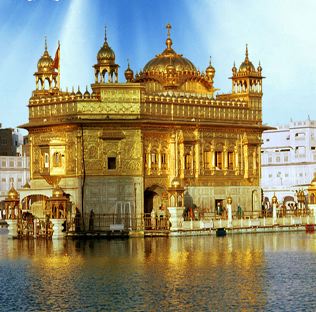
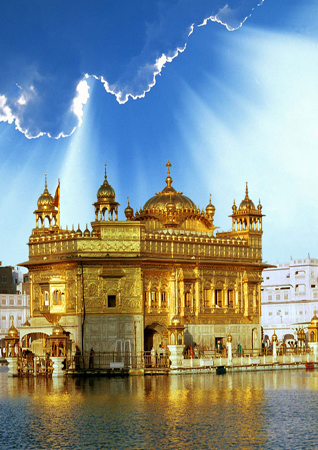
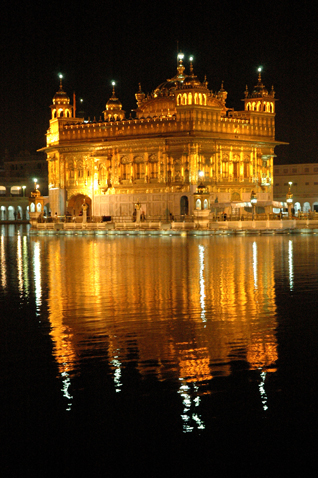
The Golden Temple of Sikh Dharma, Amritsar, India
Standing at the Golden Temple by Gurushabad Singh Khalsa
500
year ago, when Columbus first sailed across the Atlantic Ocean and
discovered the Americas, a divinely-inspired spiritual teacher by
the name of Guru Nanak traveled
by foot throughout South Asia and the Middle East elevating the social
situations of his time by teaching the oneness of humanity and tolerance
between people of different religions. Guru Nanak and his followers,
called Sikhs, wore turbans as a symbol
of their devotion to the One God that created all people and all religions.
On
April 13, 1699, the Tenth Guru of the Sikhs, Guru
Gobind Singh, recognizing these spiritual principles, incorporated
them into the the Sikh code of honor. The Sikh honor code promotes
and, more importantly, protects the equality and the diversity of
all people regardless of faith, color, caste and gender, and requires
Sikhs to protect the weak and innocent from unjust attacks. The Sikh turban and beard have come to represent
not only a spirit of universality and diversity, but also a willingness
to protect others' rights, even at the cost of their own life.
MORE POINTS TO PONDER
Women manifest their autonomy and parity when they tie turban thereby advancing gender equality. Without turban the perception persists that Kaurs are not true Sikhs.
"You
can change to any religion, to any form and shape.
But what matters is whether you have understood reality or not.
You are a human. Have you understood what "human" means?
That matters. Whether you are a good person, a bad person,
a rich person, poor person, religious person or a fake -
doesn't mean a thing." -- Yogi
Bhajan
"One
who socializes with compassion
and kindness is a human. One who
socializes with compassion, kindness
and grace is an angel." -- Yogi
Bhajan
SIKHS IN THE MILITARY "Human is a blend of Saint and Soldier (Sant
Sipahi); this is a complete person.
If you are not a Soldier your sainthood will be kicked around. If you are
only a
Soldier and not a Saint, you will start kicking others around." -- Yogi
Bhajan
Colonel Gopal Singh Khalsa (Left)
Colonel Khalsa joined the U.S. Army in 1976 as a Private, and
served in
the Special Forces Unit for 10 years on Parachute Status, as a Battalion
Commander overseeing an 800-person intelligence group, and also received
a Meritorious Service Medal with Silver Oak Leaf Cluster Award, amongst
many
other honors. He is a graduate of the Army Officer Candidate School
in Georgia, and was inducted into the Officer Candidate School Hall of Fame in
2004.
"In Prosperity, three things work: Security, Security and Security.
Because Security manifests Prosperity. Security manifests the entire
manifestation. Because Security is the Rule of Harmony." Siri Singh Sahib
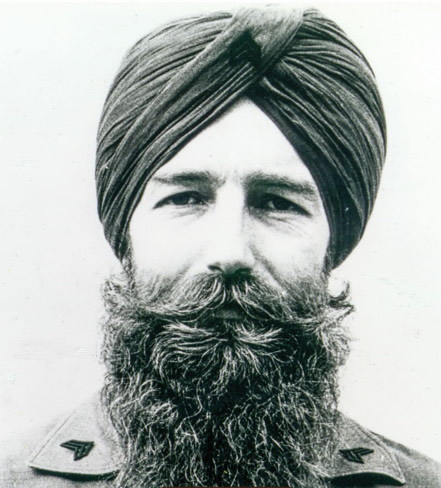
Sergeant Sevak Singh Kroesen (Center)
Sergeant Kroesen enlisted in the U.S. Army reserves in 1976 and
was
attached to the Signal Company, 11th Special Forces Group after which
he successfully completed airborne (paratrooper) and Radio Teletype
Transmission Operator training. He then completed his Special Forces
Qualification Courses and became a Special Forces Communications
Sergeant. He completed this rigorous training, and his Sikh articles
of faith
were never a hindrance to his service. Sergeant Kroesen subsequently
completed schools, training, and missions around the world all with
honor
and distinction. He was honorably discharged from active duty in 1991.
Captain Tejdeep Singh Rattan, DMD, (center)
graduates from U.S. Army's Officers Basic Training.
Captain Kamaljeet Singh Kalsi, MD, (center) with fellow graduates. More.
There are currently 22 Sikhs serving in the U.S. Army. U.S. Army Spc. Simran Lamba, center, was granted the honor of carrying a red-white-and-blue unit color flag for Alpha company, Third Battalion, 34th Infantry Regiment, during his basic training graduation ceremony at Fort Jackson, S.C., Wed., Nov. 10, 2010. Lamba was the first U.S enlisted soldier to be granted religious accommodation. It took action by several Sikh organizations and a letter to Defense Secretary Robert Gates, signed by 43 members of the House of Representatives and six U.S. senators, to change the Army's mind. A pair of special exceptions to Army Regulation 600-20 were allowed so Rattan and Kalsi, above, could wear their dastaars (turbans) and keep their unshorn hair and beards as part of their uniform, and also retain their other articles of faith.
Sikh wearing turban in photo of Civil War veterans, 2nd row from bottom
Sikhs speak from the Pentagon
IN THE AFTERMATH OF 9-11
On
September 11, 2001, when terrorists struck the World Trade Center
and the Pentagon, thousands of lives were lost and the world was dramatically
transformed. Hate crimes claimed more victims in the days that followed.
The large-scale terrorist attacks and the countless victims of hate-related
violence who suffered in the backlash from the attacks were ultimately victims of the same intolerance against
people of other faiths, cultures and traditions. See BigotDetector.com.
Four
days after the September 11th attacks, a Sikh man by the name of Balbir
Singh Sodhi was shot and killed while planting flowers outside of
his neighborhood gas station in Mesa, Arizona. The motive of the crime
was simply hate. In the years since, victims' rights advocacy groups
have identified many other people across the country who have also
been murdered because of their religious or cultural backgrounds.
In addition, hundreds of others have been physically attacked, verbally
harassed or discriminated against simply because of their diversity. See The Oak Creek Six. See Is Your Gurdwara Secure?
RELIGIOUS RIGHTS GAIN VICTORY IN OREGON
Oregon Governor Ted Kulongoski made history April 1, 2010 by signing a
landmark bill that allows public school teachers within the state
to wear
religious clothing required by their religious faith in their classrooms.
Representing the Sikh community, Ravitej Singh Khalsa and Secretary General
Gurujot Kaur (wearing white turbans) address a SALDEF gathering after the signing.
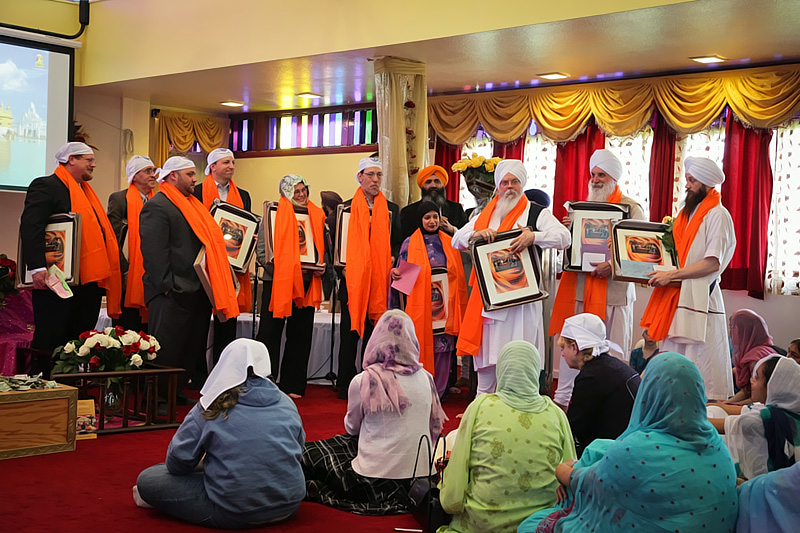
Members of Das Mes Darbasr Gurdwara community honor the Sikh supporters from the legislature
and religious groups for their efforts. The lady in the black scarf (center) is Saba Ahmed who
worked tirelessly at the State Capital to sway the vote. Sat Hanuman Singh, Ravitej Singh,
Sat Bir Singh, Eugene, Oregon Granthi, wearing their white turbans, were also honored.
As was Karta Kaur (absent), the woman who was fired in Eugene for wearing her turban.
See http://www.sikhnet.com/news/final-oregon-law-repeal-info.
"Any
woman on this planet who values herself as a
woman is great. She is a giver of life. And when you
are a giver of life, what more is there?" -- Yogi
Bhajan
"From
a woman all men are born. How then can
any man degrade any woman?" -- Hari
Kaur Khalsa
Women manifest their autonomy and parity when they tie turban thereby advancing gender equality. Without turban the perception persists that Kaurs are not true Sikhs.
The
12 Aspirations of the Sikhs
"A Sikh's sacred purpose is to celebrate Naam, and our sacred duty is to
live as saint-soldiers, defending the weak and protecting the innocent."
THE SIKHS...
Believe God is Truth and Word
is Guru.
Believe God is the One Creator,
and all of Creation is God's manifestation.
Espouse the role of woman as
representing the Universal Mother.
Maintain their hair and beard unshorn as God's gifts,
and wrap their hair in a turban.
Refrain from eating flesh
food, i.e., red meat, chicken or seafood.
Espouse the sanctity of the
path of the householder.
Maintain 'Chardee Kala' (an exalted and positive attitude towards life and other people).
Believe it is God's blessing
to serve others, and to protect the weak and innocent.
Factoid
Special Note: It
is not the customary practice of the followers of Sikh Dharma to proselytize
others. Sikhs often express the term "Sat Kartar," i.e.,
"God is the Doer." In this sense meaning, only those with
such destiny will become Sikhs.
*Sadhana is a word derived from the Sanskrit words Sa, meaning all, and Dhana,
meaning blessings.
"The
problem at this moment is the majority of us do not want to do sadhana
(spiritual practice). These unfortunate people are really cursed.
With all the teachings and all the knowledge,
isn't it a curse? It is. Sometimes you use the children as an excuse,
sometimes the husband. One way or the other, there is an excuse. To
be realistic with you, an excuse is an excuse, and sadhana is sadhana.
I know on some days, I am dead tired. I feel I can't do my sadhana.
Then what do I do? I go to the bathroom, I take cold water, and I
wash my face again and again, and again and again, until I understand
that I am fully awake. When I am doing my sadhana, sleep sometimes
wants to overtake me; I get tired. Sometimes I get home late and I
have to get up very early. Then I do pranayam and I apply some yogic locks.
I do a lot of things that I have learned and I go through it as gracefully
as a humble human being should." -- Yogi
Bhajan
"The
greatest reward of doing Sadhana is that the person becomes incapable
of being defeated. Sadhana is a self-victory, and it is a victory
over time and space. Getting up in the morning is a victory over time,
and doing it (sadhana) is a victory over space." -- The
Siri Singh Sahib of Sikh Dharma
**Banis are specific passages taken from the Guru and read each day.
THE TURBAN
AN ANCIENT PRACTICE
In
America, the members of Sikh Dharma are the only
religious group whose practice includes the wearing
of a turban.
Sikhs wear a turban as a constant reminder that we are Sikhs (students).
Why
do Sikhs wear the turban? Wearing a head covering enables one
to command the sixth center, the Agia
Chakra. Covering the head stabilizes the cerebral matter and
the twenty-six parts of your brain which are interlocked with the
neurological system and the electromagnetic field. Covering one's
head creates a focus of the functional circuit of the hemispheres,
and tunes up the neurological system. The whole head should be
covered, not just the Crown Chakra.
Any head covering that covers the whole head is acceptable; white
natural fabric, such as cotton, is ideal. See Your Amazing Brain.
In ancient times the Turban preceded the Yamaka and the Crown
as the symbol of Spiritual Wisdom, Knowledge and Power.
Transformational gems and metals were
placed
inside the Turban, and later the Crown.
THE BENEFITS OF TYING TURBAN
The benefit to tying the
turban is that when one wraps the 5 or more layers of
cloth, the temples are covered, which minimizes any variance
or movement in the different parts of the skull. In other
words, wearing a turban automatically provides an acupressure-like
cranial adjustment, which provides an aid to all mental activities. (Note: The turban also acts serendipitously as an effective
sociological filter, i.e., bigot
detector.)
Today,
in North America, the only religious group that wears turban,
are the Sikhs. The practice of wearing
the turban has not only become a rarity in many religions, but
to the unversed it is associated only with fanatical and militant
world terrorists. Since the horror of September 11, 2001, the
Sikhs have been profiled and mistakenly identified as being associated
with the fanatical Muslim Taliban of Afghanistan. In the days
following 9-11, the Sikh community around the world became painfully
aware that many people have very little knowledge of the Sikh
religion. A great deal of confusion existed then, as some
American Sikhs were attacked, some were killed, and questions
continue to this day regarding the Sikhs and their high profile
tradition of unshorn hair, maintaining
full beard, and tying turban. See Technology Behind Tying Turban. See Sikh Style Turbans. See What's The Buzz About Beards.
WHAT IS SIKHISM?
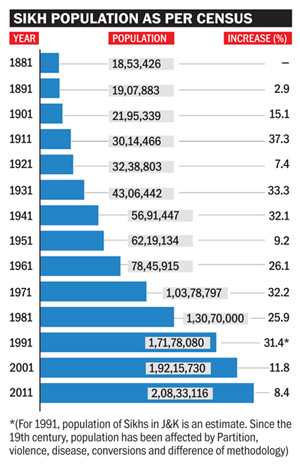
Sikhism, the youngest of the world religions and numbering about 20 million, is barely five hundred years old. Its founder, Guru Nanak, was
born in 1469. Guru Nanak spread a simple ecumenical message of "Ek Ong Kar", we are all one, created by the One Creator
of all Creation. This was at a time when India was being torn
apart by castes, sectarianism, religious factions, and fanaticism.
He aligned with no religion, and respected all religions, and
religious scriptures. He expressed the reality that there is but
one God, and many paths, and the Name of God is Truth, "Sat Nam". His simple message to all
is, "Meditate forever on the One!"
WORD IS GURU
The Siri Guru Granth Sahib
Guru
Nanak's followers are known as Sikhs (disciples of Truth). He
taught them to bow only before the one God, and to link themselves
by way of the Guru, the Light of Truth, and to live always in
direct consciousness of God, experiencing no separation. Through
words and example, the Guru demonstrates to followers how to experience
God within themselves, bringing them from darkness into light. Guru Nanak was a humble bearer of this Light of Truth. He opposed
superstition, injustice, and hypocrisy and inspired seekers by
singing divine songs, which touched the hearts of the most callous
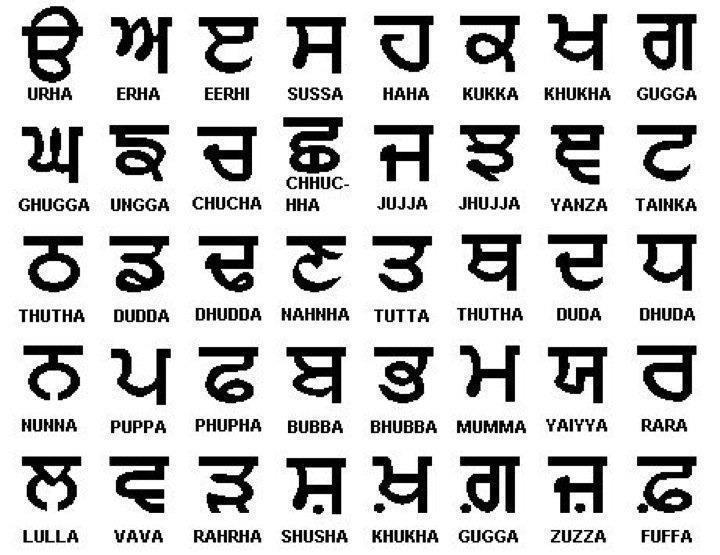
listeners. These songs were recorded in Gurmukhi script, and formed the beginnings
of the Sikhs' Sacred Writings,
later to become the "Siri Guru Granth Sahib".
THE GURMUKHI ALPHABET
GURU NANAK TAUGHT THIS SPIRITUAL LIFESTYLE
Nam Japa - To rise each day
before sunrise, clean the body, meditate on God's Name and recite
the Guru's hymns to clean the mind. And throughout the day, continuously
remember God's Name with every breath, meditating on the One.
Dharam di Kirat Karni - To
labor and earn by the sweat of the brow, live a householder's
way of life, and practice truthfulness and honesty in all dealings.
Vand Ke Chakna - To share the
fruits of one's labor with others before considering oneself.
And thus, live as an inspiration and a support to the entire community.
Guru Nanak 1469-1539 Founder of Sikh Dharma
Guru
Nanak laid down this foundation of Sikhism. Guru Nanak later
infused and passed this consciousness on to a disciple, who then
became the next Guru, who subsequently passed the light on to
the next, and so on for a total of 10 Gurus. The word "Guru"
is derived from the root words "Gu", which means darkness
or ignorance, and "Ru", which means light or knowledge.
The Guru is the experience of Truth, God, the One Reality.
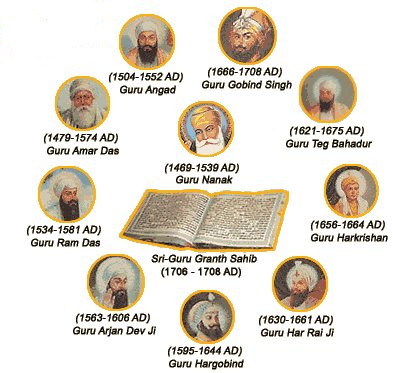
1. Guru Nanak -- Soul Body
2. Guru Angad -- Cautionary Mind
3. Guru Amar Das -- Postive Mind
4. Guru Ram Das -- Neutral Mind
5. Guru Arjan -- Physical Body
6. Guru Hargobind -- Arcline-Halo Body
7. Guru Har Rai -- Auric Body
8. Guru Har Krishan -- Pranic Body
9. Guru Teg Bahadur -- Subtle Body
10. Guru Gobind Singh -- Radiant Body
11. Siri Guru Granth Sahib -- Mastery of all ten Bodies
NOTE: Dates are given in CE (Common Era). These years correspond to
the same dates as AD but by defining the current period as the
"Common Era" the nomenclature attempts to treat all
religions and beliefs as equal.
Bhai
Sahiba,orBhai Sahib: Bhai means Sister or Brother. Sahiba or Sahib means Madam or Sir. These are also titles of reverence
bestowed upon highly respected Sikh women and Sikh men respectively for their dedication, spiritual wisdom, insight and knowledge.
God: Think about this. You grew and developed your magnificent brain, perhaps the most complicated thing in the world without even thinking about it. A supremely intelligent Life Force of unknown origin created and sustains this wondrous miracle. This benevolent Force is what Sikhs refer to
as Ek Ong Kar, the One Creator of Creation, the One In Charge, what Jews and Christians call God. See OneIsTheAnswer.com.
What is God? In reality it is your own positive self, your higher Self,
your universal Self, the Self, which knows no defeat, the Self, which can rise
again and again and again like a wave in the ocean. Yogi Bhajan 7/17/1984
Hari: Name for God,the creative aspect. 'Har' is the primal name/sound of the Creator. 'I' is the active aspect.
Karma: The force generated by a person's actions held in Hinduism and Buddhism to perpetuate transmigration and in its ethical consequences to determine the nature of the person's next existence. (Newton's Third Law of Motion. For every action, there is an equal and opposite reaction.) See More Definitions.
Kaur: Princess. Female Sikhs are given Kaur as part of their
given name. A female Sikh's given name, as in many other
traditions, usually denotes some aspect of the Creator. Female and male Sikhs
can have the same given name, e.g., Hari Kaur, woman, and Hari Singh,
man.
Khalsa: Body of Pure Ones, i.e., "those who
contemplate the Lord," from Sukhmani Sahib; who live by their inner purity and light;
who are pure of heart. Sukhmani Sahib is the name given to a set of hymns divided into 24 sections, which appear in the Sri Guru Granth Sahib. Khalsa DOES NOT apply exclusively to Sikhs. The Khalsa includes ALL those who
contemplate God; ALL who live by their inner purity and light; ALL who are pure of heart. Mankind must be ever mindful of the tendency to tribalism. Also see Tribal vs. Tribalism.
Mahan Tantric: "Mahan" is a Sanskrit word meaning principle, supreme, great, or high. "Tantric" is a Sanskrit word meaning one who weaves together, as in weaving together the physical and the spiritual, as in joining together the human and the divine. See Tantra Yoga. See TheMahanTantric.com.
Mukhia
Jathedar: Chief (Senior) Leader; the honor bestowed upon women and
men who have manifested exceptional qualities of knowledge and service to the community.
Mukhia
Sardarni Sahiba,andMukhia Singh Sahib(aka MSS): Chief Noble Lioness, and Chief Noble Lion, are ministerial titles
bestowed upon women and men respectively who have manifested exemplary service
to the community. Indicates an elder of Sikh
Dharma International.
Naam(Nam or Name):Word-Sound; the expressed sound current by which God, the I AM; the One Creator of Creation is acknowledged,
worshipped, remembered, honored, celebrated and
appreciated as the One Thee-Me in EveryBody. (See Word Physiology. See Be Your Allness. See Acknowledgements.)
Sat Kartar: The True Doer of all. A term sometimes used to acknowledge the reason Sikhs do not proselytize,* i.e., only those whose destiny is to be a Sikh will be Sikh. *See Example.
Sat Kartar:God is the Doer.
Sat
Nam: Authentic Truth. Used as a greeting, it means Truth is your One Identity, your Essential Essence. In other words, you
are IT, I am IT, we are IT. (Also see Sat Nam Means.)
Sat
Siri (Siri or Sri) Akal: Supreme Truth never ends, i.e.,
our True Identity is undying.
Shakti Pad: The status or mindset of any practitioner, who knows far less than they think they know, and which fails to acknowledge same. The worst-case scenario is that one falls into the trap of convincing oneself and others that only they know the best way, and that the old ways need to change, going forward. Beware of the 'tiger's bite'! It is a normal consequence of 'riding the tiger' of pride. One must be alert to the signs in order to take appropriate action. One must surrender their ego, realizing that learning never stops. See Antidote.
Singh: Lion. Male Sikhs are given
Singh as part of their given name. A male Sikh's given name, as in many other
traditions, usually denotes some aspect of the Infinite. Male and female Sikhs
can have the same first given name, e.g., Hari Singh, male, and Hari Kaur,
female.
Singh Means Lion
The Lion sleeps no more.
Siri
Sardarni Sahiba, and Siri
Singh Sahib(aka SSS):Supreme Noble Lioness and
Supreme Noble Lion, are ministerial titles bestowed upon women and men
respectively who are religious authorities within a particular
domain of Sikh
Dharma International. SeeSiriSinghSahib.com.
Tantra Yoga: "Tantra" means woven together. "Yoga" means union.
Wahe Guru: The Indescribable Experience of Indescribable
Wisdom, which is commonly known only as 'God'.
Wahe Guru Ji Ka Khalsa - Wahe Guru Ji Ki Fateh: An expression or greeting meaning that those who meditate on the Infinite (Khalsa) belong to the Infinite. And any and all accomplishments belong to the Infinite, i.e., God.
White Tantra Yoga: "White" connotes self-mastery, meaning under one's personal control as opposed to "Black", or under remote or other's control. See WhiteTantraYoga.com.
NOTE:White Tantra Yoga should not be confused with Black Tantra Yoga or Red Tantra Yoga. These forms of yoga also transform energy, but in a different way and for a different purpose. White Tantra Yoga directs the energy to self-mastery. Black Tantra Yoga directs the energy to manipulate other human beings, and Red Tantra Yoga directs the energy solely for sexual purposes.
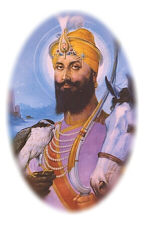
Guru
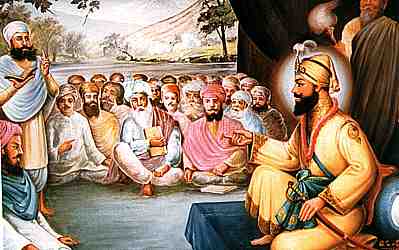
Gobind Singh was the last of the ten Sikh Gurus in human form. At the first Vaisakhi, he created the Khalsa;
a spiritual brother and sisterhood devoted to purity of thought
and action. He gave the Khalsa a distinctive external form, the
five "Ks", to inspire and remind them of their
commitment, and to help them maintain an elevated state of consciousness.
And he decreed that Sikh men carry the middle name, Singh, meaning
lion, and that Sikh women carry the middle name, Kaur, meaning
princess. Examples are, Hari Singh Khalsa, and Hari Kaur Khalsa.
There
is no mark, which sets apart
The Ever Changeless Light of hearts.
No caste or sect, shape, form or hue;
Imagination can't construe
His Greatness or His countless Names;
The King Who o'er the three worlds reigns;
A million Indras can't compete;
God's men and demons touch His feet.
The
world's vast fortunes seem as weeds
Amidst the garden of His deeds.
Thus, by His deeds His Name is placed;
Breath of Wisdom, Grace of grace.
Even forests slim or small
In glades and glens repeat the call,
"He is Infinite and All ... Infinite and All."
I
bow to Thee, Eternal,
Beyond death the Beauteous Form.
To the Merciful and Mighty,
O, I bow to Thee, Unborn;
To the One Who has no costume,
Who’s beyond all destiny,
Without treasure, without body, Indestructible is He;
Who is Nameless and cannot be named,
Who occupies no space,
Beyond karma, beyond dharma, beyond need of dwelling place.
O,
I bow to Thee Unconquerable, the Stranger to defeat.
To the Fearless, Self Sufficient One, the One without deceit;
To the One Who has no color, no beginning and no end,
Who is Bountiful and Faultless, Far Too Great to comprehend;
O, I bow to Thee Who art but One and Thee Who many be.
Beyond earth, air, water, fire and gas, I bow my Lord to Thee
...
Beyond earth, air, water, fire and gas, I bow my Lord to Thee.
I
bow to Him beyond all deeds, Who wears no special dress,
Who has no country, name or manner, the Desireless.
I bow to Thee Imperishable, Thee from sorrow free;
Beyond attachment, anger, pride, desire and greed is He;
To the One in need of no one, Who is worshipped in three worlds;
The Source of every treasure, He Who cannot be installed.
He Who’s free from all affliction, independent of all breath;
He Who organizes and destroys, Who is the Death of death.
O,
I bow to He Who generates, the One Who can't be known.
The Source of passion, strength and grace;
I bow to Thee, Unborn;
He Who is the Supreme Yogi, far beyond all intellect;
He in need of no support, yet Who supports the ocean's depth ...
He in need of no support, yet Who supports the ocean's depth.
I
bow to He Who has no caste, religion, faith or creed;
Sublime and All Prevailing Beauty, with no lineage;
The Countryless, the Garbless, Homeless, Spouseless, King of all,
Who dispenses death and mercy, He Who takes the shape of all.
O, I bow to the Creator, the Sustainer, the True Lord;
To the One Annihilator, low I bow to Thee Unborn;
To the One Who has no secrets, He Who is the Death of all;
The Creator of all beauties, their destruction and their fall.
O,
I bow to the Sustainer, Omnipresent in all hues;
Who prevails throughout the universe, the Endless Well of Truths.
O, I bow to Thee, Immortal Lord, to Thee untouched by age;
To the Doer, the Forgiver, to the Fearless and the Sage ...
To the Doer, the Forgiver, to the Fearless and the Sage.
He
Who is Every Occupation, no relations, no restraint;
To the kind and constant Husband, Aspiration of the saint;
To the Endless and the Infinite, the Love of every soul;
The Creator and Destroyer, bend thou low, this mortal coil.
Bow down to the Lord of Yogis, the Sustainer of the wife;
The Enjoyer of all pleasures, the Caretaker of all life.
He
Who's kind and understanding, more impartial than the sea;
He Who dries up all life's fluids, O, I bow my God to Thee.
To the Bountiful and Fruitful, Who is not sustained by breath;
Who is Fearless and Desireless, He Who is the Death of death;
Who is Infinitely Gracious, Who’s within and out of me;
To the Only God whose Name is Truth, I bow, my Lord to Thee ...
To the Only God whose Name is Truth, I bow, my Lord to Thee.
I
bow to Thee, O Virtuous, upon Whom all rely;
He Who lives in everyone, the One from Whom all shapes arise;
To the Moon of moons, the King of kings, the most respected One;
Unto He Who has no comrade, Hymn of hymns and Sun of suns;
He Who is the Dance within the dance, the Sound within the sound.
To the Music of all music, to the Current, I bow down;
To the One Who is the Hand and is the hand's Activity,
Who contains all forms, all maya, Great and Glorious is He.
The
Dispute of all disputes, the Supreme Siddha of the verse;
To the User of all weapons, Mother of the universe;
Who is All-Supreme in wisdom, without lust and costume free;
To the Master of maneuvers, O, I bow my Lord to Thee ...
To the Master of maneuvers, O, I bow my Lord to Thee.
I
bow to He Who cures disease, Who takes our daily care;
Present in both gods and demons, Who is Dutiful and Fair.
He Who knows all forms of cunning, the Embodiment of love;
Who bestows all life and charity, All Seeing Lord above;
To the Mantra of all mantras, Pure of fire and the Pure;
To the Jantra of all jantras, Conqueror of the universe;
The Immortal, Without Master, to the True and Blissful Form;
To the Tantra of all tantras, low, I bow to Thee Unborn.
O,
I bow to He Who rules all wealth, the Brightest of the bright;
To the Seed of seeds, the Song of songs, the Form of dark and
light;
To the Honored of all honored, without fear or mystery;
Object of all meditation, O, I bow my Lord to Thee ...
Object of all meditation, O, I bow my Lord to Thee.
I
bow to the Bestower of all knowledge time and space;
To the Source of love, the Source of strength, salvation, bliss
and grace.
He Who takes the form of passion, He Who takes the form of pain;
To the Harshest of the harsh, the Many and the One again;
To the Everlasting Sculptor Who is pleased with every mold;
The Embodiment of kindness, the Controller of the soul;
The Destroyer of the three conditions, future, past and now.
He
Who is the Life of life, bestowing undestroyable power;
To the Battle of all battles, the Embodiment of peace;
The Unalterable Essence, Formless through eternity;
To the Righteous Lord of Indras, Who’s within and out of
me;
Meditation of all meditations, Lord, I bow to Thee ...
Meditation of all meditations, Lord, I bow to Thee.
ABOUT VAISAKHI
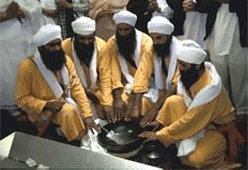
Five Sikhs prepare Amrit at Vaisakhi
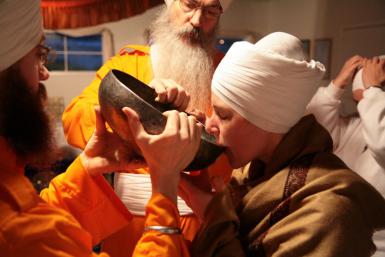
Sikh woman taking Amrit
Vaisakhi
(Baisakhi) day commemorates a very important occasion in the history of the
Sikh Faith. On this day, Guru Gobind Singh established the Khalsa
Panth. The word Khalsa comes from Persian dialect, meaning “pure”,
and Panth refers to “way of life”. He created a Fellowship
of the Pure. In a distinct ceremony, five followers of the faith
were initiated in to Panth, who passed a difficult test set for
them by the Guru, and became known as the “Panj Pyare”
(the five beloved ones). Since that time, any five baptized Sikhs
have been called upon to render decisions on important issues
facing Sikh communities. Another unique aspect is that after baptizing
the Panj Pyare, Guru Gobind Singh asked them to initiate him,
thus firmly establishing the democratic principles inherent in
the Sikh religion. The baptized Sikhs were given a distinct uniform
or identity: Kanga (wooden comb), Katchera (breeches), Kara (steel
bracelet), Kirpan (sword), the wearing of Kesh (unshorn
hair), and a “Code of Conduct” which included
abiding by truthful principles of living.
THE SIKH ARTICLES OF DHARMA
Every
baptized Khalsa Sikh vows to wear the symbols known as the 'Five
Ks', first ordered by Guru
Gobind Singh.
KESH,*the God-given hair and beard, kept
unshorn to sustain him or her in higher consciousness, and to
be covered with a Turban, the crown of spirituality. The unshorn hair is coiled, and worn
in a jura or knot (bun) on top of the head (crown
chakra), and under the turban. See Beards.
KANGHA,
the wooden comb, symbol and reminder of the commitment to cleanliness,
and used to groom the hair.
KATCHERA,
the specially designed cotton underwear, symbol and reminder of
the commitment to purity, and to refrain from sexual relationships
outside of marriage. (Khalsa Sikhs also vow to refrain
from eating meat or using tobacco, alcohol, and all other
intoxicants.)
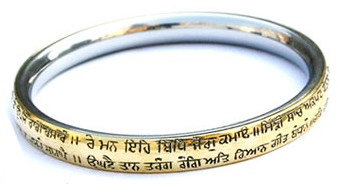
KARA, the steel ring-bracelet, symbol of One without end, i.e., Infinity, worn
on the wrist, signifying the unbreakable bondage with Truth, The
One God, The One Reality, and freedom from every entanglement.
KIRPAN,* the small sword, the symbolic Sword of Righteousness, with which
a Khalsa is committed to righteously defend the weak, protect the innocent, and
the fine line of Truth.
Solid Gold Kirpan Necklace
Scabbard, yellow gold; Blade, white gold Gold Adi Shakti overlay on scabbard
*Kirpan -- Kkeér Pahn, literally means 'hand of mercy.' It is a Punjabi (East Indian) word for 'knife' or 'dagger', that connotes a philosophy of respect for the martial arts and weapons, NOT as vehicles of aggression, but as a means of defending the defenseless. A Sikh's sacred duty is to defend the weak and protect the innocent. See GurdwaraSecurity.com.
Point To Ponder
Chanting Akaal At The Time of Death
At the time of death Sikhs chant Akaal three times. Akaal means 'Undying' and refers to the soul that is being released.
Chanting Akaal for someone at the time of death is a yogic tradition that assists the soul in its journey as it leaves the physical plane, and also brings comfort and support to those left behind. This is a valuable tool to use no matter who has passed or the circumstances...a loved one, or someone in a tragic event around the world. See More.
Then
Guru Gobind Singh infused his own being into the Khalsa, declaring
that the Khalsa was now the Guru in all temporal matters. For
spiritual matters, the Guruship was given to the "Siri Guru
Granth Sahib", a compilation of sacred ecumenical writings
taken from saints and sages of several spiritual paths who have
experienced Truth. For Sikhs, "Siri Guru Granth Sahib" is the living embodiment of the Guru, and is regarded with the utmost reverence and respect wherever
it is found. Sikhs all over the world look to the "Siri Guru
Granth Sahib" as their supreme, living Guru, as the source
of their spiritual instruction and guidance.
Sikhism is one religion, which is founded on the principles of global
interfaith communities and mutual inter-community respect and
harmony. The founders of Sikhism have, since 1469, defined and
taught the principles of interfaith respect, dialogue, and harmony.
A Sikh, by definition, will respect and accept all other world
religions. Further, the Sikh will protect, guard, and allow the
free practice of the customs and rituals of other religions.
"... We gladly accept all, and we will exclude none,
for after
all, we're the same - we are all One." --Guru
Gobind Singh
*Think
about it! Why
is hair so rapidly replaced, cut after cut?
And why is it so difficult to keep it from growing?
It contributes more to your well-being than you realize.
Sikhs consider hair to be a blessing from the Creator.
Today,
whether a man has a beard can spark controversy. Witness the case
of Maher "Mike" Hawash, an Intel contract engineer,
and a Muslim, who has pleaded not
guilty to charges related to waging war against the United States.
In some pictures he's clean shaven, and in others he has a beard.
The underlying issue has been, what kind of message does a man's
beard send about innocence, guilt, stereotypes and political correctness?
Here's a quick look at what six religious faiths
believe about
beards and letting one's hair grow.
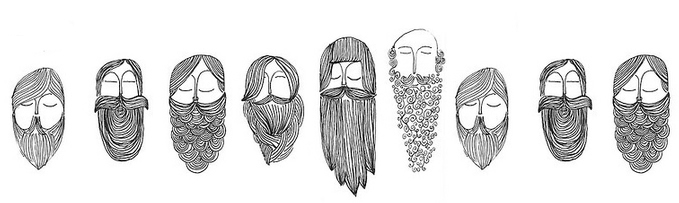
Sikhism: Devout Sikhs, both men and women, let their hair grow, wrap
their hair in a turban,* and the
men allow their beards to grow. These are some basic requirements
of the Khalsa, a fellowship of those who "belong to the divine."
The practice affirms their belief that God made men and women
perfectly, with no changes necessary. When the Khalsa arose in
1699, their unshorn hair set Sikhs apart and encouraged them to
stand up against oppression, tyranny and injustice. See Gurdwara Security.
To a Sikh, the hair is a reminder
of the One Who put it there.
But
human hair also has physiological and psychological aspects. To
the Sikhs, it is an important component in the equation of man's
physical and electromagnetic health and harmony. And in the human
male, facial hair acts as an important buffer to the solar and
lunar energies. Thus, human hair has its obvious or exoteric,
as well as yogic or esoteric aspects. In a psychological sense,
our cutting of body hair is an indication of a conflicted attitude,
since it is within the physical nature of our body to grow the
hair, and it is an attitude within our psyche to cut the hair.
Conversely, letting the hair grow expresses an inner harmony with
nature. In a biological sense, it would appear that hair is important
to our physical well being since the body repeatedly replaces
hair quickly, whenever it is cut. And in a spiritual sense, it
can be said that there is an important message to be had from
the One Creator, as to the necessity for hair, e.g., when a man's
facial hair is shaved, it rapidly reappears, time after time. See video If your dad doesn't have
a beard.
Judaism: Orthodox and Hasidic Jews wear beards and, sometimes, long
side-curls, called payot. Leviticus 19:27 forbids them to round
off the corners of their temples or "mar" the edges
of their beards. The latter is equated with shaving, but some
Jews believe that scissors and scissor-action shavers may be used.
In some circles, a beard is a sign of mourning, either for a loved
one lost or grown from Passover to Pentecost on behalf of the
Jewish people.
Christianity: God is often depicted as having a flowing white beard, and
Jesus, most often, has a darker one. No eternal, blanket understanding
about facial hair arose, but smaller groups, such as the Orthodox
churches, developed traditions about men keeping beards. In the
modern world, men may or may not adhere to them. Some groups ascribe
particular meaning to beards. Amish men, for example, may grow
beards as a sign of being married. Just a beard, though, -- a mustache
is seen as frivolous or militaristic.
Islam: The
Prophet Muhammad himself had a beard and prescribed them for his
male followers. Different styles of beards are allowed, and some
reflect cultural differences. Muslims may disagree on whether
it's permissible to trim a beard, but Muhammad said that a moustache
should be trimmed so that it didn't get wet when a man took a
drink of water. Cutting hair is a different story. Muhammad himself
had long and short hair at different times of his life. Buddhism: A goal is to dissociate from the material world and its distractions,
and hair is often a subject of pride or vanity. Buddhist monks
and nuns may shave their heads, as an outward sign of renouncing
the world. Shaven heads and faces are associated with cleanliness.
Some Western teachers avoid shaved heads because they can create
discomfort in the general population.
Rastafarianism: Their characteristic dreadlocks express their pride in African
hair and are allowed to grow free-form, uncombed and untreated
after washing. They are in keeping with a Hebrew Bible, or Old
Testament law for Nazarites, a group of people who are consecrated
or set apart. Numbers 6:5 says "no razor shall come upon
the head ... they shall be holy; they shall let the locks of the
head grow long." Sikh
music videos
*Bole
So Nihal: "One who speaks these words shall be blessed."
An exaltation traditionally expressed on occasions when
a rallying affirmation is appropriate. The answer to this
call is Sat Siri Akal: "Truth is supreme and
undying."
Sikh Coalition helps
get historic protections
for millions of students in New York State.







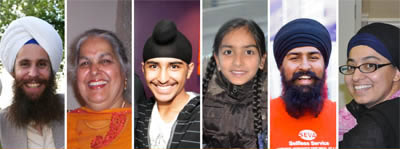


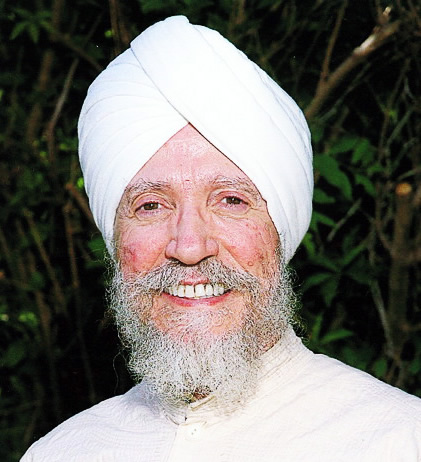







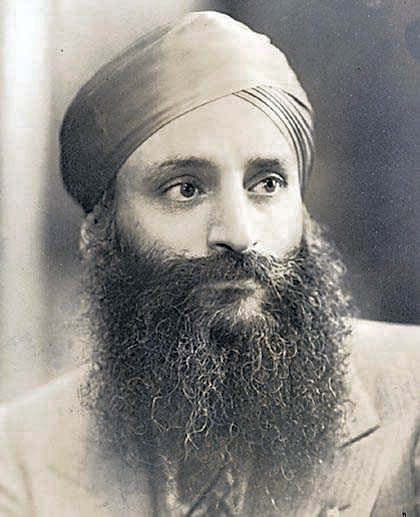


 To train the mind and the senses to recognize the Divine Light within oneself and within all of creation.
 . A life lived in awareness of oneness of the Creator,
  . A life fueled by honest earnings,
  . A life sharing one's earnings with the needy.






























 Factoid




 Denotes Beginning of Guruship










 Greetings, Names, and Titles














 Sikhism: Devout Sikhs, both men and women, let their hair grow, wrap
their hair in a turban,* and the
men allow their beards to grow. These are some basic requirements
of the Khalsa, a fellowship of those who "belong to the divine."
The practice affirms their belief that God made men and women
perfectly, with no changes necessary. When the Khalsa arose in
1699, their unshorn hair set Sikhs apart and encouraged them to
stand up against oppression, tyranny and injustice. See
Sikhism: Devout Sikhs, both men and women, let their hair grow, wrap
their hair in a turban,* and the
men allow their beards to grow. These are some basic requirements
of the Khalsa, a fellowship of those who "belong to the divine."
The practice affirms their belief that God made men and women
perfectly, with no changes necessary. When the Khalsa arose in
1699, their unshorn hair set Sikhs apart and encouraged them to
stand up against oppression, tyranny and injustice. See