 The
Wonders of Sikh
The
Wonders of Sikh 
Spirituality Come Alive
An article appearing in the New York Times
By Holland
Cotter, September 18, 2006
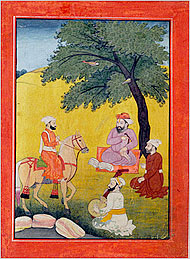
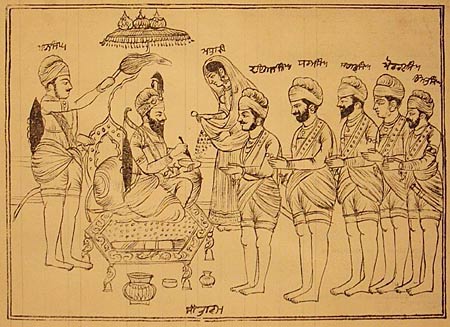
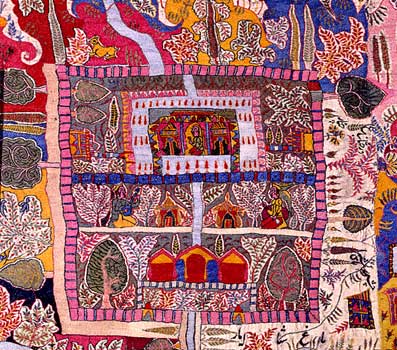
A king pays homage to Guru Nanak in an
exhibition of early Sikh art at the Rubin Museum.
Sikhism,
the world’s fifth-largest organized religion, has more than
20 million followers. Many thousands live in New York City. We can
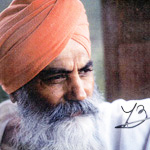
spot Sikh men on the street by their turbans and upswept whiskers. And many
of us will recall that two decades ago Sikhs were at the center of
the news when the Indian Army stormed the Golden Temple at Amritsar,
killing hundreds of Sikh separatists, and soon after Indian Prime
Minister Indira Gandhi was assassinated by her two Sikh bodyguards.
But what about Sikhism itself?
Few Westerners have even basic information.
How many people are aware that it was conceived as a universalist, open-door religion?
Or that its view of society was radically egalitarian? Or that its
Holy Book, the Siri Guru Granth
Sahib, far from being a catalog of sectarian dos and don’ts,
is a bouquet of poetic songs, blending
the fragrances of Hindu ragas, Muslim hymns and Punjabi folk tunes into a music of spiritual astonishment?
This is precisely the information delivered by the small and absolutely
beautiful show titled, “I See No Stranger: Early Sikh Art and
Devotion,” at the Rubin Museum of Art in Chelsea. Vivid but
concentrated, it presents, mostly through paintings, a culture’s
version of its own origins, the image of history shaped far more by
hard work, pluralistic politics and mysticism than by militancy.
Sikhism was founded at the end of the
15th century in northern India, when a young, high-caste Punjabi Hindu
named Nanak had a revelation. It led him
to believe that God was a formless spiritual force shared by all religions,
and that social ranks based on faith, class, caste, gender or race
were illusory. Unity was reality. The Other was just another. “I
see no stranger, I see no enemy, I look upon all with good will,”
is how Sikh scripture phrases it.
Eager to share his vision, Nanak took to the road, accompanied by
a Muslim musician named Mardana, who played the stringed instrument
called a rabab. Together they traveled, according to official accounts
of Nanak’s life, from Sri Lanka to Afghanistan, and west to
Baghdad and Mecca, composing and singing devotional songs as they
went.
They lived at a high devotional moment. The mystical brand of Islam
called Sufism was in full flower, as was the corresponding Hindu movement
called Bhakti. Saints of all sorts, and sects wandered northern India,
bumping into and bouncing off one another, turning a subcontinent
into a kind of giant love-in. Orthodox thinking was turned inside
out. Hierarchies were up-ended. Students taught and teachers learned.
The name Sikh — pronounced sick with an enunciated H at the
end — comes from a Sanskrit word for disciple.
The exhibition, organized by the art historian B. N. Goswamy of Panjab
University, and Caron Smith, chief curator of the Rubin Museum, conveys
something of the flavor of all this through dozens of miniature paintings
in Hindu and Mughal court styles, illustrating the life of Nanak,
or Guru Nanak as he came to be called.
In them he emerges as a figure of commonsensical wit, unassuming piety,
superhuman power and increasing physical bulk.
He’s a trim, soft-faced schoolboy in one 18th-century painting,
standing in class and holding out a writing board — it looks
like a boxy camera — to a teacher. Already by this time Nanak
has been lecturing his parents on the Bhagavad-Gita and writing metaphysical
verse. Some of these poems, we are meant to assume, are on the writing
board. And we know his confounded teacher will give him an A for Amazing.
Another picture shows the adult Nanak asleep on the floor of a mosque
in Mecca, with his feet pointed, in a scandalous breach of religious
etiquette, toward the Kaaba, God’s house, the holy of holies.
When an outraged mullah tries to drag him around into reverse position,
the Kaaba turns too. The lesson: no direction is unhallowed, because
God is everywhere.
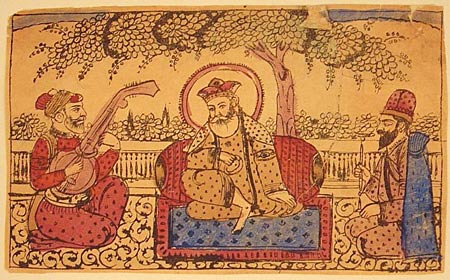
In a third painting, Nanak, now in stout middle age and wearing a
sort of zany aviator’s cap, sits with his book of hymns under
a tree. Mardana, tuning up nearby, stares blankly off into space.
From the left a princely figure, stiff-backed and poker-faced, approaches
on horseback to pay homage. Clearly the meeting is a significant one,
but nobody seems very into it, or even aware that anyone else is there.
The painting is paired in the show with the workshop drawing, produced
by a master artist, that served as its model. The contrast is striking.
In the drawing the prince, far from being restrained, practically
levitates from his saddle with ardor and leans toward Nanak as if
drawn to a magnet. Mardana plays and sings with fervor of a contemporary
bhangra star. It is in the drawing, rather than in the painting, that
the Nanak Effect, so evident in poems and songs, comes through.
Guru Nanak had nine successors, and each built on what he had begun.
The fourth guru, Ram Das, established
Amritsar as the pre-eminent Sikh pilgrimage site. The next, Guru Arjan
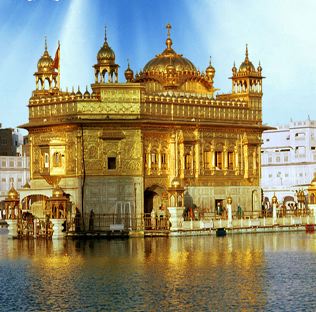
Dev, completed the Golden Temple there, built on a platform in the
center of an excavated lake. He also assembled Nanak’s poems,
along with others by Hindu and Muslim saints, to create the Holy Book, the Siri
Guru Granth.
Up to this point, at the very beginning of the 17th century, Sikh
history had been peaceful enough despite internal frictions. The site
of Amritsar was a gift outright from the Mughal emperor, Akbar, a
spiritual seeker and social philosopher who ruled much of India and
was admiring of Sikhism’s multicultural character. But after
Akbar’s death, rapport with the Mughals disintegrated.
In 1606 his son, Jahangir, an observant Muslim, imprisoned and killed
Arjan Dev. When the next guru was also jailed, the Sikhs adopted a
stance of defensive militarism and a new social ideal: the soldier-saint.
The 10th guru, Gobind Singh, formalized
this collective identity in 1699 when he established a ritual of Sikh
initiation and codified a set of communal symbols that included, for
men, leaving their hair uncut,
wearing a turban and assuming the surname
Singh (“lion”), and for women, using the surname Kaur
(“princess”). (See the five K's)
Gobind Singh also took the crucial step of designating the Adi
Granth, the Holy Book, as the next, last, and eternal Guru, under
the honorific title of Siri Guru
Granth Sahib. The Book became and remains an object of incalculable
charisma, almost a sentient being, enthroned on cushions, swathed
in rich fabrics, and handled with tender, punctilious deference. Reciting
or singing from it is the defining act of Sikh worship. So intense
is its sanctity that, while a throne has been prepared for it in the
show, the Siri Guru Granth Sahib itself is physically absent.
Absence can of course have a presence of its own, as modern Sikh history
does in this exhibition. An earlier show, “The Arts of the Sikh
Kingdoms,” organized in London in 1999, focused on Sikhism from
the British colonial period onward, tracing the entwined political
and religious developments that led to, among other things, the calamities
of 1984 in India.
The Rubin Museum has late material too, including a splendid set of
British-influenced 19th-century drawings of craftsmen at work, and
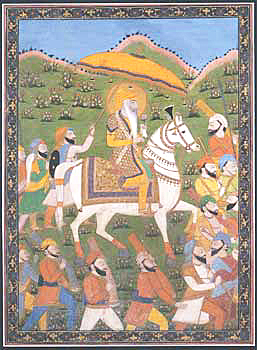
a series of formal portraits of Sikh warrior-chiefs. Unlike Nanak,
these leaders carry weapons rather than hymnals, which points to reconceived
ideals of spiritual and temporal power, though these ideals and how
they came about are only suggested here.
All-apparent, however, are the poetry and music that pervade and orchestrate
the Sikh view of the world. Traditional hymns play softly in the gallery.
A rabab is on display. Certain paintings have the gentle, doleful
lilt of evening ragas; others jump and twitch with a bhangra beat.
And running through everything, like the harmonium’s beginningless-endless
voice, are the words of the Siri
Guru Granth Sahib:
"Wonderful is sound
Wonderful is wisdom
Wonderful is life
Wonderful its distinctions
Wonderful is praise
Wonderful is eulogy
Wonderful the Presence
One sees in the present
O wonder-struck am I to see wonder upon wonder." --
The
Sikhs
"From
a woman all men are born. How then
can any man degrade any woman?" Hari
Kaur
The
12 Aspirations of the Sikhs are to:
 Believe God is Truth and Word
is Guru.
Believe God is Truth and Word
is Guru.
Believe God is the One Creator,
and all of Creation is God's manifestation.
Espouse the role of woman as
representing the Universal Mother.
Maintain their hair and beard unshorn as God's gifts,
and wrap their hair in a turban.
Refrain from eating flesh food,
i.e., red meat, chicken or seafood.
Refrain from using tobacco,
drugs or alcohol.
Perform sadhana,*
i.e., spiritual practice before sunrise, and recite banis daily.**
Believe all religion and scripture
is an expression of the One Creator.
Respect the rights and freedoms
of all spiritual paths.
Espouse the sanctity of the
path of the householder.
Maintain 'Chardee kala' (an exalted
and positive attitude towards life and other people).
Believe it is God's blessing
to serve others, and to protect the weak and innocent.
*Sadhana is a word derived from the Sanskrit words Sa, meaning all, and Dhana,
meaning blessings.
Special
Note: It
is not the customary practice of the followers of Sikh Dharma to proselytize
others. Sikhs often express the term "Sat Kartar," i.e.,
"God is the Doer." In this sense meaning, only those with
such destiny are to be Sikhs.
More Web sites by
KhalsaWebMasters.com