In
the beginning was the Word, and the Word
was with God, and the Word is God. -- John, 1, 1
In the beginning was the Word. It doesn't say
in the beginning was God. -- Yogi Bhajan
Sing songs that relate to the spirit; it is such a
beautiful emotional release. You will always be grateful
to yourself. It is a perfect way to stay sane. -- Yogi Bhajan
The
use of music for spiritual attainment and healing of the soul, which
was prevalent in ancient times, is not found to the same extent today.
Music has been made a pastime, the means of forgetting
God instead of realizing God. -- Hazrat
Inayat Khan
The Sacred Songs of the Sikhs Including 'The Peace Lagoon'
From Japji Sahib
By Guru Nanak
Pran Sutra - 33rd Pauri
A Pran Sutra is a mantra or phrase from Siri Guru Granth
Sahib with which one resonates as spiritual guidance.
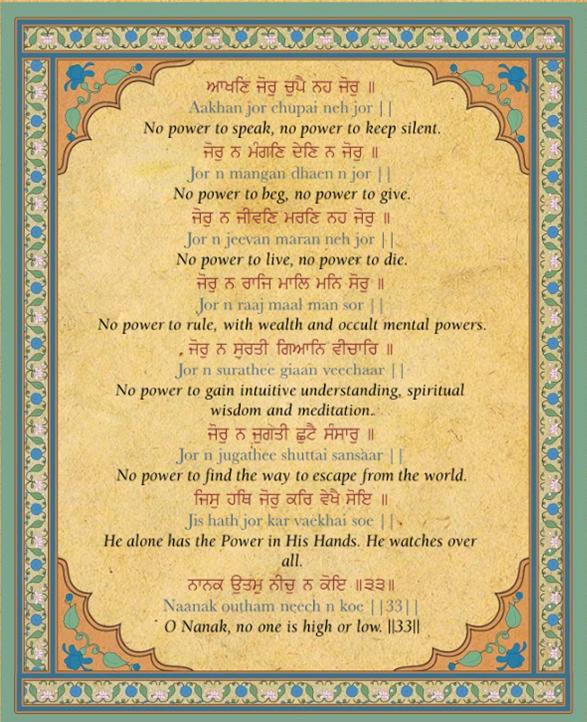
Translation No power to speak, no power to keep silent. No power to beg,
no power to give. No power to live, no power to die. No power
to rule with wealth and occult mental powers. No power to gain
intuitive understanding. No power to contemplate spiritual wisdom.
No power to find the way to escape from the world. He alone
has the Power in His hands, He watches over all.
O Nanak, no one is high or low.
"This
pauree destroys your ego and brings home your divinity.
It removes negativity, neutralizes your destructive nature
and prevents harm to others by your hand." Psyche
of the Golden Shield
"Whosoever
chants the 33rd Pauri of Japji Sahib 25 times a day,
there is nothing on Earth he will not have. Guru Nanak sang this
pauri as a sampuran kriya, a perfect, perfect seal. This pauri means
that if you ask for nothing, you will get everything -- that is the
Law.
Whosoever chants this pauri 25 times a day, there is nothing on Earth
that he or she will not have. Ask for nothing, just praise the Lord." Siri Singh Sahib of Sikh Dharma
The Many Facets of Japji Sahib
Reciting the entire Japji daily balances all aspects of yourself, and activates your soul. You may also choose to recite one Pauri 11 times each day to work on developing one particular facet.
Japji Sahib line by line in Gurmukhi
MUL MANTRA
Ek
Ong Kaar - Sat
Naam - Kartaa Purakh - Nirbhau
Nirvair - Akaal Moorat - Ajoonee Saibhang - Gur Prasaad - Jap
Aad Sach - Jugaad Sach - Hai Bhee Sach - Naanak Hosee Bhee Sach
RECITING MUL MANTRA removes your fate, and changes your destiny to prosperity.
.) RECITING FIRST PAURI gives the total knowledge and ecstasy of God. The second half is an antidote to depression. It will lift you from depression, insecurity, nightmares, and loss. Click here.
.) RECITING SECOND PAURI imparts patience and stability. Click here.
.) RECITING THIRD PAURI transforms insufficiency into sufficiency, turns depression into elevation, and transforms low self-esteem into complete self-confidence. Click here.
.) RECITING FOURTH PAURI blesses those trapped in feelings of poverty and lack of means. It blasts through the trap of these feelings like a thunderbolt. Click here.
.) RECITING FIFTH PAURI is for when you feel that you are not up to the job. This Pauri will grant you all success when you feel a sense of failure within yourself. Click here.
.) RECITING SIXTH PAURI dispels limitation. Recite it when you feel limited, cornered, trapped, or coerced. When you suffer from greed, madness for power, overbearing expansion and the need to control or when you become trapped in your territoriality. Click here.
.) RECITING SEVENTH PAURI will heal you. Click here.
.) RECITING EIGHTH PAURI gives you the power to be a perfect sage. Click here.
.) RECITING NINTH PAURI gives you expansion. Click here.
.) RECITING TENTH PAURI grants you grace. Click here.
.) RECITING ELEVENTH PAURI gives you virtuousness. Click here.
.) RECITING TWELFTH PAURI gives you solidarity of self, self-impressiveness, and self-respect, when you feel small. Click here.
.) RECITING THIRTEENTH PAURI gives you the occult knowledge of Infinity. It brings deep INTUITION. Click here.
.) RECITING FOURTEENTH PAURI will show you the way when you cannot find your path in life, when you cannot see the direction to your destiny, and when you cannot achieve fulfillment. Click here.
.) RECITING FIFTEENTH PAURI brings you liberation. Click here.
.) RECITING SIXTEENTH PAURI gives you knowledge of the structure of the universe. Click here.
.) RECITING SEVENTEENTH PAURI brings you freedom and resurrection. Click here.
.) RECITING EIGHTEENTH PAURI fights madness, deep feelings of inferiority, and self-destructive behavior. Click here.
.) RECITING NINETEENTH PAURI brings you universal knowledge, inspiration, and revelation. Click here.
.) RECITING TWENTIETH PAURI wipes away all your misdeeds when the monsters are nipping at your heels. Click here.
.) RECITING TWENTY-FIRST PAURI will maintain your status, grace and position. Click here.
.) RECITING TWENTY-SECOND PAURI will bring you victory in legal battles. It gives you the strategy. Click here.
.) RECITING TWENTY-THIRD PAURI dispels darkness and elevates the self. Click here.
.) RECITING TWENTY-FOURTH PAURI breaks through all limitations with the force of a thunderbolt, so powerfully that it affects generations. It has the power to kill misfortune. Click here.
.) RECITING TWENTY-FIFTH PAURI pre-fulfills all your needs. Prosperity, virtue, estate, and wealth are yours without asking. Click here.
.) RECITING TWENTY-SIXTH PAURI transforms nothing into everything. In your business it banishes losses, misfortunes, and miseries. Click here.
.) RECITING TWENTY-SEVENTH PAURI shows you the way when you are stuck and you cannot see the window of opportunity before you. It removes obstacles so you can leap over hurdles. Click here.
.) RECITING TWENTY-EIGHTH PAURI is the strongest permutation and combination of words in the world. It unites you with God. Click here.
.) RECITING TWENTH-NINTH PAURI is a shield of protection from enemies. It vaporizes animosity towards you Click here.
.) RECITING THIRTIETH PAURI places you upon the throne of divinity. It makes you into a sage and a saint. Click here.
.) RECITING THIRTY-FIRST PAURI pulls all virtues from the heavens. Click here.
.) RECITING THIRTY-SECOND PAURI pays your debts and completes your karma. Click here.
.) RECITING THIRTY-THIRD PAURI destroys your ego and brings forth your divinity. It removes negativity, neutralizes your destructive nature, and prevents harm to others by your hand. Click here.
.) RECITING THIRTY-FOURTH PAURI brings you stability. Click here.
.) RECITING THIRTY-FIFTH PAURI gives you the capacity to do your duty and fulfill your responsibility. Click here.
.) RECITING THIRTY-SIXTH PAURI brings you divine realization. It grants you complete understanding of the Heavens and the Earth. Click here.
.) RECITING THIRTY-SEVENTH PAURI cuts through karma and eliminates the impact of negative karmas. Click here.
.) RECITING THIRTY-EIGHTH PAURI gives you the power to rewrite your destiny. Click here.
.) RECITING THE SHALOK brings you self-satisfaction, elevation, acknowledgement, and respect. Click here.
One who chants Japji Sahib can never, ever be a coward. One who regularly chants Rehiras can never, ever be poor. One who chants Shabad Hazaray will always prosper, it doesn't matter what. One who chants Kirtan Sohila can never be dishonored. There is no more powerful prayer than Benti Chaupai.
These five banis given to you, are for you, not for Guru or for God. This is why we say...
"Bani Guru Guru hai baanee vich baanee amrit saare."
"Bani Guru, the Bani is Guru, in the Bani is all the nectar."
One
who considers himself ...
One who considers himself to be
A disciple of the True Guru,
Should rise before the coming of the light
And contemplate the Name.
During
the early hours of the morning
He should rise and bathe,
Cleansing his soul in a tank of Nectar Pure,
While he repeats the Name.
By
this procedure he truly washes away
The sins of his soul.
Then with the arrival of dawn he should sing
The hymns of praise.
He should hold the Name in his heart
All through the busy hours of the day.
The
one who repeats the Name with his every breath
Is a most dear disciple.
The disciple who has received the gift of the Lord's Name,
Truly wins the favor of the Lord.
I
seek to kiss the very dust
Under the feet of such a one,
Who recites the Name
And inspires others to do so ...
GUR
SAT GUR KA JO
SIKH AKAYAY,
SO BALAKAY OOTH ...
HAR NAM DIAYAY!
One who considers himself
To be a disciple of the True Guru,
Should rise and shine ...
Give God your glory, glory!
RAG
SUHI
By Guru Ram Das
From the 'Peace Lagoon'
I
would make myself a slave
To the one who can take me to meet my Beloved Lord.
When the Lord is merciful
He makes me to meet with the True Guru;
And I contemplate the Lord's Name ... O Lord!
If
it is Thy Will to grant me happiness;
If it is Thy Will to grant me joy;
If it is Thy Will to bring me peace within ...
I would ever meditate!
I would ever meditate on Thee.
And
even in pain, I will never forget Thee.
If Thou bring to me hunger I will feel satisfied.
And I will feel happiness if You bring me sorrow ...
And I will feel happiness if You bring me sorrow.
If
it is Thy Will ...
If it is Thy Will ...
If it is Thy Will,
I would ever meditate ...
I would ever meditate ...
I would ever meditate on Thee! --
FROM 'JAAP
SAHIB' (Meditation)
By Guru Gobind Singh
There
is no mark, which sets apart
The Ever Changeless Light of hearts.
No caste or sect, shape, form or hue;
Imagination can't construe
His Greatness or His countless Names;
The King Who o'er the three worlds reigns;
A million Indras can't compete;
God's men and demons touch His feet.
The
world's vast fortunes seem as weeds
Amidst the garden of His deeds.
Thus, by His deeds His Name is placed;
Breath of Wisdom, Grace of grace.
Even forests slim or small
In glades and glens repeat the call,
"He is Infinite and All ... Infinite and All."
I
bow to Thee, Eternal,
Beyond death the Beauteous Form.
To the Merciful and Mighty,
O, I bow to Thee, Unborn;
To the One Who has no costume,
Who’s beyond all destiny,
Without treasure, without body, Indestructible is He;
Who is Nameless and cannot be named,
Who occupies no space,
Beyond karma, beyond dharma, beyond need of dwelling place.
O,
I bow to Thee Unconquerable, the Stranger to defeat.
To the Fearless, Self Sufficient One, the One without deceit;
To the One Who has no color, no beginning and no end,
Who is Bountiful and Faultless, Far Too Great to comprehend;
O, I bow to Thee Who art but One and Thee Who many be.
Beyond earth, air, water, fire and gas, I bow my Lord to Thee
...
Beyond earth, air, water, fire and gas, I bow my Lord to Thee.
I
bow to Him beyond all deeds, Who wears no special dress,
Who has no country, name or manner, the Desireless.
I bow to Thee Imperishable, Thee from sorrow free;
Beyond attachment, anger, pride, desire and greed is He;
To the One in need of no one, Who is worshipped in three worlds;
The Source of every treasure, He Who cannot be installed.
He Who’s free from all affliction, independent of all breath;
He Who organizes and destroys, Who is the Death of death.
O,
I bow to He Who generates, the One Who can't be known.
The Source of passion, strength and grace;
I bow to Thee, Unborn;
He Who is the Supreme Yogi, far beyond all intellect;
He in need of no support, yet Who supports the ocean's depth ...
He in need of no support, yet Who supports the ocean's depth.
I
bow to He Who has no caste, religion, faith or creed;
Sublime and All Prevailing Beauty, with no lineage;
The Countryless, the Garbless, Homeless, Spouseless, King of all,
Who dispenses death and mercy, He Who takes the shape of all.
O, I bow to the Creator, the Sustainer, the True Lord;
To the One Annihilator, low I bow to Thee Unborn;
To the One Who has no secrets, He Who is the Death of all;
The Creator of all beauties, their destruction and their fall.
O,
I bow to the Sustainer, Omnipresent in all hues;
Who prevails throughout the universe, the Endless Well of Truths.
O, I bow to Thee, Immortal Lord, to Thee untouched by age;
To the Doer, the Forgiver, to the Fearless and the Sage ...
To the Doer, the Forgiver, to the Fearless and the Sage.
He
Who is Every Occupation, no relations, no restraint;
To the kind and constant Husband, Aspiration of the saint;
To the Endless and the Infinite, the Love of every soul;
The Creator and Destroyer, bend thou low, this mortal coil.
Bow down to the Lord of Yogis, the Sustainer of the wife;
The Enjoyer of all pleasures, the Caretaker of all life.
He
Who's kind and understanding, more impartial than the sea;
He Who dries up all life's fluids, O, I bow my God to Thee.
To the Bountiful and Fruitful, Who is not sustained by breath;
Who is Fearless and Desireless, He Who is the Death of death;
Who is Infinitely Gracious, Who’s within and out of me;
To the Only God whose Name is Truth, I bow, my Lord to Thee ...
To the Only God whose Name is Truth, I bow, my Lord to Thee.
I
bow to Thee, O Virtuous, upon Whom all rely;
He Who lives in everyone, the One from Whom all shapes arise;
To the Moon of moons, the King of kings, the most respected One;
Unto He Who has no comrade, Hymn of hymns and Sun of suns;
He Who is the Dance within the dance, the Sound within the sound.
To the Music of all music, to the Current, I bow down;
To the One Who is the Hand and is the hand's Activity,
Who contains all forms, all maya, Great and Glorious is He.
The
Dispute of all disputes, the Supreme Siddha of the verse;
To the User of all weapons, Mother of the universe;
Who is All-Supreme in wisdom, without lust and costume free;
To the Master of maneuvers, O, I bow my Lord to Thee ...
To the Master of maneuvers, O, I bow my Lord to Thee.
I
bow to He Who cures disease, Who takes our daily care;
Present in both gods and demons, Who is Dutiful and Fair.
He Who knows all forms of cunning, the Embodiment of love;
Who bestows all life and charity, All Seeing Lord above;
To the Mantra of all mantras, Pure of fire and the Pure;
To the Jantra of all jantras, Conqueror of the universe;
The Immortal, Without Master, to the True and Blissful Form;
To the Tantra of all tantras, low, I bow to Thee Unborn.
O,
I bow to He Who rules all wealth, the Brightest of the bright;
To the Seed of seeds, the Song of songs, the Form of dark and
light;
To the Honored of all honored, without fear or mystery;
Object of all meditation, O, I bow my Lord to Thee ...
Object of all meditation, O, I bow my Lord to Thee.
I
bow to the Bestower of all knowledge time and space;
To the Source of love, the Source of strength, salvation, bliss
and grace.
He Who takes the form of passion, He Who takes the form of pain;
To the Harshest of the harsh, the Many and the One again;
To the Everlasting Sculptor Who is pleased with every mold;
The Embodiment of kindness, the Controller of the soul;
The Destroyer of the three conditions, future, past and now.
He
Who is the Life of life, bestowing undestroyable power;
To the Battle of all battles, the Embodiment of peace;
The Unalterable Essence, Formless through eternity;
To the Righteous Lord of Indras, Who’s within and out of
me;
Meditation of all meditations, Lord, I bow to Thee ...
Meditation of all meditations, Lord, I bow to Thee. --
Bhai
Sahiba,orBhai Sahib: Bhai means Sister or Brother. Sahiba or Sahib means Madam or Sir. These are also titles of reverence
bestowed upon highly respected Sikh women and Sikh men respectively for their dedication, spiritual wisdom, insight and knowledge.
God: Think about this. You grew and developed your magnificent brain, perhaps the most complicated thing in the world without even thinking about it. A supremely intelligent Life Force of unknown origin created and sustains this wondrous miracle. This benevolent Force is what Sikhs refer to
as Ek Ong Kar, the One Creator of Creation, the One In Charge, what Jews and Christians call God. See OneIsTheAnswer.com.
What is God? In reality it is your own positive self, your higher Self,
your universal Self, the Self, which knows no defeat, the Self, which can rise
again and again and again like a wave in the ocean. Yogi Bhajan 7/17/1984
Hari: Name for God,the creative aspect. 'Har' is the primal name/sound of the Creator. 'I' is the active aspect.
Karma: The force generated by a person's actions held in Hinduism and Buddhism to perpetuate transmigration and in its ethical consequences to determine the nature of the person's next existence. (Newton's Third Law of Motion. For every action, there is an equal and opposite reaction.) See More Definitions.
Kaur: Princess. Female Sikhs are given Kaur as part of their
given name. A female Sikh's given name, as in many other
traditions, usually denotes some aspect of the Creator. Female and male Sikhs
can have the same given name, e.g., Hari Kaur, woman, and Hari Singh,
man.
Khalsa: Body of Pure Ones, i.e., "those who
contemplate the Lord," from Sukhmani Sahib; who live by their inner purity and light;
who are pure of heart. Sukhmani Sahib is the name given to a set of hymns divided into 24 sections, which appear in the Sri Guru Granth Sahib. Khalsa DOES NOT apply exclusively to Sikhs. The Khalsa includes ALL those who
contemplate God; ALL who live by their inner purity and light; ALL who are pure of heart. Mankind must be ever mindful of the tendency to tribalism. Also see Tribal vs. Tribalism.
Mahan Tantric: "Mahan" is a Sanskrit word meaning principle, supreme, great, or high. "Tantric" is a Sanskrit word meaning one who weaves together, as in weaving together the physical and the spiritual, as in joining together the human and the divine. See Tantra Yoga. See TheMahanTantric.com.
Mukhia
Jathedar: Chief (Senior) Leader; the honor bestowed upon women and
men who have manifested exceptional qualities of knowledge and service to the community.
Mukhia
Sardarni Sahiba,andMukhia Singh Sahib(aka MSS): Chief Noble Lioness, and Chief Noble Lion, are ministerial titles
bestowed upon women and men respectively who have manifested exemplary service
to the community. Indicates an elder of Sikh
Dharma International.
Naam(Nam or Name):Word-Sound; the expressed sound current by which God, the I AM; the One Creator of Creation is acknowledged,
worshipped, remembered, honored, celebrated and
appreciated as the One Thee-Me in EveryBody. (See Word Physiology. See Be Your Allness. See Acknowledgements.)
Sat Kartar: The True Doer of all. A term sometimes used to acknowledge the reason Sikhs do not proselytize,* i.e., only those whose destiny is to be a Sikh will be Sikh. *See Example.
Sat Kartar:God is the Doer.
Sat
Nam: Authentic Truth. Used as a greeting, it means Truth is your One Identity, your Essential Essence. In other words, you
are IT, I am IT, we are IT. (Also see Sat Nam Means.)
Sat
Siri (Siri or Sri) Akal: Supreme Truth never ends, i.e.,
our True Identity is undying.
Shakti Pad: The status or mindset of any practitioner, who knows far less than they think they know, and which fails to acknowledge same. The worst-case scenario is that one falls into the trap of convincing oneself and others that only they know the best way, and that the old ways need to change, going forward. Beware of the 'tiger's bite'! It is a normal consequence of 'riding the tiger' of pride. One must be alert to the signs in order to take appropriate action. One must surrender their ego, realizing that learning never stops. See Antidote.
Singh: Lion. Male Sikhs are given
Singh as part of their given name. A male Sikh's given name, as in many other
traditions, usually denotes some aspect of the Infinite. Male and female Sikhs
can have the same first given name, e.g., Hari Singh, male, and Hari Kaur,
female.
Singh Means Lion
The Lion sleeps no more.
Siri
Sardarni Sahiba, and Siri
Singh Sahib(aka SSS):Supreme Noble Lioness and
Supreme Noble Lion, are ministerial titles bestowed upon women and men
respectively who are religious authorities within a particular
domain of Sikh
Dharma International. SeeSiriSinghSahib.com.
Tantra Yoga: "Tantra" means woven together. "Yoga" means union.
Wahe Guru: The Indescribable Experience of Indescribable
Wisdom, which is commonly known only as 'God'.
Wahe Guru Ji Ka Khalsa - Wahe Guru Ji Ki Fateh: An expression or greeting meaning that those who meditate on the Infinite (Khalsa) belong to the Infinite. And any and all accomplishments belong to the Infinite, i.e., God.
White Tantra Yoga: "White" connotes self-mastery, meaning under one's personal control as opposed to "Black", or under remote or other's control. See WhiteTantraYoga.com.
NOTE:White Tantra Yoga should not be confused with Black Tantra Yoga or Red Tantra Yoga. These forms of yoga also transform energy, but in a different way and for a different purpose. White Tantra Yoga directs the energy to self-mastery. Black Tantra Yoga directs the energy to manipulate other human beings, and Red Tantra Yoga directs the energy solely for sexual purposes.
Sikh Religious Position
On the swearing of oaths in court
"Holy books can be taken to court.
Not the Guru!" -- Jaidev Singh Anand
Guru Granth Sahib is the LIVING Spiritual Guide of the Sikhs. Taking the Guru or any part of it, e.g., the Gutka, to the court constitutes an act of grave sacrilege. Stating something on oath using the word “God” or “Guru” is considered blasphemous in the Sikh religion. So also is the act of giving testimony by touching or holding the Sikh Holy Scripture, Guru Granth Sahib, or any part of it, e.g., the Gutka. Sikhs should exercise their right to Testify by Affirmation, which is more in accordance with Sikh belief and practice. Sikhs should not remove their head covering while in court. -- Sikh Missionary Society UK See More.
In
every great life comes a moment of test.
Thus have I faced both the worst and the best.
The evil are those who would oppose justice;
The allies support it and show that they trust us.
Many the Muslims who fought by my
side;
Right beside me some of them bravely died
Defending the Truth for all to enjoy
Regardless the worship that they employ.
My Muslim disciples saved me from great dangers,
While some of my Sikhs turned from
me like strangers.
One’s clan does not indicate if he is good,
But his heart and actions most certainly could.
One shouldn’t expect external signs to portray
What only the depth of the heart can convey.
It has little to do with religious systems,
With external customs or with narrow dictums.
So learn to look into the heart of a man -
That tells you much more than appearances can.
We Sikhs base our judgment on virtue, not creed.
A truly good man shows his worth by his deed.
We gladly accept all, and we shall exclude none,
For after all, we are the same - we are all One. -- Guru Gobind Singh, Tenth Guru of
the Sikhs
Bole
So Nihaal...Saat Siri Akaal
'Bole
So Nihaal', "One who speaks this shall be blessed."
An exaltation traditionally expressed on occasions when
a rallying affirmation is appropriate. The answer to this
call is, 'Saat Siri Akaal', "Truth is supreme and
undying."
Bole
So Nihaal...Saat
Siri Akaal Dhaeh shiva bar mohi eihai
Subh karaman thae kabehoon n ttaro Dhaeh shiva bar mohi eihaiSubh karaman thae kabehoon n ttaro
N ddaro ar so jab jaae laroNischai kar apanee jeeth karo Dhaeh shiva bar mohi eihai
Ar Sikh ho aapanae hee man ka
Eih laalach ho gun tho oucharo
Jab aav kee aoudh nidhaan banai
Ath hee rann mai thab joojh maro
Bole
So Nihaal...Saat
Siri Akaal Dhaeh shiva bar mohi eihai
Subh karaman thae kabehoon n ttaro
N ddaro ar so jab jaae laro
Nischai kar apanee jeeth karo
Dhaeh shiva bar mohi eihai
Jo tho praem khaelan kaa chaao
Sir dhar thalee galee maeree aao
Eith maarag paidr dhareejai
Sir dheejai kaan n keejai
Bole
So Nihaal...Saat
Siri Akaal Dhaeh shiva bar mohi eihai
Subh karaman thae kabehoon n ttaro
N ddaro ar so jab jaae laro
Nischai kar apanee jeeth karo
Dhaeh shiva bar mohi eihai
Sooraa so pehichaaneeai
J larai dheen kae haeth
Purajaa purajaa katt marai
Kabehoo n shaaddai khaeth
Bole
So Nihaal...Saat
Siri Akaal Dhaeh shiva bar mohi eihai
Subh karaman thae kabehoon n ttaro
N ddaro ar so jab jaae laro
Nischai kar apanee jeeth karo
Dhaeh shiva bar mohi eihai
Marathaa marathaa jag muaa mar bh n jaanai koe
Aisee maranee jo marai bahur n maranaa hoe
Bole
So Nihaal...Saat
Siri Akaal Dhaeh shiva bar mohi eihai
Subh karaman thae kabehoon n ttaro
N ddaro ar so jab jaae laro
Nischai kar apanee jeeth karo
Dhaeh shiva bar mohi eihai
Dhaeh shiva bar mohi eihai
Dhaeh shiva bar mohi eihai
Dhaeh shiva bar mohi eihai
Bole
So Nihaal...Saat
Siri Akaa Waheguru Ji Ka Khalsa Waheguru Ji Ki Fateh
Wah Yantee - Kar Yantee
Supreme Self - Creator Self
Patanjali
Wah Yantee mantra was taught by the yogi, Patanjali. It is said that over two thousand years ago Patanjali was lecturing students on the prophets who would come in the Iron Age, the Age of Kali Yuga. He prophesied Guru Nanak Dev's coming into the world and gave this mantra, which describes Wahay Guru. The Wah Yantee mantra also predicted the coming of the "WaHe Guru" mantra. The Wah Yantee mantra is known for awakening the intuition. According to Yogi Bhajan it is the culmination of hundreds of years of prayer.
"You cannot live by feelings and emotions;
you have to live by your intuition and consciousness."
"You have to gradually grow to develop your intuition and your consciousness and you
have to do it consciously. Once you consciously reach your intuition, you wil be a totally
different person. Then you will say, 'I call on myself and my psyche'." -- Yogi Bhajan 8/3/1995
Wah Yantee Kar Yantee Jag Dut Patee
Wah yantee kar yantee, jag dut patee,
aadak it waha, brahmaday trayshaa guroo, it Wahay Guru.
Everything is the Supreme Self. Everything is the Creator. Three aspects of God are Brahma, Vishnu, Mahesh...this is Wahay Guru.
Ang Sang Wahe Guru*
*Ang Sung Wahe Guru celebrates the realization that there is no piece or part of ourselves, no action, and no life that is not already the living vibration of the Infinite. IT is all God. We are One. See YouAreTheEssence.com.
On
The Appreciation of Indian Classical Music
Indian
classical music is principally based on melody and rhythm, not
on harmony, counterpoint, chords, modulation and the other basics
of Western classical music.
The system of Indian music known as Raga Sangeet can be traced
back nearly two thousand years to its origin in the Vedic hymns
of the Hindu temples, the fundamental source of all Indian music.
Thus, as in Western music, the roots of Indian classical music
are religious. To us, music can be a spiritual discipline on the
path to self-realisation, for we follow the traditional teaching
that sound is God - Nada Brahma. By this process individual consciousness
can be elevated to a realm of awareness where the revelation of
the true meaning of the universe - its eternal and unchanging
essence - can be joyfully experienced. Our ragas are the vehicles
by which this essence can be perceived.
The ancient Vedic scriptures teach that there are two types of
sound. One is a vibration of ether, the upper or purer air near
the celestral realm. This sound is called Anahata Nad or unstruck
sound. Sought after by great enlightened yogis, it can only be
heard by them. The sound of the universe is the vibration thought
by some to be like the music of the spheres that the Greek, Pythagoras,
described in the 6th century B.C. The other sound Ahata Nad or
struck sound, is the vibration of air in the lower atmosphere
closer to the earth. It is any sound that we hear in nature or
man-made sounds, musical and non-musical.
The tradition of Indian classical music is an oral one. It is
taught directly by the guru to the disciple, rather than by the
notation method used in the West. The very heart of Indian music
is the raga, the melodic form upon which the musician improvises.
This framework is established by tradition and inspired by the
creative spirits of master musicians.
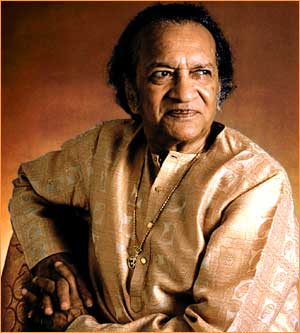
Ravi Shankar
Ragas are extremely difficult to explain in a few words. Though
Indian music is modal in character, ragas should not be mistaken
as modes that one hears in the music of the Middle and Far Eastern
countries, nor be understood to be a scale, melody per se, a composition,
or a key. A raga is a scientific, precise, subtle and aesthetic
melodic form with its own peculiar ascending and descending movement
consisting of either a full seven note octave, or a series of
six or five notes (or a combination of any of these) in a rising
or falling structure called the Arohana and Avarohana. It is the
subtle difference in the order of notes, an omission of a dissonant
note, an emphasis on a particular note, the slide from one note
to another, and the use of microtones together with other subtleties,
that demarcate one raga from the other.
There is a saying in Sanskrit, "Ranjayathi iti Ragah,"
which means, "that which colours the mind is a raga."
For a raga to truly colour the mind of the listener, its effect
must be created not only through the notes and the embellishments,
but also by the presentation of the specific emotion or mood characteristic
of each raga. Thus through rich melodies in our music, every human
emotion, every subtle feeling in man and nature can be musically
expressed and experienced.
The performing arts in India, e.g., music, dance, drama, and poetry,
are based on the concept of Nava Rasa, or the "nine sentiments."
Literally, rasa means "juice" or "extract"
but here in this context, we take it to mean "emotion"
or "sentiment." The acknowledged order of these sentiments
is as follows: Shringara (romantic and erotic); Hasya (humorous);
Karuna (pathetic); Raudra (anger); Veera (heroic); Bhayanaka (fearful);
Vibhatsa (disgustful); Adbhuta (amazement); and Shanta (peaceful).
Each raga is principally dominated by one of these nine rasas,
although the performer can also bring out other emotions in a
less prominent way. The more closely the notes of a raga conform
to the expression of one single idea or emotion, the more overwhelming
the effect of the raga.
In addition to being associated with a particular mood, each raga
is also closely connected to a particular time of day or a season
of the year. The cycle of day and night, as well as the cycle
of the seasons, is analogous to the cycle of life itself. Each
part of the day - such as the time before dawn, noon, late afternoon,
early evening, late night - is associated with a definite sentiment.
The explanation of the time associated with each raga may be found
in the nature of the notes that comprise it, or in historical
anecdotes concerning the raga.
Although there are 72 "melas" or parent scales upon
which ragas are based, Indian music scholars have estimated that,
with all their permutations and combinations, there exist over
6,000 ragas! But a raga is not merely a matter of the ascending
- descending structure. It must have its "chalan" or
certain note patterns characteristic of the raga; its principle
important note (vadi); the second important note (samavadi); and
its main feature known as "jan" (life) or "mukhda"
(face), the cluster of a few notes by which a raga is immediately
recognised.
In terms of aesthetics, a raga is the projection of the artist's
inner spirit, a manifestation of his most profound sentiments
and sensibilities brought forth through tones and melodies. The
musician must breathe life into each raga as he unfolds and expands
it. As much as 90 percent of Indian music may be improvised and
because so very much depends on understanding the spirit and nuances
of the art, the relationship between the artist and his guru is
the keystone of this ancient tradition. From the beginning, the
aspiring musician requires special and individual attention to
bring him to the moment of artistic mastery. The unique aura of
a raga (one might say its "soul") is its spiritual quality
and manner of expression, and this cannot be learned from any
book.
It is only after many long and extensive years of "sadhana"
(dedicated practice and discipline) under the guidance of one's
guru and his blessings, that the artist is empowered to put "prana"
(the breath of life) into a raga. This is accomplished by employing
the secrets imparted by one's teacher such as the use of "shrutis"
(microtones other than the 12 semitones in an octave, Indian music
using smaller intervals than Western music, 22 within an octave);
"gamakas" (special varieties of glissando which connect
one note to the other); and "andolan" (a sway - but
not a vibrato). The result is that each note pulsates with life
and the raga becomes vibrant and incandescent.
Next to be considered are the "talas" or "rhythmic
cycles" of a raga. There is unique intricacy and rhythmic
sophistication in Indian music. There are talas ranging from a
3 beat cycle to 108 beats within a cycle! The most popular talas
are those which have 5, 6, 7, 8, 10, 12, 14, and 16 beats to a
cycle. There are also other cycles such as 9, 11, 13, 15, 17,
and 19 beats, etc., which are only played by outstanding musicians
on rare occasions.
The division in a tala, and the stress on the first beat (called
sum), are the most important rhythmic factors. While there are
talas having the same number of beats, they differ because the
division and accents are not the same. For example, there is a
tala known as "Dhamar" which has 14 beats in the cycle
divided 5+5+4. Another tala, "Ada Chautal" has the same
number of beats, but is divided 2+4+4+4. Still another tala, "Chanchar"
is divided 3+4+3+4.
In vocal music, a drummer will accompany a singer either in slow,
medium, or fast tempo at the start of a song in whatever tala
the singer chooses. He will do the same when he accompanies an
instrumentalist in the gat section of a composition. Like ragas,
talas also have their own characteristics. Some of the older traditional
talas, such as "Chautal" (12 beats) and "Dhamar"
(14 beats) are played on a two-faced drum known as pakhawaj.
This accompaniment is used in the old traditional "Dhrupad-Dhamar"
form of singing and in instrumental performances on the veena,
rabab, surbahar, etc. Today, most vocal and instrumental music
is based on the contemporary form called "khyal" and
is accompanied by the tabla, a two-piece drum.
The improvisatory nature of Indian classical music requires the
artist to take into consideration the setting, time allowed for
his recital, his mood and the feeling he discerns in the audience
before playing. Since Indian music is religious in origin, one
finds the spiritual quality in most of the musician's performances.
The traditional recital begins with the alap section - the stately
and serene exploration of the chosen raga. After this slow, introspective,
heartfelt, sometimes sad beginning, the musician moves on to the
jor. In this part, rhythm enters and is developed. Innumerable
variations on the raga's basic theme are elaborated. There is
no drum accompaniment in either the alap or the jor.
The alap and the jor evolve into the gat, the fixed composition
of the raga. Here the drums enter with the wonderful rhythmic
structure of the gat and its time cycle, the tala. This section
in based on the "Khyal" form. From this moment on, the
gat (which can be anything between 4 and 16 bars of fixed composition)
becomes the vehicle for the musician to return to after his improvisation.
While the artist has complete freedom to improvise, he may do
so only as long as he does not leave the format of the raga and
tala. This freedom within the bounds of artistic discipline comes
only after many years of training and sadhana. This is why one
cannot rightfully compare the improvisation in Indian music with
the improvisation of jazz.
The step-by-step acceleration of the rhythm in the gat finally
culminates in the jhala portion as it becomes more and more playful
and exciting.Sawal jabab, the dazzling and rapid dialogue between
sitar and tabla, has the power to enthrall even the most uninitiated
listener with its thrilling interplay.
Often at the conclusion of a recital, the musician may choose
to play a "thumri' or "dhun." This semi-classical
style is much freer and completely romantic, sensual and erotic.
Indian music is much more appreciated and respected today in the
West. Many composers and musicians have been influenced by our
music. The openness, willingness to learn, and sincere enthusiasm
of Western audiences are a continuing source of inspiration and
delight. --






 .) RECITING FIRST PAURI gives the total knowledge and ecstasy of God. The second half is an antidote to depression. It will lift you from depression, insecurity, nightmares, and loss.
  .) RECITING SECOND PAURI imparts patience and stability.
  .) RECITING THIRD PAURI transforms insufficiency into sufficiency, turns depression into elevation, and transforms low self-esteem into complete self-confidence.
  .) RECITING FOURTH PAURI blesses those trapped in feelings of poverty and lack of means. It blasts through the trap of these feelings like a thunderbolt.
  .) RECITING FIFTH PAURI is for when you feel that you are not up to the job. This Pauri will grant you all success when you feel a sense of failure within yourself.
 .) RECITING SEVENTH PAURI will heal you.
  .) RECITING EIGHTH PAURI gives you the power to be a perfect sage.
  .) RECITING NINTH PAURI gives you expansion.
  .) RECITING TENTH PAURI grants you grace.

 One who chants


 Greetings, Names, and Titles