|
Women's Select Rifle Drill Team
POINTS TO PONDER If you cannot walk together, you Those who shall not learn to obey shall never A woman who is not a leader is a miserable person… The Synergistic Equation: 1 plus 1 equals 11. Preface
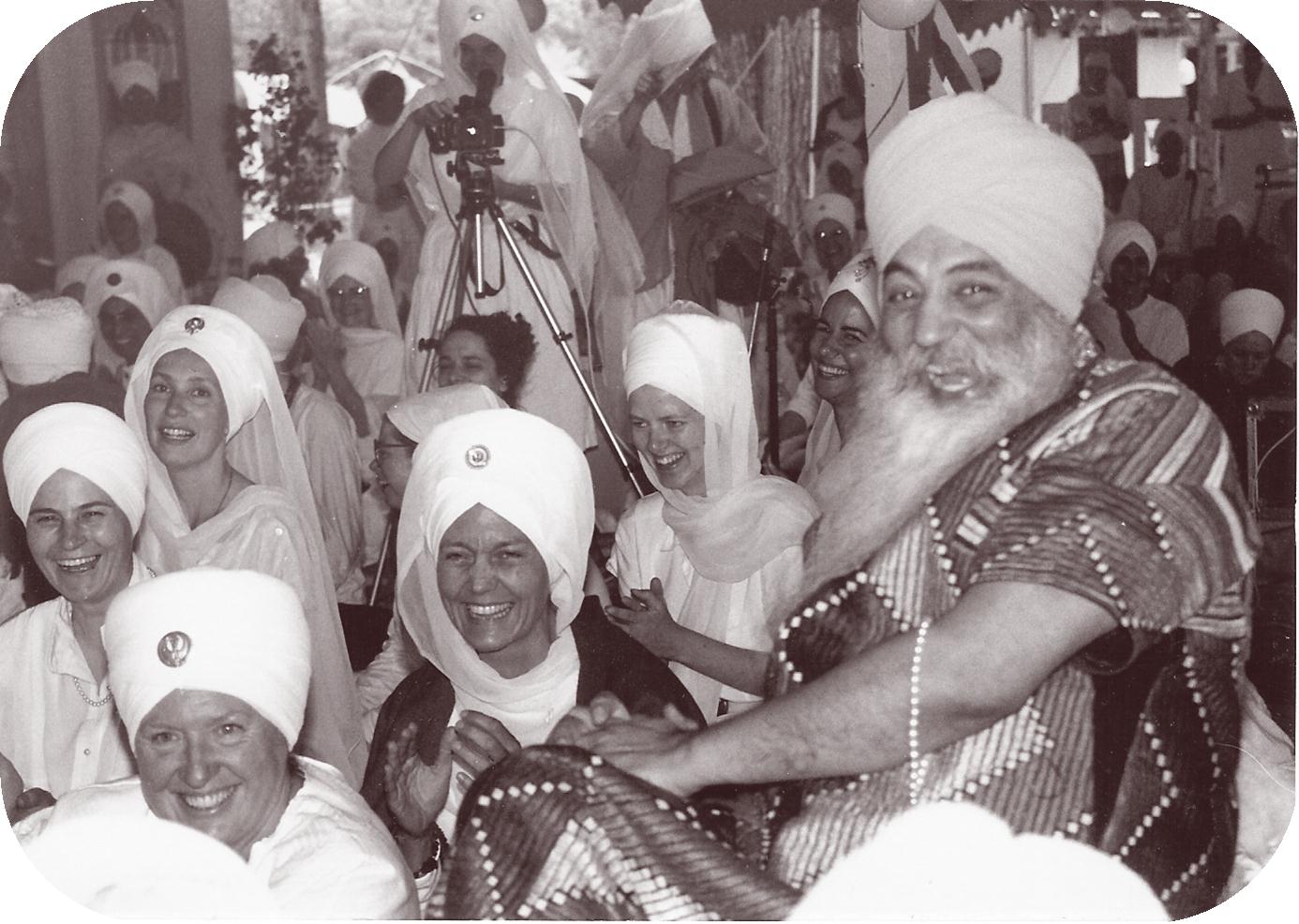
My Transformation I take my place an arm’s length distance from each lady on both sides of me. We are to line up by height and I think I should be before Prem Siri Kaur but her turban is such a smokestack it makes her about an inch taller than me. I am twelve years old. “Eyes, right!” The drillmaster calls. We snap our heads to the right, adjusting ourselves ever so slightly so the only thing I see is my own shoulder and the next person’s body at firm attention. “Attention!” He calls. We snap back, arms down and eyes front. Today we are starting the Select Rifle Drill Team. Only fifteen ladies from the whole camp will work with Hari Singh for hours each day, learning tight maneuvers and fancy steps, how to follow orders on the clip, turn on a dime, and handle those beautiful white parade rifles. Every morning after Sadhana, for the first week of camp, all the ladies march in formation to the call of Hari Singh’s cadence. The Siri Singh Sahib, aka Yogi Bhajan, says we should master this marching ("If you cannot walk together, you cannot work together.") to get our minds disciplined and clear so we can follow orders precisely, without hesitation. Most of the ladies hate it. I hear them groan and moan about the forced marches, sometimes at double time, up Shady Lane and down the dirt road from the ashram, over the dead frogs squashed by the tractor and through clouds of red dust. Yesterday, somebody even fainted while we were all standing in formation. I guess they think it’s hard - either the physical exertion, or the mental focus. It’s clear they don’t like being ordered around, by “that man”, no less. Hari Singh is the only man allowed in camp, other than the Siri Singh Sahib, that is. Maybe that’s why they don’t like it, because they have to take orders from a man during these sacred, women-only weeks.
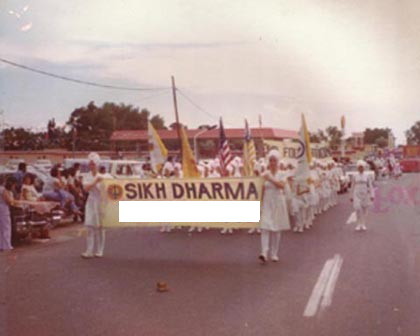
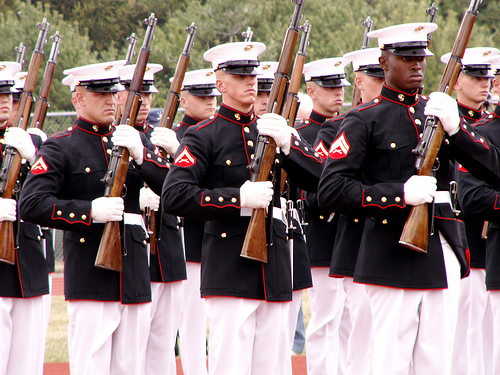
I love it! I’ve finally found something in which I can excel at this camp. I’m good at precision, and I even like the discipline. If I know what I’m supposed to do I have no problem focusing and following through. I’m kind of scared of Hari Singh, but it makes me want to do my best. It feels so great to know that I’m looking good with my Khalsa sisters, so beautiful in our white bana, standing tall like soldier saints. Marching all together, even though we are fifteen, it sounds like just one pair of feet. I even like that it’s hard. I revel that I can do this; that I can push through the heat, the sweat, the exhaustion, and the challenge. I can coordinate the difficult moves, too -- even with the rifles. My favorite is “With a Twirl, Left Shoulder, Right Shoulder, Aarms!" And, "Preessent, Aarms!” It took so many tries for all of us to get that move together but when we did, wow, it felt so great, like we were all part of one intricate machine, a Swiss timepiece, with each part moving exactly together. (See Photos). We knew we looked good. We were proud. (See US Marine Corps Drill Team.) Every day, the Select Rifle Drill Team, those fifteen of us that got to use the parade rifles, worked with Hari Singh for an additional two hours. Usually it is during the morning classes. I don’t mind missing gurmukhi class - I can already sound out the phonetic script. I don’t really get much out of the discussion groups with the other ladies either, they are always talking about how their husband does this, or their husband does that. I don’t have a husband yet, and thank God, won’t for a very long time. So I march. One day, Hari Singh has us marching up and down Shady Lane, even though it was the middle of the day, (not early morning after Sadhana, when there aren’t any cars). He orders me to stand guard, at attention, blocking the road so no cars can come by. The team is marching up and down the street moving to the complicated drill calls. Another lady is stationed at the far rear to block any traffic from the other direction. I am incredibly nervous. “What if a car comes and wants to get through?” I think. “These Espanola people won’t put up with this. We’re blocking traffic. We should get out of the street.” But my commander has given me an order and I have to stay firm. In parade stance, with my feet firmly planted, shoulder width apart I hold the rifle with both hands diagonally across my chest. I look straight ahead, focused on the horizon, down the street towards the intersection with the highway. Soon, a car turns our way. It is a purple low-rider, crawling slowly towards me. I can hear the stereo pumping a low base. I can feel the surprise, incredulity, even hate, seep from the occupants towards me. “Stand your ground!” I hear Hari Singh shout to me. I continue my resolve. I don’t look at the driver, just hold firm to the rifle. It is solid wood, but maybe the driver will think it is real. He blares his horn and yells at me. Will he run me over? Will Hari Singh come over and talk to him or move the ladies out of the way? The honking, the shouting, and my monkey mind keep going. My body is shaking with fear. After what seems like an eternity the purple car backs up, does a quick U-turn and speeds out of there leaving a cloud of dust. I stay at attention and let out a huge exhale of relief and gratitude. Hari Singh calls the team to Halt, and orders me back to the formation. At attention, we all listen as he praises my steadfastness, my focus, and how I caused the gangster-type, low-riders to retreat since they knew they had no chance against a strong Khalsa woman. I feel eleven feet tall. -- See WomenWimpsOrWarriors.com.
WOMEN Are
Those who shall not learn to obey shall never Create dependable
children, not dependent children. Give your children The basic aspect of you as woman is not in your sensuality and in your dramas. Your reliability will give people the courage to trust you. Children are born with intrinsic leadership traits that prepare them for life. OUR YOUTH DESERVE LEADERSHIP TRAINING Sat Nam, Khalsa Ji! I am a passionate proponent of a more equitable balance between our collective Saint-Soldier mind set as Sant Sipahi. In this context I strongly urge Khalsa parents, especially our women, the first teachers of our children, to consider the following points.
New Mexico Military Institute offers an outstanding two year college option for your sons and daughters after they complete their time at Miri Piri Academy. For those families for which MPA is not an option, NMMI has an excellent four year high school college prep program in addition to their two year college program. New Mexico Military Institute has been ranked No. 5 on a list of the nation’s top 50 community colleges by an independent organization, i.e., TheBestSchools.org, which has described the Roswell, New Mexico school as the “only state-supported, coeducational, military boarding school in the United States.” The school offers college prep, a four-year high school and a two-year junior college. See NMMI Strategic Measures Statistics. Each of the former Sikhi students/graduates of NMMI provide a testament to the advantages of attending NMMI, which include a rigorous and challenging lifestyle, camaraderie and fellowship, and outstanding leadership training especially, along with NMMI's excellent scholastic program. This experience prepared them for additional university training, and exciting careers all over the world. NMMI is the only American prep school I know that has a history of accommodating the Sikhi lifestyle, i.e., sadhana, kesh, turban, sipahi training, and vegetarian diet. And it is an excellent environment for Sikhi youth to learn leadership and soldiering skills for which the Siri Singh Sahib was a passionate proponent. The NMMI program offers MPA students and other Sikh youth
a unique and reasonably cost-effective opportunity to transition
from the Indian program into the American experience as a unit, and the obvious advantage of continued
bonding with their peers. See NMMI
Admissions, or click admissions@nmmi.edu, or call 800-421-5376.
Again, our youth deserve leadership training going forward. I know of no readily available source of formal leadership training available to our Sikh youth other than the New Mexico Military Institute. Humbly, Mukhia Singh Sahib Hari Singh Bird Khalsa --
"I want woman to be strong. I am a believer that when a woman falls,
The above article was originally featured at
3HOHistory.com Pages And Points To Ponder
MySikhSense.com Pages And Points To Ponder
3HO Women's Camp
Moments, Memories and Missives See more at 3HOLegacyLinks.com. Memories to share? Register here.
New Mexico Military Institute Drill Team See How The Marines Transform Me Into We The U.S. Marine Corps Silent Drill Team With Rifles
 More Web sites by KhalsaWebMasters.com 
|
|



 From the very first day of training to the final march on the graduation parade deck,





 One of the highest spiritual practices I ever did was Close Order Drill at the Denver ashram. I learned so much about responding over reacting -- about authority over disrespect -- about the other over the self. Thank you,



 .) I urge you to consider enrolling our children at the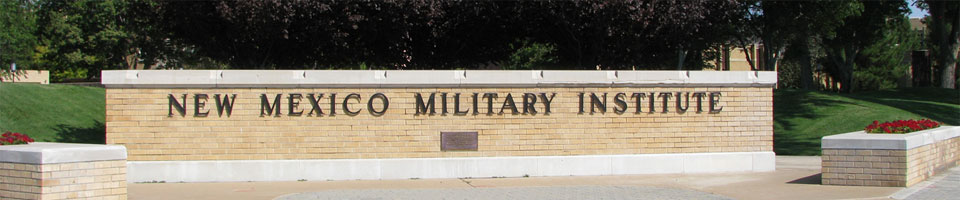

 .) I urge you to support a resurgence of the
  .) I urge you to reflect on the Siri Singh Sahib's words, "Human
is a blend of Saint and Soldier (
.) I urge you to reflect on the Siri Singh Sahib's words, "Human
is a blend of Saint and Soldier (