AMBLYOPIA,
LAZY EYE: A condition that affects just two to three
percent of the population. But, if left uncorrected,
this vision problem can have a very big impact on those
affected. Central vision fails to develop properly,
usually in one eye, which is called amblyopic. A related
condition, strabismus, sometimes causes amblyopia.
Untreated amblyopia may lead to functional blindness
in the affected eye. Although the amblyopic eye has
the capability to see, the brain "turns off"
this eye because vision is very blurred, and the brain
elects to see only with the stronger eye.
Amblyopic
or 'Lazy' Eye
Clearer vision occurs in the eye with normal sight
Blurry vision occurs in the lazy eye, even with glasses
Signs
and Symptoms
Amblyopia
generally develops in young children, before age six,
and symptoms often are noted by parents, caregivers
or health-care professionals. These symptoms include:
Eyestrain Overall
poor visual acuity Squinting
or completely closing one eye to see Headaches
Causes
Trauma
to the eye at any age can cause amblyopia, as well as
a strong uncorrected refractive error (nearsightedness
or farsightedness) or strabismus. It's important to
correct amblyopia as early as possible, before the brain
learns to entirely ignore vision in the affected eye.
Treatment
Amblyopic
children can be treated with vision therapy (which often
includes patching one eye), atropine eye drops, the
correct prescription for Nearsightedness or Farsightedness,
or surgery.
Vision therapy exercises the eyes and helps both eyes
work as a team. Vision therapy for someone with amblyopia
forces the brain to see through the amblyopic eye, thus
restoring vision.
Sometimes the eye doctor or vision therapist will place
a patch over the stronger eye to force the weaker eye
to learn to see. Patching may be required for several
hours each day or even all day long and may continue
for weeks or months. If you have a lot of trouble with
your child taking the patch off, you might consider
a prosthetic contact lens that is specially designed
to block vision in one eye but is colored to closely
match the other eye.
In
some children, atropine eye drops have been used to
treat amblyopia instead of an eye patch. One drop is
placed in your child's good eye each day (your eye doctor
will instruct you). Atropine blurs vision in the good
eye, which forces your child to use the eye with amblyopia
more, to strengthen it. One advantage is that it doesn't
require your constant vigilance to make sure your child
wears the patch.
Recently a study compared atropine therapy with patching
in 419 children age 3 to almost 7 and found it an effective
alternative. As a result, some previously skeptical
Eye Care Professionals are using atropine as their first
choice over patching.
Patched
Eye
Anissa's
Fun Patches
Innovative amblyopia patches help children comply with
their amblyopia treatment.
You can help your child accept patching more readily. Anissa's
Fun Patches, for instance, require no adhesive because
they slide onto the temple of an eyeglass frame.
However, atropine does have side effects that should
be considered: light sensitivity (because the eye is
constantly dilated), flushing and possible paralysis
of the ciliary muscle after long-term atropine use,
which could affect the eye's accommodation, or ability
to change focus.
If your child has become amblyopic due to a strong uncorrected
refractive error or a large difference between the refractive
errors of both eyes, amblyopia can be treated with eyeglasses
or contact lenses in the correct prescription. Your ECP, Eye Care
Professional, may prescribe an eye patch along with
the new glasses or contact lenses.
Surgery is best for amblyopic children with an underlying
physical problem, such as strabismus.
The surgery corrects the muscle problem that causes
strabismus so the eyes can focus together and see properly.
ASTIGMATISM:
A blurred vision condition produced by a football-shaped
cornea, which is too steep in one meridian and too flat
in another. An astigmatic cornea focuses light in two
different places in the eye, adversely affecting both
near and distance vision. See CYLINDER below.
Astigmatism
Objects appear blurry at all distances
BEFORE
Corrected VisionAFTER
Corrected Vision
AXIS:
An expression in the form of numbers that corresponds
to the orientation of the cylinder power of an ophthalmic
lens in terms of degrees from 0 to180.
BRIDGE:
That part of the frame front that connects the eyewires
and holds the frame in place at the nose.
BRIDGE
TYPES: KEYHOLE BRIDGE: A type of bridge that fits only
on the sides, and does not touch the top. Resembles
a keyhole. SADDLE BRIDGE is a type of bridge that sits
uniformly over the nasal crest.
CATARACT:
A clouding of the lens of the eye. More in depth cataract
data, here.
CYLINDER:
An expression in the form of numbers indicating the
amount of astigmatism correction in an ophthalmic lens. See ASTIGMATISM above.
Left
image, spherical lens with no cylinder.
Vertical and horizontal meridians are equal.
Right, lens with cylinder to correct astigmatism.
Vertical and horizontal meridians are unequal.
DBL:
The Distance Between Lenses, i.e., the least distance
between the two mounted lenses, or the frame's bridge
size.
DIOPTER:
A measurement of an ophthalmic lens refractive power
equal to the reciprocal of the focal length of a lens
in terms of meters, e.g., a 2.00 Diopter lens will bring
parallel rays of light to a focus at a half meter, i.e.,
.50 meters. Also, the measurement of the degree to which
light converges (a plus Diopter, +2.00D, lens will correct farsighted
vision), or the degree to which light diverges (a
minus Diopter, -2.00D, lens will correct nearsighted
vision).
"It
is how well the eyewear makes contact with the
Patient that ultimately defines Ophthalmic Dispensing."
DISPENSING
OPTICIAN, LICENSED DISPENSING OPTICIAN or REGISTERED DISPENSING OPTICIAN, LDO or RDO (depending on the State's designation): EYE CARE PROFESSIONAL, ECP, herein defined as a Board
Certified and-or State Licensed Eye Care Practitioner
who specializes in the design of prescription eyewear,
i.e., lenses, frames and contact lenses, which includes
the duplicating, measuring, inspecting, and verifying
of prescription lenses, and any subsequent frame Alignment and other Adjustments,
which includes the Final
Fitting, whereby the Patient's visual comfort,
the long term comfort and wearability of their eyewear
is the primary objective. Watch 'What Is An Optician'.
NOTE: An expanded definition as defined by the U.S. Dept.
of Labor, Bureau of Labor Statistics: "Designs,
measures, fits, and adapts lenses and frames according
to a written optical prescription or specifications;
assists with selecting frames; measures for size of
eyeglasses and coordinates frames with facial and eye
measurements and optical prescriptions; prepares a work
order for an optical laboratory containing instructions
for grinding and mounting lenses in an ophthalmic frame;
verifies exactness of finished lenses; adjusts frame
and lens positions to fit the wearer; shapes or reshapes
frames. Includes contact lens Opticians." See alsoOpticiansForChange.com.
"When's
the last time you saw or heard a retail optical
ad that promoted the custom fitting of eyewear?"
Opticians are Eyewear Professionals. Opticianry
is ultimately defined by how well the eyewear makes
contact with the Patient, not by the number of Customers served.
For the truly skilled Optician, the standard of care must
include a
customized design and handcrafted fitting of eyewear on each
Patient.
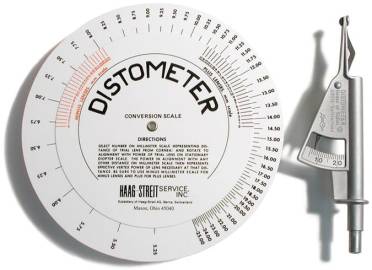
DISTOMETER:
A device used for measuring Vertex
Distance. When an eyeglass prescription reaches
a certain strength, the vertex distance between the
eyes and the Patient's eyeglasses must match the vertex
distance between the Patient's eyes and the
Phoropter, i.e., the instrument used during the
comprehensive eye examination to determine refractive
error, at the time of the Doctor's refraction. Patients
can experience problems with an Rx of about 6
Diopters of power, give or take. A 1mm difference
between the working distance of the Phoropter at the
time of their exam and the fitting distance of their
corrective lenses can cause significant refractive error
relative to the Patient. Therefore it is important to
match the vertex distance between that of the Phoropter
and their glasses, or modify the optics in order to
accommodate the actual fitting distance of the eyeglasses.
The Distometer is an instrument used for measuring and
calculating this compensation.
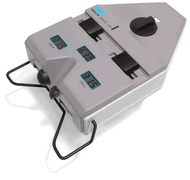
Conversion
Scale and Distometer
The
Distometer measures the vertex distance and compensates
for the average eyelid thickness. The Patient closes
their eyes in a relaxed fashion with the eyeglasses
in position while the Optician places the flat end on
the Patient’s eyelid directly behind the lens.
As the elongated button at bottom of photo above is
pushed the Distometer arm moves from its resting position.
As it lightly touches the back of the lens, the Optician
observes the reading. The rotating chart above is designed
to calculate the correct Rx compensation. From here,
the Optician can adjust the frame and fit the glasses
at that same distance or determine the necessary changes
to be made in the Rx. Note: The further away the lenses
are positioned from the cornea, the smaller the field
of view.
ECP or EYE CARE PROFESSIONAL: Any Health Care Professional
who specializes in a) the medical examination or treatment
of eye disease or injury; b) refracts the eye for the
purpose of correcting vision error; c) designs prescription
eyewear, i.e., lenses, frames and contact lenses, which
includes the duplicating, measuring, inspecting, and
verifying of lenses, and any subsequent dispensing or
delivery, including Alignment and other Adjustments,
which includes the Final
Fitting of prescription and safety eyewear, and
contact lenses. NOTE: The Florida
Board of Opticianry is an entity within the Florida
Department of Health, which has jurisdiction over
Florida Eye Care Professionals. Also seeDISPENSING
OPTICIAN, LDO and see Letter to Eye Care Professionals.
EYEWEAR:
A medical prosthesis, i.e., an ophthalmic device which
acts as a vision aid and-or eye protection for a dysfunctional
or otherwise at-risk system of sight, inclusive of both
eyeglasses and contact lenses. For the purposes of the Hands-on Frame Fitting
Course, the word EYEWEAR refers to any streetwear, sunwear, safety, athletic,
or other occupational or avocational prosthesis, utilizing
corrective or plano lenses, which are worn in combination
with an ophthalmic frame.
EYEWIRE:
That portion of the eyeglass frame front into which
the lenses are inserted or mounted and which is connected
to its opposite by the bridge.
EYE
DISEASES - CATARACTS, DIABETES, GLAUCOMA
CATARACTS:
The natural lens in the eye gradually becomes less clear
as we get older. When opacities develop in the lens
and the lens gets too hazy, vision will be impaired.
When the cataract affects the vision to the extent that
one cannot read or see distant objects comfortably,
cataract surgery may be required.
DIABETES:
Diabetic Patients should have a dilated retinal examination
each year. Laser treatments have proven to slow the
progression of retinal eye disease for many Patients.
Diabetes often stimulates the growth of new blood vessels
in the back of the eye, which ultimately leak and damage
the retina. If this condition is discovered early, laser
treatment can destroy these vessels.
GLAUCOMA:
Glaucoma gradually destroys the optic nerve tissue in
the back of the eye. The greatest danger of glaucoma
stems from the fact that the disease is painless and
without obvious symptoms until significant damage has
occurred. The most common cause is from pressure being
too high inside the eye, but vascular disease and other
diseases can also cause glaucoma. A full eye exam includes
checking the pressure of the eye, screening for peripheral
vision defects and analyzing the appearance of the optic
nerve. If you are diagnosed with glaucoma, your eye
care professional may prescribe medications that lower
the eye pressure. Most forms of glaucoma are successfully
treated with eye drops. Laser treatments and eye surgery
are secondary treatments that offer alternative ways
to treat more advanced glaucoma.
FRAME:
That portion of a pair of eyeglasses that is designed
to hold the lenses in the proper position before the
eyes.
Hands on the Patient
Frame Fitting is an
artful handcraft, which is fast disappearing.
HANDS-ON DISPENSING AND DELIVERY: Herein defined as those procedures, which involve eyewear adjustments
performed by a skilled Dispensing Optician, which specifically
include, a) the
visual and 'touch and feel,' hands on the Patient, tactile
assessment of the frame, while it is in-place, on the face
of the Patient, in order to determine any misalignment,
and b) any subsequent multi-dimensional hands on the Patient,
tactile, artful 'touch and feel' handcrafting that is
required to refit, align, adjust, reshape, bend, stretch,
twist and sculpt the components of the frame in order
to personalize the eyewear for maximum visual comfort
and wearability. See example.
SPECIAL NOTE: This level of craftsmanship can be accomplished
only after a visual as well as a tactile, i.e., touch
and feel, assessment of the frame, in-place, on the
Patient, and requires the removal and re-placement of
the eyewear directly on the Patient, BY THE OPTICIAN,
as many times as necessary to complete the procedure.
(Unfortunately, many of today's Dispensers make no contact
with either the Patient or their eyewear while in place,
on-the-face, whereby it is impossible to make a significant
assessment or subsequent multi-dimensional adjustments
to the frame. This practice is akin to a Dentist making
no direct contact with a Patient while attempting fit
dentures. Sadly, latter generation Dispensers give little
or no attention to fitting a new frame after it arrives
from the lab, presumably four-point inspected on a flat
surface by the lab technicians. Just as in the case
of fitting a set of dentures, a frame must ultimately
be custom fitted to the variable dimensions of the Patient,
not the one-dimensional surface of a flat table. The
lab only zeroes-out any frame misalignment in lieu of
anticipated adjustments by the Optician.)
Hands-on
frame fitting requires direct contact
between the Optician and the Patient.
Furthermore, a properly executed hands-on, in-place,
on-the-face assessment, and frame fitting procedure
requires not only appropriate communications between
the Dispenser and the Patient, but some direct physical
contact must occur as well. A proper hands-on fitting
involves the repeated removal and re-placement of the
frame on and off the Patient by the Dispenser until
such time as the fitting is completed, which depends
of course on the experience of the Dispenser, any asymmetric
features of the Patient, and the type and design of
the eyewear. See example. The Dispenser cannot rush the procedure.
Much time is actually saved in the long run when the
fitting is done with sensitivity and patience whereby
Patient return visits are minimized.
HEALER: One who contributes to making a person whole.
HEALING ARTS: Those skillful practices, which contribute
to the health and wellness of those to whom they are
applied. See also Ophthalmic Health and Wellness.
HEALTH CARE PRACTITIONER: Any professional individual
or organization, which provides health and wellness
products and services to the public. NOTE: The Florida
Board of Opticianry is an entity within the Florida
Department of Health, which has jurisdiction over
Florida Health Care Practitioners.
HYPEROPIA: Another word for FARSIGHTEDNESS, which is
a common vision problem, affecting about a fourth of
the population. People with hyperopia can see distant
objects very well, but have difficulty focusing on objects
that are up close. Farsightedness can be corrected with
glasses or contact lenses to change the way light rays
bend into the eyes. If your glasses or contact lens
prescription begins with plus numbers, like +2.50, you
are farsighted. You may need to wear your glasses or
contacts all the time or only when reading, working
on a computer or doing other close-up work.
Hyperopia
or Farsightedness
Near objects appear blurry, far objects appear clear
BEFORE
Corrected VisionAFTER
Corrected Vision
IN-DEPTH LIFESTYLE INTERVIEW: Each Patient needs to undergo an adequate lifestyle interview in order to establish their primary and secondary needs whether they be for work or play. Many times their vision needs require multiple pairs of eyewear. Therefore the interview must include the appropriate amount of time and dialogue for the Optician to discover the true needs of the Patient. (Note: This interview must take place absent bias on the part of the interviewer with regard to profit incentives in order to be successful.) The absence of this interview is a primary reason for unhappy Patients to return for remakes or to request refunds. Here's an example. Many times Refractionists, Many times Refractionists, i.e., Optometrists and Ophthalmologists, will make an entry on their prescriptions
such as "No-line Bifocals" or "Progressive
Lenses," both of which refer to a Progressive Addition
Lens or PAL. Too many times this is a subjective entry on their part, which
is made in the absence of any discussion with the Patient, and minus any explanation to the Patient as to why a Progressive
Lens is better, or how the lens works, or what other options
are available. Of course, these points are better left
to the Optician to give more complete coverage during an in-depth lifestyle interview, but which too often never occurs. See
video.
LASIK SURGERY or LASER VISION CORRECTION: A medical
procedure in which a flap is surgically cut in the cornea
and gently folded back. An Excimer Laser is used to
reshape the cornea into a flatter shape (this is reminiscent
of a contact lens that corrects vision by forming a
new shape on the cornea). The flap is then put back
in place, acting like a natural bandage. The healing
process is quick and the discomfort level is quite low.
Following the procedure Patients will often say that
they did not feel anything, and could see well the very
first day. Most people have improved vision in 24-48
hours but it must be noted that each person will heal
at a different rate. Vision, although greatly improved
immediately after surgery, often continues to improve
for some weeks, even months.
LASIK is not for everyone. People's eyes are different
and it may not be the best course of treatment for you.
Consult your eye care professional.
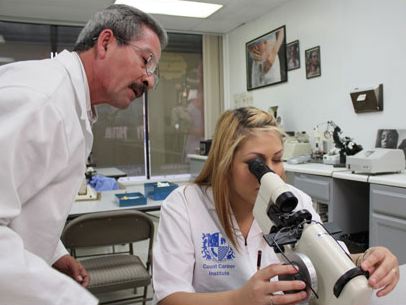
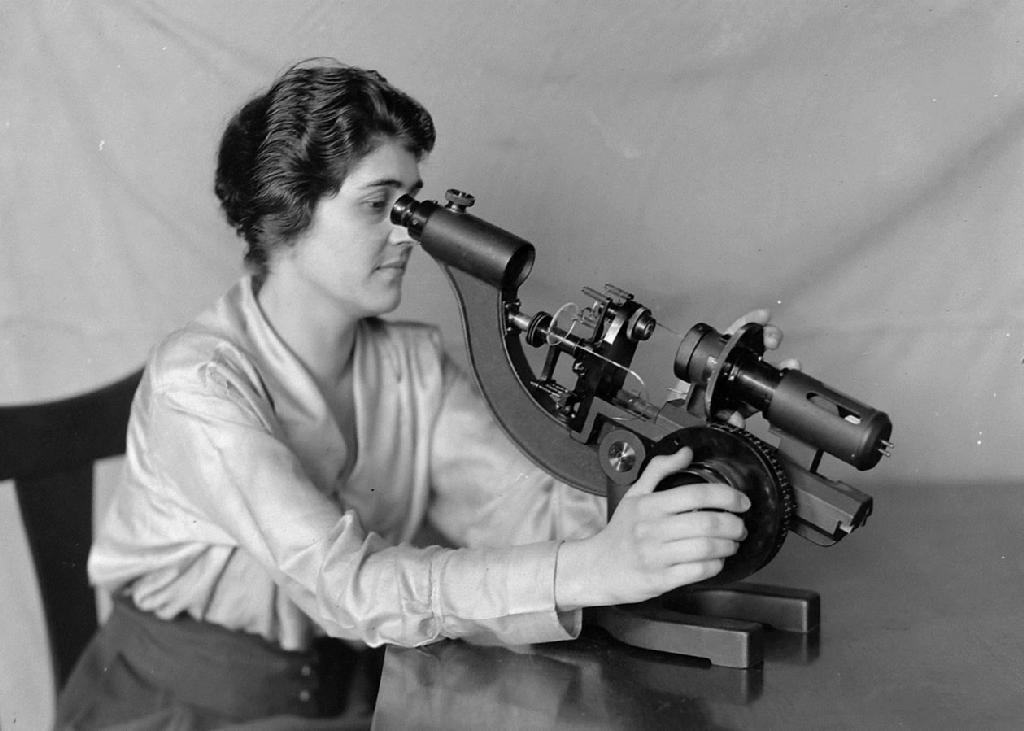
LENSMETER,
Lensometer or Vertometer, is the instrument used to
read the dioptric power of an ophthalmic lens and to
locate the optical center of the lens. See alsoUsing
a Lensmeter.
Optician using a Lensmeter
Estelle Glancy, inventor of first Lensometer
MASTOID:
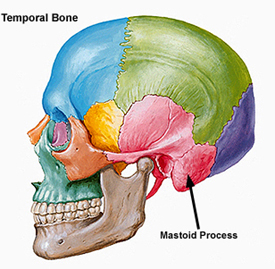
A protruding bony area in the lower part of the skull that is located behind the ear in humans and many other vertebrates and serves as a site of muscle attachment. The mastoid process contains small air-filled cavities called mastoid cells that communicate with the middle ear. This area is not uniformly flat on the majority of human skulls. On the contrary, the mastoid has a somewhat wave-like topographical variance that can range from subtle to severe, which requires that handcrafted form-fitting procedures be applied to the temple-ends in order to hold the eyewear in place and thereby afford long-term wearability. The mastoid area is not so sensitive to touch but is sensitive to pressure for most patients.
NOTE: Contrary to popular opinion and practice, full contact
with a LIGHT TOUCH OF THE SKULL, NOT THE EARS, is the primary means by which the frame should be held in place for long-term comfort and wearability. The ears should NOT be used as the main reference in order to stabilize or hold the eyewear in place. Ears act only as a 'stop'. It is the uniformcontact of the frame temples with the mastoid area, with no pressure, that provides the greatest degree of stability and comfort.
The mastoid process
MYOPIA:
Another word for NEARSIGHTEDNESS, which is a vision
problem experienced by up to about one-third of the
population. Nearsighted people have difficulty reading
highway signs and seeing other objects at a distance,
but can see for up-close tasks such as reading or sewing.
Nearsighted people often have headaches or eye strain
and might squint or feel fatigued when driving or playing
sports. If you experience these symptoms while wearing
your glasses or contact lenses, a comprehensive eye
exam as well as a new prescription may be needed. Myopia
occurs when the eyeball is slightly longer than usual
from front to back. This causes light rays to focus
at a point in front of the retina, rather than directly
on its surface. Nearsightedness runs in families and
usually appears in childhood. This vision problem may
stabilize at a certain point, although sometimes it
worsens with age. This is known as myopic creep. Nearsightedness
may be corrected with glasses, contact lenses or eye
surgery.
Myopia
or Nearsightedness
Distant objects appear blurry, near objects appear clear
BEFORE
Corrected VisionAFTER
Corrected Vision
OPHTHALMIC: An expression which means anything that
pertains to the eye or is situated near the eye.
OPHTHALMIC DISPENSER:
Any Eye Care Professional,
ECP, who specializes in the design of prescription
eyewear, i.e., lenses, frames and contact lenses, which
includes the duplicating, measuring, inspecting, and
verifying of lenses, and any subsequent delivery, Alignment and other Adjustments,
including the Final
Fitting of the eyewear. See alsoDISPENSING
OPTICIAN, LDO.
"It
is how well the eyewear makes contact with the
Patient that ultimately defines Ophthalmic Dispensing."
OPHTHALMIC
DISPENSING: As herein defined is those
frame adjustments performed by a qualified ECP, Eye
Care Professional, usually an Optician, which includes,
a) the fullest discovery and maximum consideration of
the Patient's visual needs, b) the assistance and advice
to the Patient regarding the appropriate choice of lens
design and frame selection, c) the duplicating, measuring,
inspecting, and verifying of lenses, and d) any subsequent Gross Frame Alignment and Subtle Frame
Adjustments, including the Final
Fitting.
OPHTHALMIC HEALTH AND WELLNESS: As herein defined is
that state of well-being wherein a Patient's visual
health and comfort is supported, and the long term wearability
of their eyewear is provided and maintained.
OPHTHALMIC PATIENT: As herein defined is one who needs
or receives health related services having to do with
their vision and-or eyewear.
ECPs, Eye
Care Professionals
THE THREE Os Ophthalmologist,
Optician, and Optometrist
OPHTHALMOLOGIST
.) OPHTHALMOLOGIST,
MD or DO: EYE CARE PROFESSIONAL, ECP, who is a State Licensed-Board
Certified Health
Care Practitioner who specializes in
the diagnostic, surgical, and other medical treatments
as well as the refraction of the eye in order to determine
any refractive visual error and the means by which the
error can be corrected. An Ophthalmologist is a Physician,
i.e., a Doctor of Medicine or Doctor of Osteopathy, who specializes
in the comprehensive care of the eyes and visual system
in the prevention of eye disease and injury. An Ophthalmologist
must complete four or more years of college level premedical
education, four or more years of medical school, one
year of internship, and three or more years of specialized
medical and surgical training and experience in eye
care. An Ophthalmologists is a Physician who is qualified
by lengthy medical education, training and experience
to diagnose, treat and manage all eye and visual system
problems, and is licensed by a state regulatory board
to practice medicine and surgery. The Ophthalmologist
is a medically trained specialist who can deliver total
eye care: primary, secondary and tertiary care services,
i.e., vision services, contact lenses, eye examinations,
medical eye care and surgical eye care, and diagnose
general diseases of the body. The steps taken by Ophthalmologists to treat a patient`s eye are the following:
1) Take a good history and listen to the patient and don`t miss or dismiss any complaint.
2) Ask about systemic diseases that may affect the eye as diabetes and hypertension and about drugs the patient regularly takes.
3) Ask if the condition is recurrent or this was the first time and if recurrent, what previous medications were taken.
4) After a good history you are supposed to have reached the diagnosis or a differential diagnosis that is to be confirmed with examination.
5) Do full ophthalmological examination including fundus and IOP (Intra Ocular Pressure) measurement.
6) If needed supplement the examination with one or two investigations specific to confirm the diagnosis or give clues for treatment or prognosis.
7) Explain for the patient his or her case fully including prognosis.
8) Explain the treatment given and how to apply it and its importance and the consequences of discontinuing the treatment without doctor`s order.
9) Give the patient dates for follow up and explain the danger of not coming in for the specified appointment times.
10) Let there be a way for the him or her to communicate with you if any problems or complaints occurred before the next follow up visit.
11) Finally and most important be kind to the patient and give him or her adequate time during the examination and if their case is out of your capabilities to treat or of another subspecialty, refer them to whomever can give them better service.
OPTICIAN
.) OPTICIAN,
i.e., LICENSED DISPENSING OPTICIAN, LDO, or REGISTERED DISPENSING OPTICIAN, RDO, depending on the State's designation, EYE CARE PROFESSIONAL, ECP, who is a State Licensed-Board
CertifiedHealth
Care Practitioner who is qualified
to fit, adapt, and dispense eyewear, i.e., eyeglasses and contact lenses
or other optical devices, based on the written prescription
of a licensed Physician or Optometrist, or to duplicate
same. Depending on the State, an Optician's education
may consist of at least (2) two years of study in Opticianry
science at an accredited college of ophthalmic dispensing
or a state approved apprenticeship program. Florida
and Arizona require American
Board of Opticianry and National
Contact Lens Examiners certification, in addition.
(Some states require only national certification.)
In addition, an Optician must pass a State Board examination.
In order to maintain licensure, an Optician must fulfill
approved Continuing Education requirements. (NOTE: A
Dispensing Optician is related to the health care industry
just as a Registered Pharmacist is related to the health
care industry. Both fulfill the prescription needs of
their respective Patients.) See alsoDISPENSING
OPTICIAN.
Optometrist
OPTOMETRIST
.) OPTOMETRIST,
OD: EYE CARE PROFESSIONAL, ECP, who is a State Licensed-Board Certified Health
Care Practitioner who specializes in the refraction
of the eye in order to determine any refractive visual
error and the means by which the error can be corrected.
Optometrists are primary Eye Care Professionals for
the eye who are trained and state licensed to provide
primary eye care services. These services include comprehensive
eye health and vision examinations; diagnosis and treatment
of eye diseases and vision disorders; the detection
of general health problems; the prescribing of glasses,
contact lenses, low vision rehabilitation, vision therapy
and medications; the performing of certain surgical
procedures; and the counseling of Patients regarding
their surgical alternatives and vision needs as related
to their occupations, avocations and lifestyle. The
Optometrist will have completed pre-professional undergraduate
education in a college or university, and four years
of professional education at a College of Optometry,
leading to a Doctor of Optometry, OD, degree. Optometrists
must complete a residency under the laws of some states.
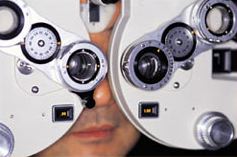
Phoropter
Most
Refractionists use a Phoropter to
determine corrective lenses for the Patient.
PHOROPTER:
The instrument that contains multiple lenses for use
by a Refractionist, i.e., Optometrist,
OD, Ophthalmologist,
MD, or Osteopathic Physician, DO, during a comprehensive eye examination to determine
any refractive error. Any prescription for eyeglasses
or contact lenses is determined mostly with this instrument.
In some cases a digital Auto-Refractor is used, but
it is not nearly as accurate as the manually operated
Phoropter.
PRESBYOPIA:
A term used to describe a condition whereby a person
needs vision assistance by way of READING GLASSES and-or
BIFOCALS or TRIFOCALS. During middle age, usually beginning
in the 40s, people experience blurred vision at near
points, such as when reading, sewing or working at the
computer. There's no getting around it -- this happens
to everyone at some point in life, even those who have
never had a vision problem before. Currently an estimated
90 million people in the United States either have presbyopia
or will develop it by 2014. This is generating a huge
demand for eyewear, contact lenses, and surgery that
can help presbyopes deal with their failing near vision.
Presbyopia
Objects appear blurry at near and intermediate distances
BEFORE
Corrected VisionAFTER
Corrected Vision
BEFORE
Corrected VisionAFTER
Corrected Vision
When
people develop presbyopia, they find they need to hold
books, magazines, newspapers, menus and other reading
materials at arm's length in order to focus properly.
When they perform near work, such as embroidery or handwriting,
they may have headaches or eyestrain or feel fatigued.
Presbyopia is caused by an age-related process. This
is different from astigmatism, nearsightedness and farsightedness,
which are related to the shape of the eyeball and caused
by genetic factors, disease or trauma. Presbyopia is
generally believed to stem from a gradual loss of flexibility
in the natural lens inside your eye.
These age-related changes occur within the proteins
in the lens, making the lens harder and less elastic
with the years. Age-related changes also take place
in the muscle fibers surrounding the lens. With less
elasticity, the eye has a harder time focusing up close.
Other, less popular theories exist as well.
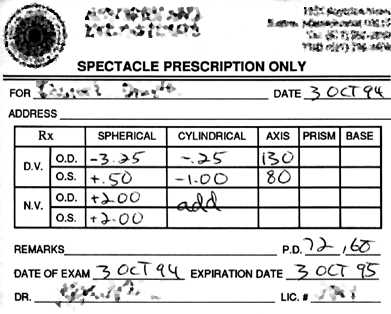
PRESCRIPTION:
The document, which expresses the lens powers and other
pertinent details, and is signed by the attending Refractionist,
i.e., Optometrist, OD, Ophthalmologist, MD, or Osteopathic
Physician, DO.
PRISM:
An element added to the prescription if the Patient's
eyes need help working more effectively together, and-or
to remain in proper alignment.
Eyeglass
Rx
Eye
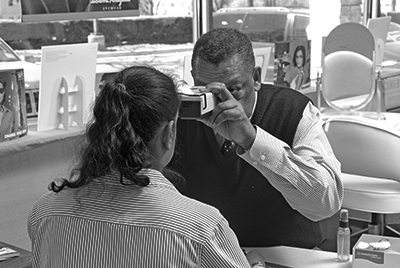
Care Professional using a Pupillometer*
The
Pupillometer measures the distance between
pupils via the light reflected from the corneal surfaces.
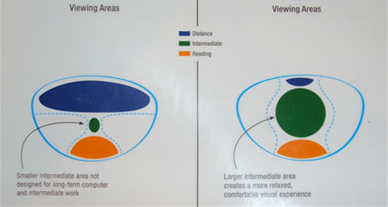
PROGRESSIVE ADDITION LENS (PAL):
A multifocal lens whose corrective powers change progressively throughout the lens. Each area of correction is blended invisibly to the next, so these lenses do not have the lines typically associated with bifocals or trifocals and afford the most “natural” vision at all distances: near,
far, and intermediate.
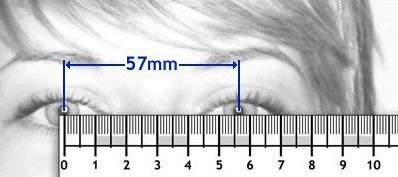
PUPILLARY
DISTANCE or PD: The measurement in millimeters of the
distance between the eyes for distance vision, far PD,
and for reading, near PD. This measurement is used to
determine placement of the optical centers of the lenses
in the Patient's eyewear. For more accuracy, this measurement is taken using a specialized instrument called a *Pupillometer (see photo above), which measures the distance between the light reflected from the surface of the cornea. Using a pupillometer produces a much more precise measurement, which is particularly important in designing progressive addition lenses, PALs and for lenses of significant spherical and-or cylindrical power ranges. NOTE: There can be a significant variable in the distance between one corneal apex reflection to the center of the nose and the other, which means that the optical centers of the lenses will be placed asymmetrically in the final design of the lenses in order to accommodate this disparity. SeeFacial Asymmetry.
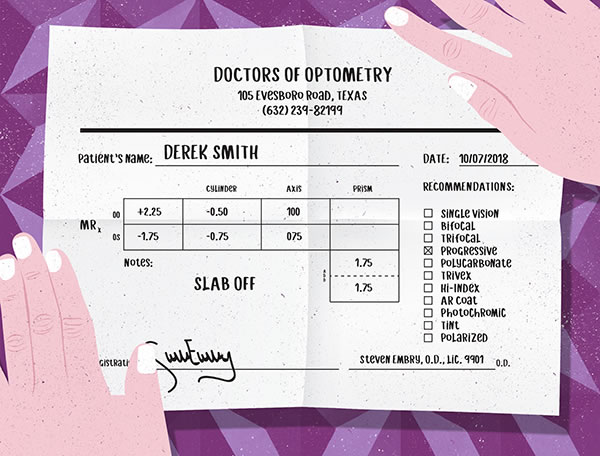
RX: This is an abbreviation of the word, PRESCRIPTION, that refers
to the document, which expresses the lens powers and
other pertinent details, and is signed by the attending
Refractionist, i.e., Optometrist, OD, or Ophthalmologist,
MD, or Osteopathic Physician, DO.
SLAB OFF: Also known as bicentric grinding. Bicentric grinding is a type of lens fabrication process in which base-up prism is ground on the lower portion of the lens to redirect light as a patient gazes downward. This technique allows the patient to fuse the images and prevent prism as the eye travels down the vertical meridian of the lens. The term slab-off came about because the technique makes the finished lens look as if someone removed a small section of the bottom portion. Of all the ways to correct vertical imbalance, slab-off is by far the most common technique used. BTW: There are six methods of correcting this imbalance: Two pairs of glasses, i.e., one for reading and another for distance; dis-similar segments; r-compensated segments; Fresnel press-on prisms; prism segments; and of course, slab-off. See How To Calculate Slab Off Prism. See Slab Off Calculator.
SPRING
HINGE: A type of hinge on eyeglass frames that flexes,
making the frames more durable. Spring hinges also help
keep the eyewear in proper alignment and help reduce
the need for some adjustments.
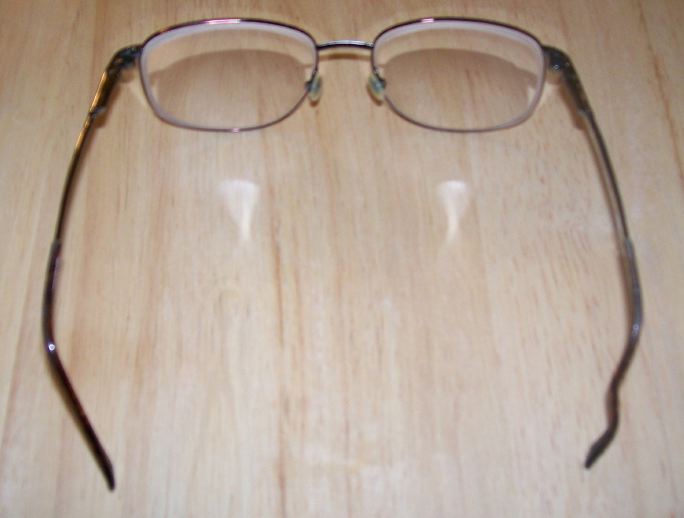
TEMPLES:
Generally defined as the hinged extensions on each side
of the frame front, which when the frame is worn, extend
along each side of the head, and in most styles, bend
down behind the ears. Temples are made to be reshaped
to follow the contours of the skull (see
example) and avoid direct contact with ears, while
resting evenly against the skull with minimum pressure,
whereby they act to hold the eyewear comfortably in
place. See alsoVariations
on Styles of Temples.
TEMPLE-END:
That part of the temple that extends down behind the
ear and makes direct contact with the mastoid portion
of the skull. The temple-end is designed to be reshaped
to follow the contours of the skull whereby it acts
to stabilize and hold the eyewear in place for long term
comfort and wearability. The temple-ends, with all
gaps and space removed, and making full contact with
the skull, NOT THE EARS, are the primary means of holding
the eyewear in place.
Form-fitting the
Mastoid Complex
With a Handcrafted Mastoid Dip and Wrap
Every
Patient deserves a sufficiently handcrafted,
multi-dimensional, form-fitting frame adjustment, e.g.,
gaps and spaces are removed from between the frame's
temples and the skull behind the ears, in order to enhance
comfort, stability, and long term wearability. Full contact
with
a light touch of the skull, NOT THE EARS, is the primary means
by which the frame should be held in place for long-term comfort.
BEFORE temple-end is in out-of-the-box condition,
i.e., it doesn't make contact with the Patient's
skull,
whereas the AFTER temple has been form-fitted with
an added handcrafted mastoid dip and mastoid wrap.
It now fits the mastoid bone like a glove since it has
been
shaped to make full, direct contact with this Patient's
skull.
The customized temple-ends become invisible when worn
and the
resultant fit avoids pressure and is extremely comfortable. Note: This skill cannot be learned virtually, i.e., via lecture or online.
This skill is acquired only by handcrafting the eyewear using direct, face
to face, on the Patient, tactile, touch and feel contact with the Patient. The
availability, knowledge and skilled use of related handcrafting tools is essential. Also, keep in mind that online merchants are incapable of providing this service.
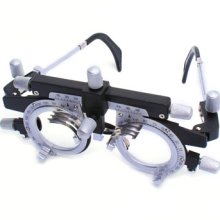
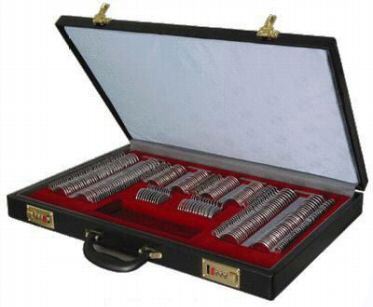
TRIAL
FRAME AND LENSES: The Trial Frame and Lens Set is an
important aid to the Optician. A Trial Frame and Lenses
can be used to determine the Patient's visual acuity
before a new Rx is ordered, give the Patient a preliminary
real-world experience of their new prescription, and
assist the Patient in determining lens design, i.e.,
bifocal, trifocal or PAL.
Trial
Frame and Lenses "A
picture is worth a thousand words."
Trial Frame and Lenses can be used to demonstrate a
new Rx. This gives the Patient
the visual experience of various lens designs.
VERTEX
DISTANCE: The distance between the back surface of a
corrective lens, i.e. glasses (spectacles) or contact
lenses, and the front of the cornea. Increasing or decreasing
the vertex distance changes the optical properties of
the system, by moving the focal point forward or backward,
effectively changing the power of the lens relative
to the eye. Since most refractions are performed at
a vertex distance of 14mm, the power of a corrective
device fitted at a different vertex distance may need
to be compensated to effect the same correction of the
Doctor's initial refraction. Usually, when the lens
power exceeds ±6.00 or ±7.00 diopters,
depending on the Patient, vertex distance must be considered
as an important factor. See also Distometer. NOTE: A Refraction is that portion of
a comprehensive eye exam that is performed using a Phoropter.
WRAP-AROUND
EYEWEAR (WRAP): Type of eyeglass lens-frame that curves
around the head, from the front to the side. Wrap-around sunglasses tend to
offer extra sun protection because the lenses usually
hug close to the face and protect the delicate tissue
around the eye as well. Get the rap on wrap-arounds here. See
Advisory on Frame Selectionhere.
X-PLANE,
Y-PLANE, Z-PLANE OPTICAL SYSTEM AXIS ALIGNMENT: Click
here.



 AMBLYOPIA,
LAZY EYE: A condition that affects just two to three
percent of the population. But, if left uncorrected,
this vision problem can have a very big impact on those
affected. Central vision fails to develop properly,
usually in one eye, which is called amblyopic. A related
condition, strabismus, sometimes causes amblyopia.
AMBLYOPIA,
LAZY EYE: A condition that affects just two to three
percent of the population. But, if left uncorrected,
this vision problem can have a very big impact on those
affected. Central vision fails to develop properly,
usually in one eye, which is called amblyopic. A related
condition, strabismus, sometimes causes amblyopia.

 Eyestrain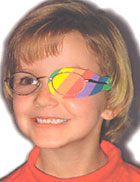











 .) OPHTHALMOLOGIST,
MD or DO: EYE CARE PROFESSIONAL, ECP, who is a State Licensed-Board
Certified Health
Care Practitioner who specializes in
the diagnostic, surgical, and other medical treatments
as well as the refraction of the eye in order to determine
any refractive visual error and the means by which the
error can be corrected. An Ophthalmologist is a Physician,
i.e., a Doctor of Medicine or Doctor of Osteopathy, who specializes
in the comprehensive care of the eyes and visual system
in the prevention of eye disease and injury. An Ophthalmologist
must complete four or more years of college level premedical
education, four or more years of medical school, one
year of internship, and three or more years of specialized
medical and surgical training and experience in eye
care. An Ophthalmologists is a Physician who is qualified
by lengthy medical education, training and experience
to diagnose, treat and manage all eye and visual system
problems, and is licensed by a state regulatory board
to practice medicine and surgery. The Ophthalmologist
is a medically trained specialist who can deliver total
eye care: primary, secondary and tertiary care services,
i.e., vision services, contact lenses, eye examinations,
medical eye care and surgical eye care, and diagnose
general diseases of the body. The steps taken by Ophthalmologists to treat a patient`s eye are the following:
.) OPHTHALMOLOGIST,
MD or DO: EYE CARE PROFESSIONAL, ECP, who is a State Licensed-Board
Certified Health
Care Practitioner who specializes in
the diagnostic, surgical, and other medical treatments
as well as the refraction of the eye in order to determine
any refractive visual error and the means by which the
error can be corrected. An Ophthalmologist is a Physician,
i.e., a Doctor of Medicine or Doctor of Osteopathy, who specializes
in the comprehensive care of the eyes and visual system
in the prevention of eye disease and injury. An Ophthalmologist
must complete four or more years of college level premedical
education, four or more years of medical school, one
year of internship, and three or more years of specialized
medical and surgical training and experience in eye
care. An Ophthalmologists is a Physician who is qualified
by lengthy medical education, training and experience
to diagnose, treat and manage all eye and visual system
problems, and is licensed by a state regulatory board
to practice medicine and surgery. The Ophthalmologist
is a medically trained specialist who can deliver total
eye care: primary, secondary and tertiary care services,
i.e., vision services, contact lenses, eye examinations,
medical eye care and surgical eye care, and diagnose
general diseases of the body. The steps taken by Ophthalmologists to treat a patient`s eye are the following: .) OPTICIAN,
i.e., LICENSED DISPENSING OPTICIAN, LDO, or REGISTERED DISPENSING OPTICIAN, RDO, depending on the State's designation, EYE CARE PROFESSIONAL, ECP, who is a State Licensed-
.) OPTICIAN,
i.e., LICENSED DISPENSING OPTICIAN, LDO, or REGISTERED DISPENSING OPTICIAN, RDO, depending on the State's designation, EYE CARE PROFESSIONAL, ECP, who is a State Licensed-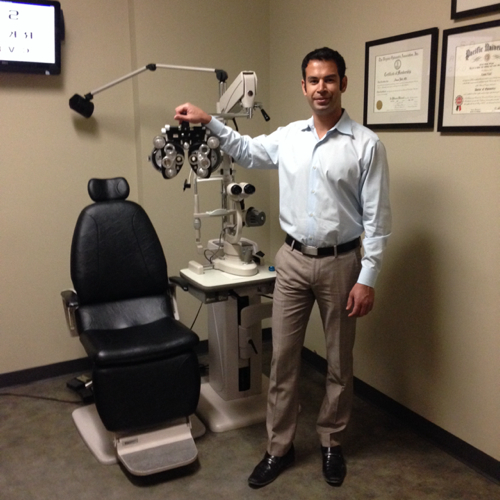
 .) OPTOMETRIST,
OD: EYE CARE PROFESSIONAL, ECP, who is a State Licensed-Board Certified Health
Care Practitioner who specializes in the refraction
of the eye in order to determine any refractive visual
error and the means by which the error can be corrected.
Optometrists are primary Eye Care Professionals for
the eye who are trained and state licensed to provide
primary eye care services. These services include comprehensive
eye health and vision examinations; diagnosis and treatment
of eye diseases and vision disorders; the detection
of general health problems; the prescribing of glasses,
contact lenses, low vision rehabilitation, vision therapy
and medications; the performing of certain surgical
procedures; and the counseling of Patients regarding
their surgical alternatives and vision needs as related
to their occupations, avocations and lifestyle. The
Optometrist will have completed pre-professional undergraduate
education in a college or university, and four years
of professional education at a College of Optometry,
leading to a Doctor of Optometry, OD, degree. Optometrists
must complete a residency under the laws of some states.
.) OPTOMETRIST,
OD: EYE CARE PROFESSIONAL, ECP, who is a State Licensed-Board Certified Health
Care Practitioner who specializes in the refraction
of the eye in order to determine any refractive visual
error and the means by which the error can be corrected.
Optometrists are primary Eye Care Professionals for
the eye who are trained and state licensed to provide
primary eye care services. These services include comprehensive
eye health and vision examinations; diagnosis and treatment
of eye diseases and vision disorders; the detection
of general health problems; the prescribing of glasses,
contact lenses, low vision rehabilitation, vision therapy
and medications; the performing of certain surgical
procedures; and the counseling of Patients regarding
their surgical alternatives and vision needs as related
to their occupations, avocations and lifestyle. The
Optometrist will have completed pre-professional undergraduate
education in a college or university, and four years
of professional education at a College of Optometry,
leading to a Doctor of Optometry, OD, degree. Optometrists
must complete a residency under the laws of some states.