Swimming Pools They can make you sick By Stephanie Booth
Reprinted From AOL Health
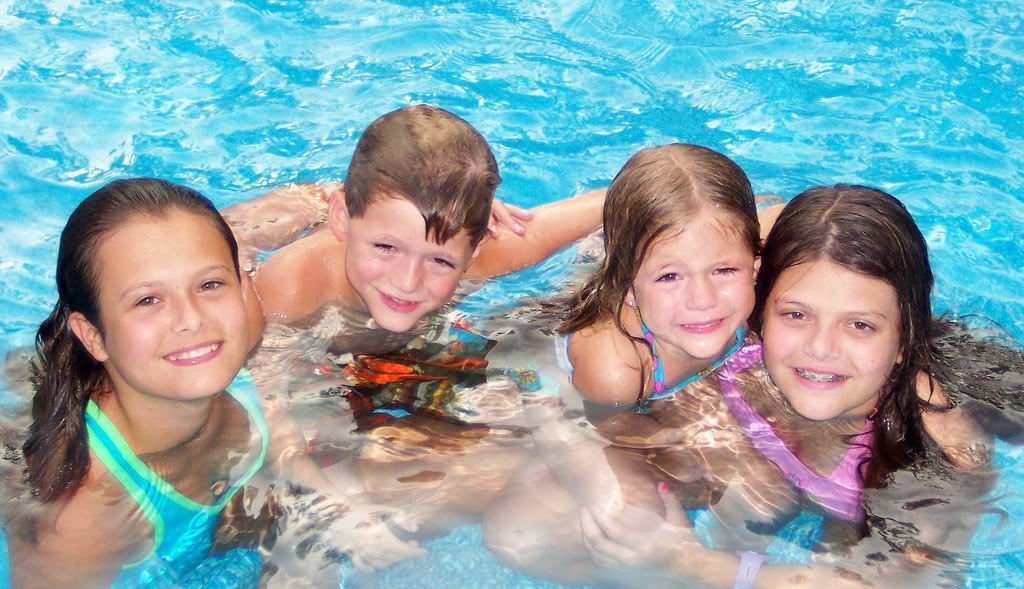
Chlorinated Water Does Not Eliminate Your Risk! Don't allow toddlers in pool without
waterproof undergarments. Shower with soap before
entering a swimming pool. Don't swallow pool water,
or spit in the pool. And never blow your nose
into the water.
Can't wait to dive into that swimming pool? Well, here's a reason
to hold your breath. That water could be teeming with germs waiting
to make you sick.
"The assumption that swimming pools are cess pools can be
correct," Dr. Ranit Mishori, assistant professor of family
medicine at Georgetown University
Medical Center, says, "Swimming is a wonderful activity,
but everyone should take precautions."
The problem is you're sharing germs with everyone else in the
pool, and they can be transmitted as easily as swallowing a mouthful
of water while playing Marco Polo.
A well-maintained swimming pool uses the appropriate amount of
chlorine and other disinfectants to kill bacteria which cause
illness, explained Dr. Philip J. Tierno Jr., director of clinical
microbiology and immunology at NYU
Langone Medical Center in New York City. However, the time
it takes chlorine to kill each germ varies. And the more crowded
the pool, the faster the chlorine is used up. Although diarrhea
is by far the most commonly reported, swimming-related illnesses
can also manifest as eye, ear, respiratory, skin or neurological
infections.
"All
it takes is one child with diarrhea, or whose diaper falls off,
to contaminate a whole pool," said Mishori.
Here are the pathogens you might be sharing the pool with this
summer:
Cryptospordium:
This chlorine-resistant parasite is the leading cause of gastroenteritis
outbreaks at swimming pools, and can live for days in even properly
chlorinated pools, according to the CDC.
Escherichia
coli: Or simply E. coli, is one of the many groups of bacteria
that live in the intestines of healthy humans and most warm-blooded
animals. E. coli bacteria help maintain the balance of normal
intestinal flora (bacteria) against harmful bacteria and synthesize
or produce some vitamins.
However, there are hundreds of types or strains of E-coli bacteria.
Different strains of E. coli have different distinguishing characteristics.
A particular strain of E-coli known as E. coli O157:H7 causes
a severe intestinal infection in humans. It is the most common
strain to cause illness in people. It can be differentiated from
other E. coli by the production of a potent toxin that damages
the lining of the intestinal wall causing bloody diarrhea.
**Infection may also occur after swimming in, or drinking water
that has been contaminated with E. coli O157:H.
Giardia:
Like crypto, giardia is a microscopic parasite passed through
feces, which can cause diarrhea.
Noroviruses:
Exposure to this group of viruses can cause vomiting, nausea,
stomach cramping and diarrhea that can last for several days.
Pseudomonas
aeruginosa: This germ -- which is present in soil and water, not
feces, is responsible for "swimmers ear," an itchy or
painful inflammation of the ear.
Unlike flu viruses, new strains of swimming pool microorganisms
don't premiere each summer. "We've seen these same strains
for years," said Tierno.
And because they aren't going away any time soon, the best way
to stay safe is by practicing good personal hygiene like:
Shower with
soap before entering the pool.
Don't swallow
pool water.
Don't spit
in the pool.
Don't blow
your nose into the water.
Super Important:Children's Swim
Diapers should be secured tightly and changed frequently,
preferably not poolside. Anybody with diarrhea should skip the
pool altogether. (Never take an infant into the water naked.)
Also, be on the lookout for lifeguards or facility managers running
pH tests to make sure chlorine in the water is at an optimal level.
Clear water and clean, not slimy, tiles are also good signs.
If the pool is standing room only on a hot day, reconsider getting
in, since your risk of getting sick will be higher.
Very young children, pregnant women and people with immune deficiencies
who may be more susceptible to illness, should limit the time
spent in a pool. --
If
you like doing laps in the swimming pool, you might want to
stock up on the energy drinks before diving in to this one.
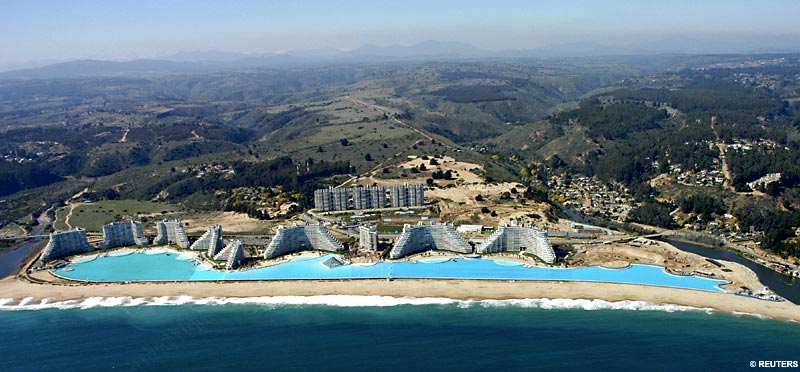
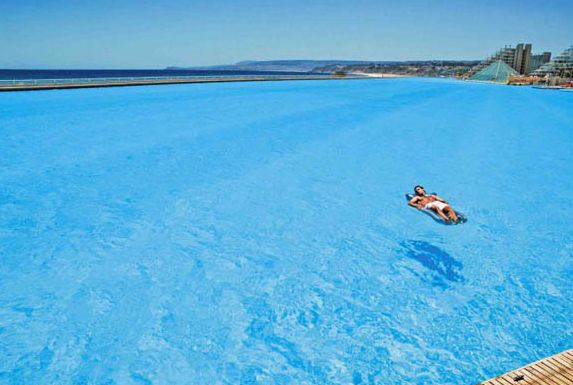
It is more than 1,000 yards long, covers 20 acres, has a 115
feet deep end, and holds 66 million gallons of water.
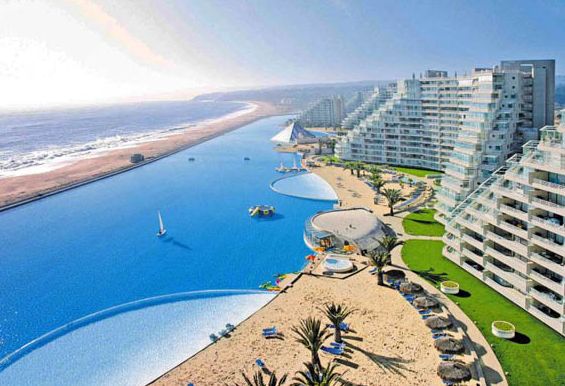
The Guinness Book of Records named the vast pool beside the
sea in Chile as the biggest in the world.
But if you fancy splashing out on one of your own - and you
have the space to accommodate it - then beware: This one took
five years to build, cost nearly $1 billion and the annual
maintenance bill will be $2 million. (See what a Trillion
Dollars looks like.)
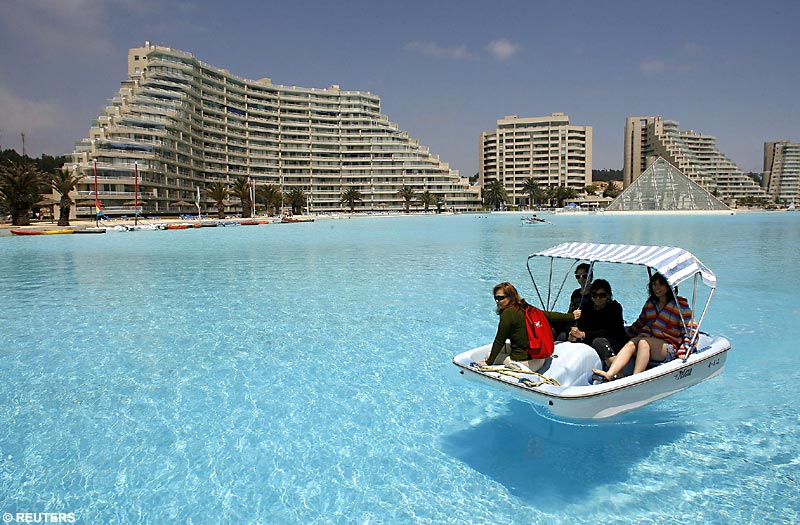
The man-made saltwater lagoon has been attracting huge crowds
to the San Alfonso del Mar resort at Algarrobo, on Chile 's
southern coast, since it opened recently.
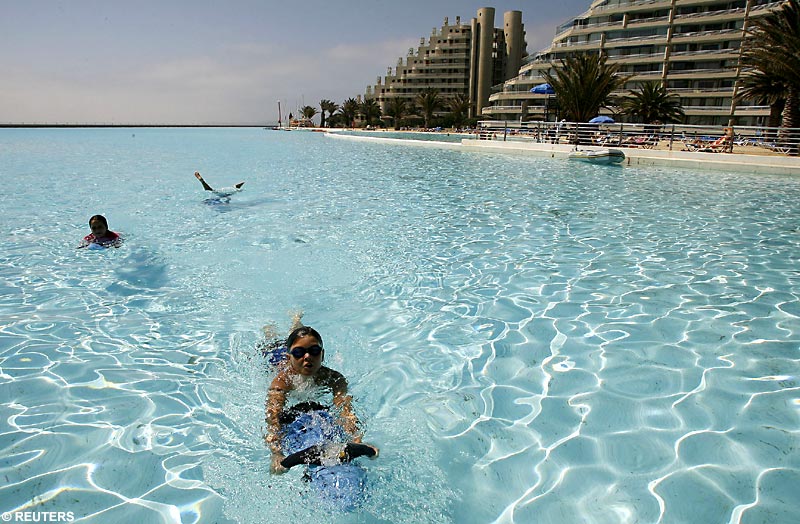
Its turquoise waters are so crystal clear that you can see
the bottom even in the deep end.
It dwarfs the world's second biggest pool, the Orthlieb -
nicknamed the Big Splash - in Morocco , which is a mere 150
yards long and 100 yards wide. An Olympic size pool measures
some 50 yards by 25 yards.
Chile's monster pool uses a computer - controlled suction
and filtration system to keep fresh seawater in permanent
circulation, drawing it in from the ocean at one end and pumping
it out at the other.
The sun warms the water to 26°C, nine degrees warmer than
the adjoining sea.
Chilean biochemist Fernando Fischmann, whose Crystal Lagoons
Corporation designed the pool, said advanced engineering meant
his company could build "an impressive artificial paradise"
even in inhospitable areas.
"As long as we have access to unlimited seawater, we
can make it work, and it causes no damage to the ocean."
--
Due
to the power and corrupting influence of Big
Pharma, the teaching
of nutritional science and the use of vitamin and herbal supplements
is
not taught to any significant extent in our medical schools.
The obvious
reason is that teaching this science reduces the use of prescription
drugs.
*Consultation
with a health care professional should occur before applying
adjustments or treatments to the body, consuming medications
or nutritional supplements and before dieting, fasting or exercising.
None of these activities are herein presented as substitutes
for competent medical treatment. See
Disclaimer.


 EqualsHappiness.com

 Don't allow toddlers in pool without


 Cryptospordium:
This chlorine-resistant parasite is the leading cause of gastroenteritis
outbreaks at swimming pools, and can live for days in even properly
chlorinated pools, according to the CDC.
Cryptospordium:
This chlorine-resistant parasite is the leading cause of gastroenteritis
outbreaks at swimming pools, and can live for days in even properly
chlorinated pools, according to the CDC. Shower with
soap before entering the pool.
Shower with
soap before entering the pool. 

 BIGGEST POOL FACTOIDS









 Your Health By DaSign

 Meatless Is Better
 *Consultation
with a health care professional should occur before applying
adjustments or treatments to the body, consuming medications
or nutritional supplements and before dieting, fasting or exercising.
None of these activities are herein presented as substitutes
for competent medical treatment.
*Consultation
with a health care professional should occur before applying
adjustments or treatments to the body, consuming medications
or nutritional supplements and before dieting, fasting or exercising.
None of these activities are herein presented as substitutes
for competent medical treatment.