Study
Questions Safety of Canned Foods
By David Knowles
(November
9) -- Opening a can of soup on a cold winter day is a time-honored
tradition in America. It may also prove harmful to your health,
according to a new study.
In the study released by Consumer
Reports, canned soup, tuna, juice and green beans have all been
found to contain potentially dangerous levels of bisphenol A, a
man-made chemical preservative that increases shelf-life. Hundreds
of scientific, peer-reviewed studies have suggested health risks
from exposure to the chemical, known as BPA, including increased
incidence of diabetes, cardiovascular disease, liver disorders,
breast cancer and abnormal reproductive organ development, Consumer
Reports said.
"Just one or a few servings of these products is enough to
take you to a level of concern, in which the scientific literature
shows similar levels causing problems in animals," says Urvashi
Rangan, a senior scientist at Consumer Reports who was involved
in analyzing the data.
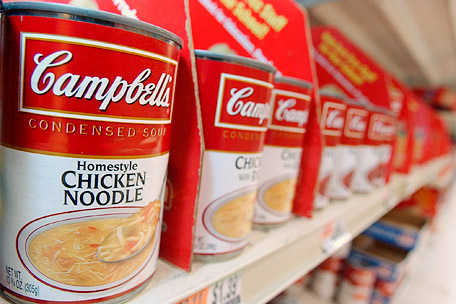
The highest concentrations of BPA that Consumer Reports measured
were in Campbell's and Progresso soup cans, and canned Del Monte
green beans. The magazine even discovered BPA in the canned version
of Similac Advance infant formula.
Anthony Sanzio, a spokesman for Campbell's, took issue with the
notion that the BPA used to line the cans of his company's signature
product is in any way unsafe. "Every leading regulatory agency
in the world has concluded that BPA is safe," Sanzio said.
"We use BPA to protect what's inside the can, and ensure safety."
According to Consumer Reports, however, a 165-pound adult who ate
one serving of canned green beans would exceed by about 80 times
what the magazine's experts considered an acceptable daily amount
of BPA. Children who ate multiple daily servings of foods found
to have high levels of BPA would approach levels found to have done
harm in animals, the report said.
Current federal guidelines, which Consumer Reports believes are
based on inaccurate science, limit exposure of BPA to 50 micrograms
per kilogram of body weight. Sanzio notes that Campbell's is adhering
to the law.
Stephen G. Hentges, spokesman for the American
Chemistry Council, an industry group, does not deny the specific
levels of BPA that Consumer Reports measured in the canned goods,
but, like Sanzio, argues that the amounts are not harmful. "We
have reached the same conclusion as government agencies all over
the world," Hentges said. "Studies show that in low doses,
BPA is safe."
Rangan counters that government standards were based on a handful
of decades old studies. "Since then we have hundreds of newer
studies that show that low dosage levels of BPA are harmful to animals,"
Rangan said.
Frederick vom Saal, a professor of biological sciences at the University
of Missouri and one of the world's leading researchers on BPA, is
hopeful that regulatory action will soon restrict the use of the
chemical in canned goods. "The chemical industry is heading
off a cliff on BPA," vom Saal said. "These are the same
product protection people who worked with the cigarette industry."
First approved for use in 1963, BPA became widespread in the United
States in the 1980s. This year, 8 billion pounds of BPA will be
produced worldwide, up from 6 million pounds in 1970, vom Saal said.
He believes our growing use of BPA helps explain skyrocketing obesity
rates, and cited research linking BPA and obesity in rats. See Report
on MSG.
"In our studies with BPA, obesity in animals is not because
they are eating more. Because of BPA, their metabolic systems do
not work properly," vom Saal said. "Between 1992 and 1998,
the CDC found a 50 percent increase in obesity in America. So what
change happened in those six years? Being a couch potato doesn't
explain it."
Bills introduced in both the U.S. House of Representatives and the
Senate have proposed a ban on BPA, and this coming year the EPA
and the FDA plan separate inquiries into whether to regulate the
use of BPA in food packaging. Canada has banned BPA in baby bottles,
and Walmart stores have voluntarily removed baby bottles with BPA
from store shelves in the U.S.
In light of what it views as the negative health effects of BPA,
Consumer Reports made the following recommendations:
 Choose fresh
food whenever possible.
Choose fresh
food whenever possible.
Consider alternatives
to canned food, beverages, juices and infant formula.
Use glass containers
when heating food in microwave ovens.
In a written statement rebutting that advice, Hentges said, "The
recommendations from Consumer Reports' unnamed experts are inconsistent
with the conclusions of expert regulatory bodies worldwide, all
of which have confirmed that BPA exposure levels are low, and well
within safety standards."
See
the published Consumer
Report Study here.
See
Sugar is a four letter word. See
Sugar: The Bitter Truth.



 EqualsHappiness.com
 Today's Factoids








 *Consultation
with a health care professional should occur before applying adjustments
or treatments to the body, consuming medications or nutritional
supplements and before dieting, fasting or exercising. None of
these activities are herein presented as substitutes for competent
medical treatment.
*Consultation
with a health care professional should occur before applying adjustments
or treatments to the body, consuming medications or nutritional
supplements and before dieting, fasting or exercising. None of
these activities are herein presented as substitutes for competent
medical treatment.