YOU CAN MAKE A DIFFERENCE
During
a BBQ gathering, a friend stumbled and took a little fall. She
assured everyone that she was fine. They offered to call paramedics,
but she said she had just tripped over a brick because of her
new shoes.
They got her cleaned up and got her a fresh plate of food. While
she appeared a bit shaken up, Ingrid went about enjoying herself
the rest of the evening.
Ingrid's husband called later telling everyone that his wife had
been taken to the hospital. At 6:00 pm Ingrid passed away. She
had suffered a stroke at the BBQ. Had someone known how to identify
the signs of a stroke, perhaps Ingrid would have survived. Some
stroke victims don't die, but they end up in a helpless, hopeless
condition instead.
Neurologists say that if they can get to a stroke victim within
3 hours of the episode they can totally reverse the effects of
a stroke ... totally. The trick is to recognize and diagnose the
event as a stroke, and then to get the patient medically cared
for within 3 hours.
RECOGNIZING A STROKE
You can recognize a stroke by asking a suspected victim to perform
three tasks:
 S -- Ask them
to SMILE.
S -- Ask them
to SMILE.
T -- Ask them
to TALK. Have them speak a simple sentence coherently, e.g., “It
is a sunny day today.”
R -- Ask them
to RAISE both of their arms.
If they have trouble with ANY ONE of these tasks, CALL 911 IMMEDIATELY.
Describe the symptoms to the dispatcher and then follow their
instructions.
NOTE: Another stroke 'sign': Ask the person to 'stick' out their
tongue. If their tongue is 'crooked', i.e., if it hangs to one
side or the other, it's an indication of a possible stroke. --

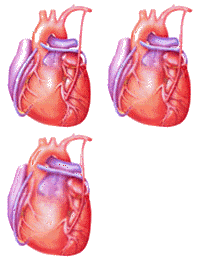
Since
many people are alone when they suffer a heart attack, this article
seemed to be in order. Without help, the person whose heart is
beating improperly and who begins to feel faint, has only about
10 seconds left before losing consciousness.
However, these victims can help themselves by coughing repeatedly
and very vigorously. A deep breath should be taken before each
cough, and the cough must be deep and prolonged, as when producing
sputum from deep inside the chest. A breath and a cough must be
repeated about every two seconds without let up until help arrives,
or until the heart is felt to be beating normally again.
Deep breaths get oxygen into the lungs and the coughing movements
squeeze the heart and keep the blood circulating. The squeezing
pressure on the heart also helps it regain normal rhythm. In this
way, heart attack victims can get to a hospital.
Tell as many
other people as possible about this, it could save their lives!
--



About
Hair
Eyes
Have It
Ear
Candling
Back
Walking
Energy-Drinks
The
Water Cure
Inner
Clean Diet
What
About Gout
For
Women Only
The
Human Body
For
Garlic Lovers
Sugar Is A Poison
Reflexology
Chart
Path2Fitness.com
What's
Eating You
Yogi
Bhajan's Diet
The Oreo Dilemma
Vegetarian
Recipes
Food
Ads vs. Reality
A
Healing Meditation
Drinking Driving Dead
Test
Your Eyes Online
Beware:
Canned Soup
Notes From Your Liver
Meditation
For Women
How
To Reverse Aging
Sugar Dumbs Us Down
What
About Gallstones
What
About Chemtrails
What
About Aspartame
The
Color of Depression
Beware:
"No Added MSG"
Do
Doctors Cause Dementia
Texting And Driving Is Crazy
It's
Time To Rag On Ragweed
What
About Sodium Benzoate
SugarIsAFourLetterWord.com
Left
Brain-Right Brain Diversity
Be
Warned If You're On Statins
The Aquarian Age Wake Up Call
10
Warning Signs of Alzheimer's
Lasik
Eye Surgery - FDA Warning
Drug
Company Insider Confesses
Corporations
are killing Americans
A
Critical Look At Optical Retailers
Jimmy
Carter And Women's Rights
What
Your Optician Needs To Know
Is
Alzheimer's Diabetes of The Brain
Appendix:
A Newly Discovered Organ
Another
Side of The Soy-Protein Story
See
What Happens When You Meditate
See
Why Sikhs Keep Their Hair Unshorn
What
About PPA (PhenylPropanolAmine)
Use
Himalayan Salt - Do Not Use Table Salt
Opticians:
Merchants or Health Care Providers
 Your Health By DaSign
  Other Views
 Cleansing
Diet
Cleansing
Diet  Meatless Is Better


 EqualsHappiness.com

 Factoid






 *Consultation
with a health care professional should occur before applying
adjustments or treatments to the body, consuming medications
or nutritional supplements and before dieting, fasting or exercising.
None of these activities are herein presented as substitutes
for competent medical treatment.
*Consultation
with a health care professional should occur before applying
adjustments or treatments to the body, consuming medications
or nutritional supplements and before dieting, fasting or exercising.
None of these activities are herein presented as substitutes
for competent medical treatment.