The
Longevity Link* "In
each and every environment, good
health and sustained wellness is dependant
on the rapid removal of waste.
In terms of our
personal health, one needs to void solid waste two to
three times a day or once between each meal, without
straining, to maintain basic health and wellness. Toxins can
be harmless if removed quickly from the body." -- Hari Singh
Maria
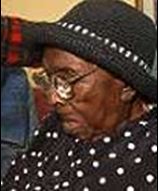
Esther de Capovilla
Guayaquil, Ecuador at 116
"People
live longer when they have active physical and social lives.
Pills and diets aren't as important as having purpose in life."
-- Dan Buettner
In the same way organisms select for characteristics
that favor the survival and well-being of its species over successive
generations, so too do cultures. With organisms, we call this
process evolution and it represents a sort of accumulated wisdom.
There is no word for this process in cultures, but there is
one for the result. And that word is tradition.
For the past eight years, my team of scientists and National
Geographic researchers have explored five parts of the world
-- "Blue Zones" -- where people live measurably longer
lives.
Compared to American averages, we found a bronze-age culture
in Sardinia's interior that produces about 10 times more male
centenarians; a remote peninsula in Costa Rica where 50 year-olds
have a three-fold better chance or reaching age 90; a Greek
island completely free of Alzheimer's (about 50 percent of Americans
over age 90 suffer from dementia); and islands in southern Japan
where people suffer one-sixth the rate of heart disease. How
do they do it?
The Danish Twin Studies established that only about 20 percent
of average life span (within certain biological limits) is dictated
by genes. Lifestyle explains most of the rest of the longevity
formula.
We found that all five Blue Zones possessed the same nine lifestyle
characteristics. Among them: a
low-meat, plant-based diet (all of them ate a lot of
beans) and a ritual of "downshifting" each day. They
experience the same stresses we do -- kids, health, finances
-- but they managed it through daily prayer, meditation,
ancestor veneration or city-wide happy hours (like the Sardinians).
The secret to longevity, as I see it, has less to do with diet,
or even exercise, and more to do with the environment in which
a person lives: social and physical. What do I mean by this?
They live rewardingly inconvenient lives. They walk to the store
and to their friends' homes and they live in houses set up with
opportunities to move mindlessly. They do their own yard work,
hand-knead their own bread dough, and, in the case of Okinawa,
get up and down off the floor several dozen times a day.
"I
aim to live forever. So far, so good."
They live in strong families that keep them motivated to support
loved ones. Centenarians are still living near their children
and feel loved and the expectation to love. Instead of being
mere recipients of care, they are contributors to the lives
of their families. They grow gardens to contribute vegetables,
they continue to cook and clean. This has a powerful two-fold
effect: Children and grandchildren in these families benefit
from their grandparents' wisdom and care while the centenarians
feel the motivation to stay active, to get out of bed in the
morning, and live for a purpose.
They live in cities where it is easy to walk to their friends'
houses, to the store or to church. So, we figured they get about
105 minutes of physical activity everyday -- and no health club
membership!
We know from the Framingham studies that happiness, smoking
and obesity are all "contagious." If your three best
friends are obese, there's a 70 percent better chance that you'll
be overweight. People in the Blue Zones either proactively surround
themselves with people who practice the right behaviors or are
born into communities of people who do -- or people whose idea
of fun is gardening, or bocce ball or swimming; people who eat
meat sparingly, who have faith, who are trusting and trust-worthy.
Why is this so important?
"Do
not go gentle into that good night...
Rage, rage against the dying of the light." -- Dylan
Thomas
No supplement, hormone, antioxidant or pill of any sort has
been shown to reverse, stop or even slow aging. The problem
is two-fold: to do the study properly, you'd need to follow
two groups of people for life: one who takes the pill, the other
that doesn't. Then you'd have to control for all other factors
and compare the average age of death for each group. No such
study has ever been done on a "longevity" supplement.
The second problem is adherence. People in general just don't
stick to doing anything for very long. Are you taking supplements?
How long have you been taking them? I'll bet not more than a
few years.
Science (and hucksters) have offered us countless diets but
research done by the University of Minnesota's Dr. Robert W.
Jeffrey has shown that fewer than 2 percent of people adhere
to diets for more than two years. For anything to really impact
your life expectancy positively, you need to do it for most
of your life. Friends, unlike pills or diets, are much more
likely to be much longer-term undertakings.
The secret to solving much of America's health care crisis and
battle with chronic diseases lies in emulating the environment
in Blue Zones. Is it possible?
Last year, my partners and I made Blue Zones-inspired changes
to the environment of an entire American town -- Albert Lea,
Minnesota, (see AARP Magazine article). We made the town more walkable
and bikeable, dug public gardens, made it easier for kids to
walk to school and people to expand their face-to-face social
networks to include more people motivated to change their health
habits. The results were astounding.
"If
men cease to believe that they will one day become
gods then they will surely become worms."-- Henry
Miller
If the trends continue, life expectancy for the average participant
would rise about three years and health care costs for city
workers would decrease by 48 percent.
The wisdom of the world's Blue Zones represents centuries or
even millennia of observed human experience. As Democrats and
Republicans argue over how to solve the health care crisis,
perhaps they should take a moment to consider the wisdom of
their grandmothers. --
Note: The opinions expressed in this commentary are solely those
of Dan Buettner.
*Consultation
with a health care professional should occur before applying adjustments
or treatments to the body, consuming medications or nutritional
supplements and before dieting, fasting or exercising. None of these
activities are herein presented as substitutes for competent medical
treatment. See Disclaimer.



 EqualsHappiness.com









 Meatless Is Better
 *Consultation
with a health care professional should occur before applying adjustments
or treatments to the body, consuming medications or nutritional
supplements and before dieting, fasting or exercising. None of these
activities are herein presented as substitutes for competent medical
treatment.
*Consultation
with a health care professional should occur before applying adjustments
or treatments to the body, consuming medications or nutritional
supplements and before dieting, fasting or exercising. None of these
activities are herein presented as substitutes for competent medical
treatment.