Offering Free Training Courses For Eyewear Professionals and Consumers
Soft Contact Lenses Care and Compliance Objective: The avoidance of infection and the possible
loss of visual acuity.
It's best to act on the side of caution by removing lenses before sleeping.
A leading brand of 30-day wear contact lenses advertises their
product along with this statement, "Serious eye problems may occur".
Use great care to avoid using contaminated products.
Eye Care Professionals need to strongly emphasize the consequences
of Patient non-compliance with any and all of the following procedures.
2015 SURVEY OF CL WEARERS
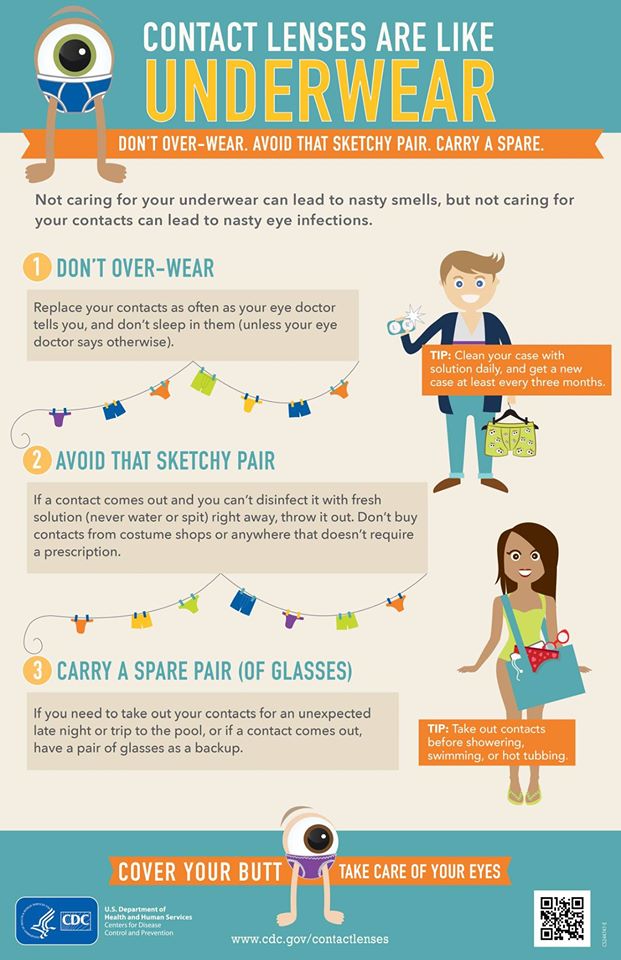
CDC Report finds all contact lens wearers engage in at least one behavior that could put them at risk for an eye infection.
1.) Keeping their lens cases longer than recommended (82.3%)
2.) "Topping-off" solution in the lens case (55.1%)
3.) Wearing their lenses while sleeping (50.2%)
4.) Showering in contact lenses (84.9percent)
THE
RULES
CLEAN, RINSE, DISINFECT
Wash
your hands so that you minimize the transfer of foreign objects
and germs into your eyes. Avoid moisturizing soaps. They should
not be used with contact lenses. Dry your hands with a lint-free
towel.
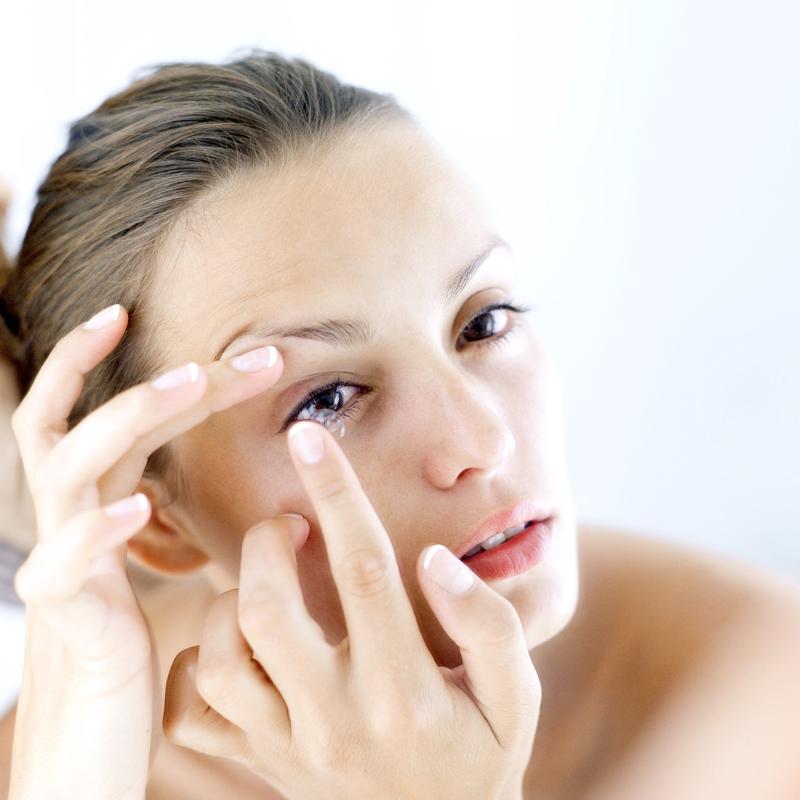
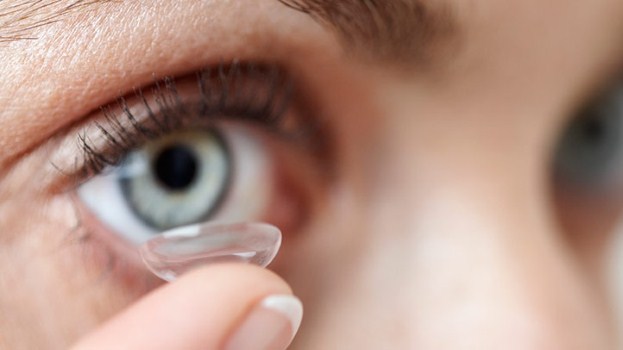
Remove
a lens and clean it with the recommended solution. Cleaning
removes eye-produced-protein buildup, cosmetics and other
debris that impairs lens comfort. The FDA recommends that
you rub the lens in the palm of your hand with a few drops
of solution, EVEN if you are using a "no-rub" product.
Rinse
the lenses again to remove the loosened debris, making sure
to take as long as the package directs. NOTE: Rinsing is an
important step, almost as important as cleaning.
Place
the lens in your CLEAN lens case or lens holder and fill with
fresh sterile solution. DO NOT "top off" your OLD
SOLUTION. Disinfecting kills microorganisms on the lens. Disinfecting
time varies from product to product; check the package for
details. Do not use tap water.
Repeat
steps two through four for your other lens.
All
contact lens wearers are urged to remove their contact lenses during time of sleep in order to minimize eye-produced-protein
buildup and the risk of infections. See Disclaimer.
"Risk of serious eye problems (i.e., corneal ulcer) is greater for extended wear. In rare cases, loss of vision may result. Side effects like discomfort, mild burning or stinging may occur." -- AirOptix
Beyond
Clean, Rinse and Disinfect
"The most perfect lens prescription can be compromised
if your
contact lenses do not provide comfort and long term wearability."
Protein. Depending on what kind of contact lenses you wear and how
much protein your eyes deposit on your contacts, your doctor
may recommend you use a product for protein removal.
While cleaning them does remove some protein, it can still
build up on your lenses and make them uncomfortable. That's
why the longer you wear lenses before replacing them, the
more likely you are to need a protein remover.
For example, if you wear disposable lenses, you probably won't
need one; but if you wear the kind of lenses that are replaced
only once or twice a year, you definitely will. Products for
removing protein include enzymatic cleaner and daily protein
removal liquids.
Eye Dryness and Irritation. Use
contact lens eye drops to lubricate your eyes and re-wet your
lenses.
Eye Sensitivity and Allergies. A
small percentage of lens wearers develop an eye allergy to
the chemicals present in contact lens solutions. If this is
the case with you, you don't need an additional product: You
just need to switch products to those marked "preservative-free."
THE
PRODUCTS
Cleaning, Rinsing and Disinfecting Solutions
Saline
Solution is for rinsing and storing contact
lenses, when you're using a heat or UV disinfection system.
You may also need it for use with enzymatic cleaning tablets
or cleaning/disinfecting devices. Never use saline products
for cleaning and disinfection.
Daily cleaner is for cleaning your contact lenses. Place a
few drops in the palm of your hand and carefully rub the lens
for as long as directed, usually around 20 seconds, making
sure to clean both sides. Use other products for rinsing and
disinfection.
Multipurpose Solution is for cleaning,
rinsing, disinfecting and storing your contact lenses. Clean
your lenses as you would with daily cleaner, then rinse (as
long as directed) and disinfect, all with the same solution;
or rinse the lenses twice, then place them in a CLEAN lens
case with solution to clean and disinfect. When you are ready
to wear the lenses, rinse them again. With multipurpose solutions,
no other lens care products are necessary.
Hydrogen Peroxide Systems may help
wearers who are sensitive to the preservatives in multipurpose
solutions. Hydrogen peroxide solution is for cleaning, disinfecting,
rinsing and storing your contact lenses. With this product,
you place your lenses in the provided basket and rinse them,
then place the basket in its cup and fill the cup with solution
to clean and disinfect your lenses.
Some lens holders for hydrogen peroxide systems have a built-in
neutralizer (to convert the hydrogen peroxide to water, so
it doesn't sting your eyes), but with others you need to add
a neutralizing tablet.
After the disinfection and neutralizing step is completed,
you can remove the lenses from the case and put them on.
IMPORTANT: Never rinse your contacts with hydrogen peroxide
solution and apply them directly to your eyes without completing
the entire disinfecting and neutralizing step. Doing so can
cause a painful chemical injury to the eye.
Trouble-free
contact lens wear requires
Patient compliance and attention to detail.
"The best vision and eye health require compliance with the
rules."
FDA Warns Eye Care Professionals About LASIK Claims
Speaking on behalf of the American Society of Cataract and Refractive Surgery, Dr. Eric D. Donnenfeld said the group supports the FDA's latest efforts regarding LASIK providers making false claims.
LASIK is exceptionally safe when done by the right doctor on the right patient, stressed Donnenfeld, who is an ophthalmologist with offices throughout Long Island, NY. However, he said that "choosing the right doctor is the most important thing one can do." See LASIK Surgeon Ratings.
"A lot of patients make a decision based on an ad in a magazine or an audio clip on radio," Donnenfeld said. This may not be the smartest approach, he said, because" there are a lot of very good doctors who advertise, but it doesn't mean a doctor is good because he advertises or offers group discounts."
"We have to go beyond the advertising or Groupons and have to treat [LASIK] as a surgical procedure," he said.
Not everyone is a good candidate for LASIK, either, Donnenfeld added. People with thin or irregular corneas and other eye diseases such as dry eye, glaucoma (increased pressure in the eye) or cataract (cloudy areas in the lens) might be advised against the procedure, for example.
Donnenfeld's advice for finding a good LASIK surgeon: ask your eye doctor who he or she would see for their own eyes.
But he also stressed that as LASIK technology has improved many risks have been minimized, if not eliminated. For example, "the risk of glare and halo have largely gone away," Donnenfeld said.
"Dry eye is common after LASIK and it almost always goes away after three or six months," he noted, and people who already have dry eye prior to the surgery are not candidates for LASIK.
Infection is also a risk with any surgery, Donnenfeld said, but following preoperative instructions -- including taking antibiotics -- can help reduce this risk. Another potential risk may be larger pupils.
"These should all be discussed during your consultation," he said. --
Infection Threatens Woman's Sight After
Using Tap Water To Store Contact Lenses
Erin with husband, Justin
Huffington Post, 10/10/2013 -- How many times have you let your basic contact lens hygiene slide, not doing things like washing your hands before handling your lenses, using tap water instead of saline solution or sleeping in your lenses?
During a busy week at work, a woman named Erin was out of contact lens solution but didn't have time to buy any, so she used tap water to store her contact lenses.
That would soon prove to be a mistake: She contracted a rare amoeba infection that began to attack her cornea.
"The pain was excruciating," she told Dr. Travis Stork on The Doctors. She went to the ER, where doctors thought she had a simple eye infection and prescribed her a steroid. However, after the pain still did not go away, she visited an optometrist who realized that she had an amoeba infection.
"The steroid was, in fact, hiding the infection," she said. "It was keeping my sight but it was actually feeding the amoeba, via the steroid, making it stronger."
Stork noted that steroids can actually be detrimental in cases like this, because they make it harder for the body to fight off the infection.
To find out how Erin's vision has now been compromised because of the infection, watch this video. For what you need to know about contact lenses, click here. And for more FAQs about contact lens hygiene and health, click here. --
Eye Care Professionals, watch this
new test for Dry Eyes and more.
When Opticians relate to consumers as Customers,
it often has an adverse impact on the relationship.
When consumers order their prescription eyewear, they
should invariably be served as Patients, never Customers.
Patients receive healthcare. Customers receive merchandise.
Books,
lectures and tests can take an Optician's
skills only so far.
It is time for touch-and-feel, Hands on the Patient training.
Only one on one craftsmanship training provides this. Craftsmanship cannot be learned virtually.
"Handcrafted frame fitting, i.e., touch and feel, hands-on dispensing,
cannot be outsourced to lectures or virtual sources. It is an art form,
which requires actual and multi-dimensional contact with the patient."
HANDS ON THE PATIENT
WORKSHOP TRAINING AVAILABLE
HERE "It is incumbent on those who know, to teach those who do not know.
It is incumbent on those who do not know to surrender their ego."
Grateful
appreciation is hereby expressed to Ennco Display Systems and Systems of
Sight for
permission to use their copyrighted images on this Web
site.
*Consultation
with a health care professional should occur before inserting
contact lenses, applying adjustments or treatments to the body, consuming medications
or nutritional supplements and before dieting, fasting or exercising.
None of these activities are herein presented as substitutes
for competent medical treatment. See
Disclaimer.









 Wash
your hands so that you minimize the transfer of foreign objects
and germs into your eyes. Avoid moisturizing soaps. They should
not be used with contact lenses. Dry your hands with a lint-free
towel.
Wash
your hands so that you minimize the transfer of foreign objects
and germs into your eyes. Avoid moisturizing soaps. They should
not be used with contact lenses. Dry your hands with a lint-free
towel. Remove
a lens and clean it with the recommended solution. Cleaning
removes eye-produced-protein buildup, cosmetics and other
debris that impairs lens comfort. The FDA recommends that
you rub the lens in the palm of your hand with a few drops
of solution, EVEN if you are using a "no-rub" product.
Remove
a lens and clean it with the recommended solution. Cleaning
removes eye-produced-protein buildup, cosmetics and other
debris that impairs lens comfort. The FDA recommends that
you rub the lens in the palm of your hand with a few drops
of solution, EVEN if you are using a "no-rub" product. Rinse
the lenses again to remove the loosened debris, making sure
to take as long as the package directs. NOTE: Rinsing is an
important step, almost as important as cleaning.
Rinse
the lenses again to remove the loosened debris, making sure
to take as long as the package directs. NOTE: Rinsing is an
important step, almost as important as cleaning. Place
the lens in your CLEAN lens case or lens holder and fill with
fresh sterile solution. DO NOT "top off" your OLD
SOLUTION. Disinfecting kills microorganisms on the lens. Disinfecting
time varies from product to product; check the package for
details.
Place
the lens in your CLEAN lens case or lens holder and fill with
fresh sterile solution. DO NOT "top off" your OLD
SOLUTION. Disinfecting kills microorganisms on the lens. Disinfecting
time varies from product to product; check the package for
details.  Repeat
steps two through four for your other lens.
Repeat
steps two through four for your other lens.  All
contact lens wearers are urged to remove their contact lenses during time of sleep in order to minimize eye-produced-protein
buildup and the risk of
All
contact lens wearers are urged to remove their contact lenses during time of sleep in order to minimize eye-produced-protein
buildup and the risk of 














































 *Consultation
with a health care professional should occur before inserting
contact lenses, applying adjustments or treatments to the body, consuming medications
or nutritional supplements and before dieting, fasting or exercising.
None of these activities are herein presented as substitutes
for competent medical treatment.
*Consultation
with a health care professional should occur before inserting
contact lenses, applying adjustments or treatments to the body, consuming medications
or nutritional supplements and before dieting, fasting or exercising.
None of these activities are herein presented as substitutes
for competent medical treatment.