|
|
"Peace comes within the Souls of Men when "There is nothing wrong in this world if you do not hate anyone or create a superiority complex to make anyone else feel inferior."
Where Will Our Children Live A
lonesome warrior stands in fear of what the future brings, Our
many nations once stood tall and ranged from shore to shore We
shared our food and our land and gave with open hearts, All
this was taken; we did not know what the white man had in store, But
those of us who still remain hold our heads up high, Our
dreams will live on forever and our nations will be reborn, If
you listen close you will hear the drums and songs upon the winds,
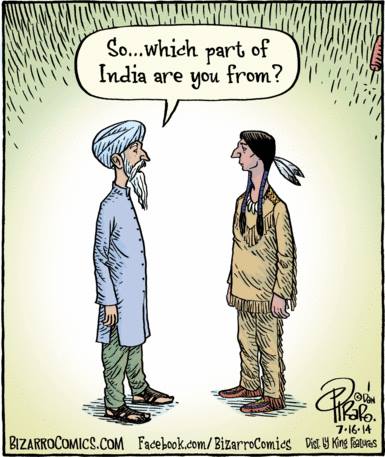
Long before the white man set foot on American soil, the American Indians, or rather the Native Americans, had been living in America. When the Europeans came here, there were probably about 10 million Native Americans populating America north of present-day Mexico. And they had been living in America for quite some time. It is believed that the first Native Americans arrived during the last ice age, approximately 20,000 - 30,000 years ago through a land bridge across the Bering Sound, from northeastern Siberia into Alaska. The oldest documented Native American cultures in North America are Sandia (15000 BC), Clovis (12000 BC) and Folsom (8000 BC). Although it is believed that the Native American Indians originated in Asia, few if any of them came from India. Christopher Columbus, who believed mistakenly that the mainland and islands of America were part of the Indies, in Asia, first applied the name "Indian" to them.
So, when the Europeans started to arrive in the 16th and 17th century they were met by Native Americans, and enthusiastically so. The Natives regarded their white complexioned visitors as something of a marvel, not only for their outlandish dress and beards and winged ships but even more for their wonderful technology, steel knives and swords, fire-belching arquebus and cannon, mirrors, hawksbills and earrings, copper and brass kettles, and so on. However, conflicts eventually arose. As a starter, the arriving Europeans seemed attuned to another world; they appeared to be oblivious to the rhythms and spirit of nature. Nature to the Europeans, the Native Americans perceived, was something of an obstacle, even an enemy. It was also a commodity: A forest was so many board feet of timber, a beaver colony so many pelts, a herd of buffalo so many robes and tongues. Even the Native Americans themselves were a resource; souls ripe for the Jesuit, Dominican, or Puritan plucking. It was the Europeans' cultural arrogance, coupled with their materialistic view of the land and its animal and plant beings, that the Native Americans found repellent. Europeans, in sum, were regarded as something mechanical; soulless creatures that wielded diabolically ingenious tools and weapons to accomplish mad ends. The Europeans brought with them not only a desire and will to conquer the new continent for all its material richness, but they also brought diseases that hit the Native Americans hard. Conflicts developed between the Native Americans and the Invaders, the latter arriving in overwhelming numbers, as many "as the stars in heaven". The Europeans were accustomed to own land and laid claim to it while they considered the Native Americans to be nomads with no interest to claim land ownership. The conflicts led to the Indian Wars, the Indian Removal Act empowered by President Andrew Jackson in 1830 and other acts instituted by the Europeans in order to accomplish their objectives, as they viewed them at the time. In these wars the Native American tribes were at a great disadvantage because of their modest numbers, nomadic life, lack of advanced weapons, and unwillingness to cooperate, even in their own defense. The end of the wars more or less coincided with the end of the 19th century. The last major war was not really a war; it was a massacre in 1890 when Native American Indian warriors, women, and children were slaughtered by US cavalrymen at Wounded Knee, South Dakota, in a final spasm of ferocity. A stupefying record of greed and treachery, of heroism and pain, had come to an end, a record forever staining the immense history of the westward movement, which in its drama and tragedy is also distinctively and unforgettably American. "Any man who thinks he can be happy and
THE CHEROKEE
A European emigrating to the US during the latter part of the 20th century cannot fully comprehend what happened during the past few centuries. Many descendants of emigrants as well as many Native Americans feel the same way. We are all a product of our time and the prevailing circumstances. If we had lived with the Europeans in America during the 19th century, would we have embraced what was going on then? If we had lived with the Germans in the 1930s and 40s, would we have embraced what was going on in Germany then? If we had lived in Scandinavia during medieval time witnessing the horrors of slavery and killings, would we have embraced what was going on then? (The Nordic countries practiced slavery during the middle ages. A master could for any reason kill his slave. This was abolished in 1335.) These are hard questions for anyone to honestly answer. It is easy to toss around opinions now, at the start of the 21st century, being conveniently removed from circumstances and conditions in a distant and foreign time. It is time to learn from the past and move into the 21st century as better human beings. After all, we are ONE people under GOD and we can only look back to the past as what it is, history. Now we attempt to cooperate to the best of our ability in the present and we are looking forward to the future for a better world. Let us once again cross the Bering land bridge and sail the Mayflower, but this time together, for the common goal of building mutual respect and trust.
ABOUT THE CHEROKEE PEOPLE
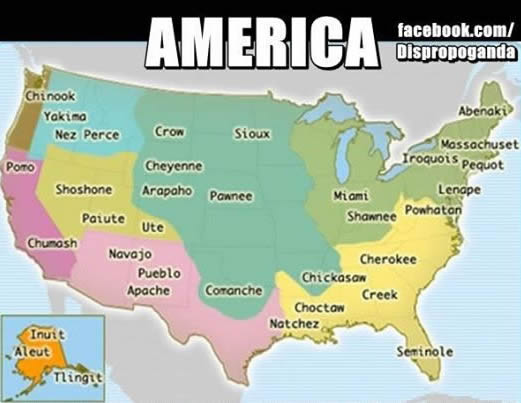
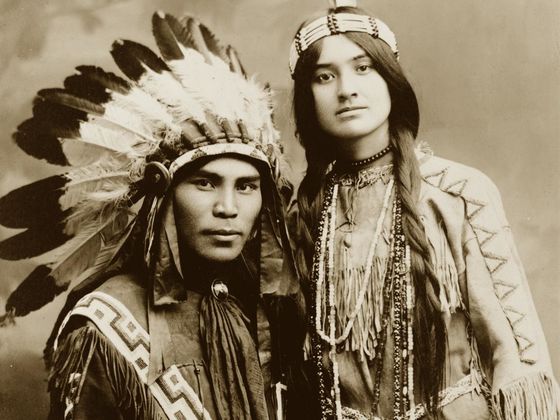
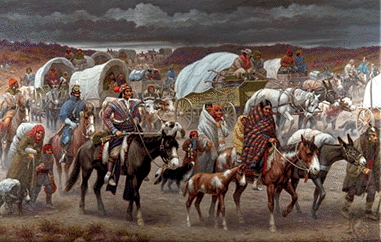
The Cherokee, a North American tribe, are of the Iroquois linguistic family and the Southeast culture area. The Cherokee played an important role in colonial America and in United States history. They remain one of the largest tribes in the United States. Archaeological and linguistic evidence indicates that the Cherokee migrated in prehistoric times from present day Texas or northern Mexico to the Great Lakes area. Wars with the Iroquois tribes of the New York area and the Delaware tribes pushed them southeast to the Allegheny and Appalachian mountain regions in modern North and South Carolina, Tennessee, and northern Georgia and Alabama. There the Spanish explorer Hernando de Soto encountered them in 1540. In 1715 smallpox reduced their population to about 11,000. During the British and French struggle for control of colonial North America, the Cherokee generally sided with the British, and during the American Revolution the tribe aided Great Britain. In 1785 they negotiated a peace treaty with the United States, but Cherokee resistance continued for a decade thereafter. In 1791 a new treaty reconfirmed the earlier one; part of Cherokee territory was ceded to the United States, and the permanent rights of the tribe to the remaining territory were established. Between 1790 and 1819, several thousand of the tribe migrated west of the Mississippi, becoming known as the Western Band. In 1820 the tribe established a governmental system modeled on that of the United States, with an elected principal chief, a senate, and a house of representatives. Because of this system, the Cherokee were included as one of the so-called Five Civilized tribes. In 1827 they drafted a constitution and incorporated as the Cherokee Nation. Meanwhile, valuable gold deposits were discovered in tribal lands, which by previous cessions had been reduced to about 2,830,000 hectares (about 7 million acres) in northwest Georgia, eastern Tennessee, and southwest North Carolina. In 1819 Georgia appealed to the US government to remove the Cherokee from Georgia lands. When the appeal failed, attempts were made to purchase the territory. In retaliation the Cherokee Nation enacted a law forbidding such a sale on punishment of death. In 1828 the Georgia legislature outlawed the Cherokee government and confiscated tribal lands. President Andrew Jackson rejected Cherokee appeals for federal protection. In 1832 the Supreme Court of the United States ruled that the Georgia legislation was unconstitutional, but federal authorities, following Jackson's policy of Native American removal, ignored the decision. About 500 leading Cherokee agreed in 1835 to cede their tribal territory in exchange for $5,700,000 and land in Native American Indian Territory (now Oklahoma). Their action was repudiated by more than nine-tenths of the tribe, and several members of the group were later assassinated. In 1838 federal troops began forcibly evicting the Cherokee. Approximately one thousand escaped to the North Carolina mountains, purchased land, and incorporated in that state; they were the ancestors of the present day Eastern Band. Meanwhile, most of the tribe, including the Western Band, were driven west about 1,285 km (about 800 mi.) in a forced march, known as the Trail of Tears. About 4,000 perished through hunger, disease, and exposure while on the journey or in stockades awaiting removal. In Native American Indian Territory the Cherokee reorganized their government under their chief, John Ross.
During the American Civil War, after great internal conflict, the tribe sided with the Confederacy; a postwar treaty with the United States freed the black slaves of tribal members. Under the General Allotment Act of 1887, uncompromisingly resisted by the Cherokee, plots of tribal land were forcibly allotted to individual members. The government of the Cherokee Nation was dissolved, and its people became US citizens when Oklahoma achieved statehood in 1907. Surplus lands were parceled out by the federal government, and in 1891 the tribe's western land extension, the Cherokee Strip or Cherokee Outlet, was sold to the United States; in 1893 it was opened, mostly to white settlers, in a famous land run.
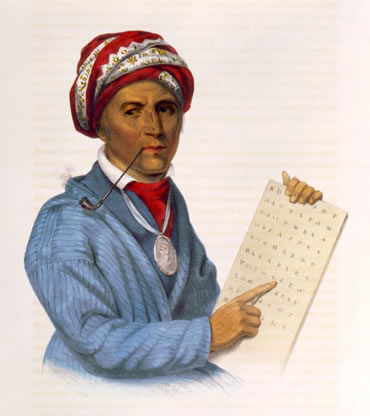
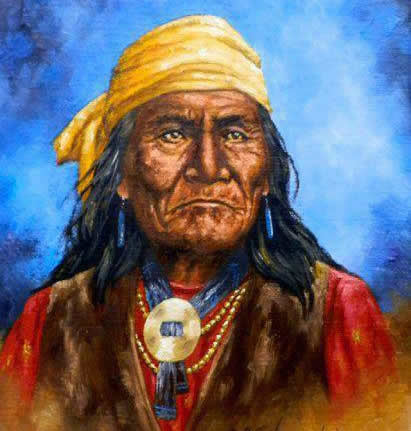
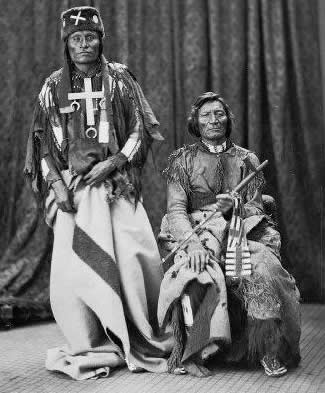
Early print of Cherokee man wearing turban.
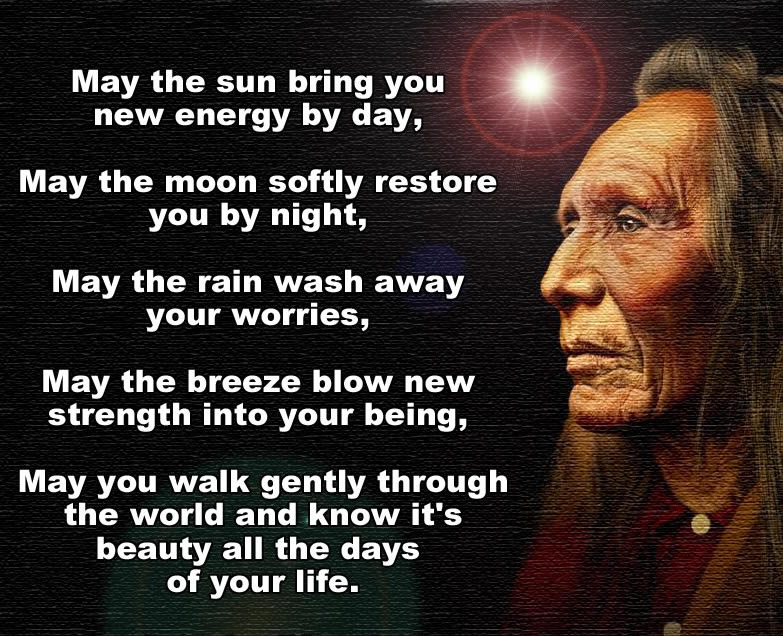
A Cherokee Prayer Blessing "May
the warm winds of heaven blow softly upon your house, The Indian Chief Classic A Tale of Six Boys On Iwo Jima If Your Dad Doesn't Have A Beard Notable Women of Native America Look, Listen and Experience Peace Life According To Native Americans A Notable Woman of Native America 18 Things White People Should Know U.S. Marine Corps Warfighting Manual Why Native Americans Keep Long Hair How Sikh Women Transform 'Me' Into 'We' To The Greatest Generation ... "Before You Go" The U.S. Marine Corps Silent Drill Team With Rifles
|
|








 At
the time of Removal in 1838, the
At
the time of Removal in 1838, the 

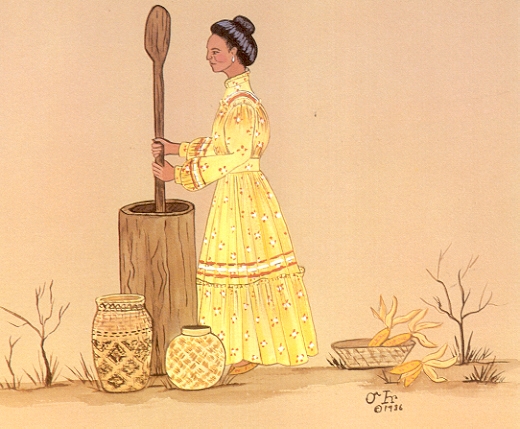

 Who were the Cherokee
princesses?
Who were the Cherokee
princesses?