ABOUT US CONTACT US DISCLAIMER HOME PAGE NEWS AND VIEWS SEARCH UNIVERSITY OF DIVERSITY |
Semper Fidelis
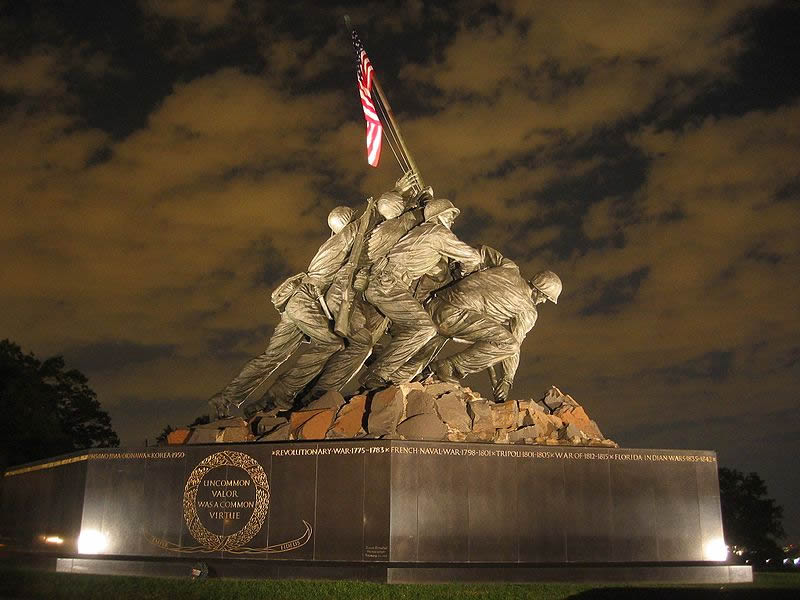
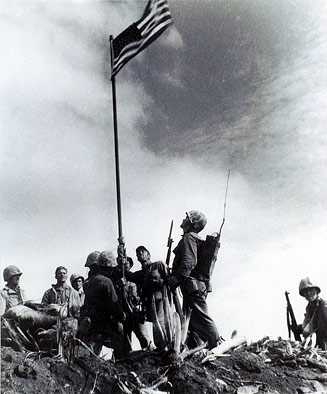
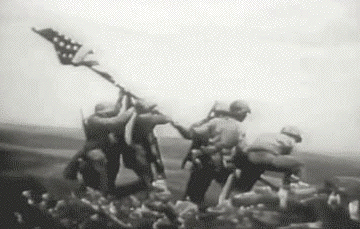
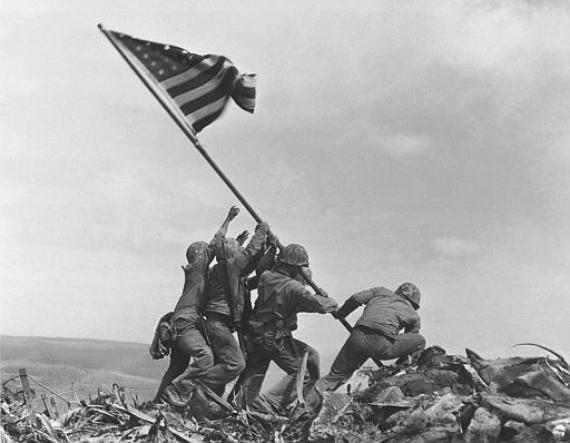
"To serve is to succeed." First Flag Raising Second Flag Raising
See To The Greatest Generation...Before You Go. The Birth of The Corps The birthday of the United States Marine Corps, November 10, 1775, occurred when the Second Continental Congress decreed that, "two battalions of Marines be raised consisting of one Colonel, two Lieutenant Colonels, two Majors and other Officers, as usual in other Regiments; that they consist of an equal number of Privates as with other Battalions, that particular care be taken that no persons be appointed to offices, or enlisted into said Battalions, but such as are good seamen, or so acquainted with maritime affairs as to be able to serve for and during the present war with Great Britain and the Colonies; unless dismissed by Congress; that they be distinguished by the names of the First and Second Battalions of Marines."
Samuel Nicholas was the first Commandant of the Marine Corps. A Tale of Six Boys
"A
true leader emerges only when their consciousness evolves to "Each
year I am hired to go to Washington, D.C., with the eighth grade class
from Clinton, WI, where I grew up, to videotape their trip. I greatly
enjoy visiting our nation's capitol, and each year I take some special
memories back with me. This fall's trip was especially memorable.
Iwo
Jima is now known as Iwo
To, Over
one hundred students and chaperones piled off the buses and headed
towards the Memorial. I noticed a solitary figure at the base of the
statue, and as I got closer he asked, "Where are you guys from?"
Leadership
training starts on the drill field
Harlon,
at the age of 21, died with his intestines in his hands. I don't say
that to gross you out, I say that because there are people who stand
in front of this statue and talk about the glory of war. You guys
need to know that most of the boys on Iwo Jima were 17, 18, and 19
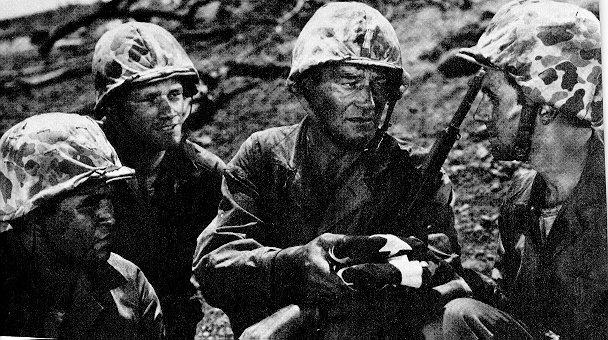
years old. "My dad never fished or even went to Canada. Usually, he was sitting there right at the table eating his Campbell's soup. But we had to tell the press that he was out fishing. He didn't want to talk to the press. *HISTORICAL CORRECTION: The Marine Corps has determined that Pfc. Harold Schultz is the Marine mistakenly identified as Navy Corpsman John Bradley.
June 23, 2016 -- After a three-month investigation into the Iwo Jima photograph, ordered by Marine Corps Commandant, General Robert Neller, service officials determined that Marine Private First Class (Pfc.) Harold Schultz was the sixth of the original flag-bearers, not Navy Corpsman John Bradley, as The Associated Press initially reported and which became the official history since. (Associated Press) See More.
When
the public first demanded this stamp commemorating the Flag "You
see, my dad didn't see himself as a hero. Everyone thinks these guys
are heroes, 'cause they are in a photo and on a monument. My dad knew
better. He was a medic. John Bradley from Wisconsin was a caregiver.
In Iwo Jima he probably held over 200 boys as they died. And when
boys died in Iwo Jima, they writhed and screamed in pain. MARCH 21, 2015, IOTO, Japan (AP) Source. Dozens of aging U.S. veterans, many in their early 90s and some in wheelchairs, gathered on the tiny, barren island of Iwo Jima on Saturday to mark the 70th anniversary of one of the bloodiest and most iconic battles of World War II. More than 30 veterans flown in from the U.S. island territory of Guam toured the black sand beaches where they invaded the deeply dug-in forces of the island's Japanese defenders in early 1945. They were bused to the top of Mount Suribachi, an active volcano, where an Associated Press photo of the raising of the American flag while the battle was still raging became a potent symbol of hope and valor to a war-weary public back home that was growing increasingly disillusioned with the seemingly unending battle in the Pacific. For some of the veterans, the return to the island where many of their comrades died, and which is still inhabited only by a contingent of Japanese military troops, brought out difficult emotions. "I hated them," said former Sgt. John Roy Coltrane, 93, of Siler City, North Carolina. "For 40 years, I wouldn't even buy anything made in Japan. But now I drive a Honda." Speeches at the Reunion of Honor ceremony held near the invasion beach were made by senior Japanese politicians and descendants of the few Japanese who survived the battle. Also speaking were U.S. Secretary of the Navy Ray Mabus and Gen. Joseph Dunford, the commandant of the Marine Corps, who noted that the battle for Iwo Jima remains the "very ethos" of the Marine Corps today. "We should never forget that the peace and prosperity of Japan and the United States at present has been built on the sacrifice of precious lives," Japanese Defense Minister Gen Nakatani said in his remarks. This was the first time that Japanese Cabinet officials attended the anniversary ceremony, now in its 16th year. And while the presence of veterans able to make the grueling trip has been steadily dwindling, the number of participants - about 500 - was double that of last year because of the significance of the 70th year since Japan's surrender ended World War II. After the joint memorial, the U.S. and Japanese dignitaries and guests went their separate ways to visit the parts of the island that were of the most significance to their own troops. The Japanese have erected several memorials to their dead, and in a traditional way of placating their souls poured water and placed flowers on the memorial sites. The Marines invaded Iwo Jima in February 1945, and it was only declared secured after more than a month of fighting. About 70,000 U.S. troops fought more than 20,000 Japanese - only 216 Japanese were captured as POWs and the rest are believed to have been either killed in action or to have taken their own lives. The island was declared secure on March 16, 1945, but skirmishes continued. In about 36 days of battle, nearly 7,000 U.S. Marines were killed and 20,000 wounded. It is to this day considered sacred ground to many Japanese. As a haunting reminder of the ferocity of the fighting, search teams continue to dig up more and more Japanese remains each year - it's estimated that 12,000 have yet to be found. The United States returned the island to Japan in 1968. Wreckage of military equipment can still be seen dotting some of the beach areas, along with pill boxes and extensive mazes of caves. Though the idea of developing the island for tourism has been mulled for decades, and possibly using its natural hot springs as an attraction, the island is virtually untouched other than the small airfield used by the Japanese. Though a tiny volcanic crag, the island - now called Ioto or Iwoto on Japanese maps - was deemed strategically important because it was being used by the Japanese to launch air attacks on American bombers. After its capture, it was used by the U.S. as an emergency landing site for B-29s, which eventually made 2,900 emergency landings there that are estimated to have saved the lives of 24,000 airmen who would have otherwise had to crash at sea. Twenty-seven Medals of Honor were awarded for action in the battle, more than any other in U.S. military history. The only surviving Medal of Honor recipient from Iwo Jima, Hershel "Woody" Williams, 91, attended the ceremony. Afterward, he said his feelings toward the Japanese had not changed in the decades since the battle. "They were just doing their jobs, just like we were," he said. "We tried to kill them before they could kill us. But that's war." -- See More.
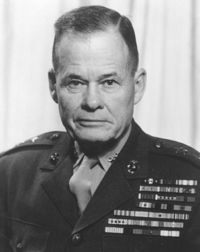
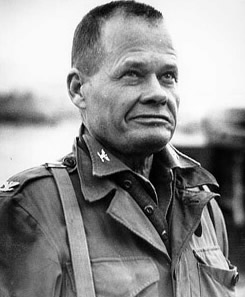
"Most of us wonder if our lives made any difference. General Chesty Puller
A Marine Corps Hero
Fourteen
personal decorations for combat, five Navy Crosses
The most recognizable military hymn and the oldest official song in the U.S. Armed Forces, The Marines' Hymn is a reminder of the sacrifice and courage that Marines have shown on the battlefield. It is an important part of Marine Corps culture—every Marine can recite its three stanzas by heart. From the Halls of Montezuma, The Marine Corps Standard Lexicon Starboard: Right This is my rifle. There are many like it, but this one is mine. My rifle is my best friend. It is my life. I must master it as I must master my life. My rifle, without me, is useless. Without my rifle, I am useless. I must fire my rifle true. I must shoot straighter than my enemy who is trying to kill me. I must shoot him before he shoots me. I will…
A Tale of Six Boys On Iwo Jima Look, Listen and Experience Peace For Men Only: MasculineMoments.com How The Marines Transform Me Into We Museum of The American Military Family To The Greatest Generation...Before You Go U.S. Marine Corps Silent Drill Team With Rifles
 More Web sites by
KhalsaWebMasters.com 
|
|
ABOUT US CONTACT US DISCLAIMER HOME PAGE NEWS AND VIEWS SEARCH UNIVERSITY OF DIVERSITY |
 OohRahMemorial.com
 Factoid