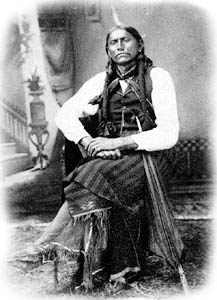
Quanah
Parker was the last Chief of the Comanches and never lost a
battle to the White man. His tribe roamed over the area where
Pampas stands. He was never captured by the Army, but decided
to surrender and lead his tribe into the White man's culture,
only when he saw that there was no alternative.
His was the last tribe in the Staked Plains to come into the
reservation system.
Quanah, meaning "fragrant," was born about 1850, son
of a Comanche Chief, Peta Nocona*,
and Cynthia Ann Parker, a White
girl taken captive during the 1836 raid on Parker's Fort, Texas.
Cynthia Ann Parker was recaptured, along with her daughter,
during an 1860 raid on the Pease River in northwest Texas. She
had spent 24 years among the Comanche, however, and thus never
readjusted to living with the Whites again.
She died in Anderson County, Texas, in 1864 shortly after the
death of her daughter, Prairie Flower. Ironically, Cynthia Ann's
son would adjust remarkably well to living among the White men.
But first he would lead a bloody war against them.
Quanah and the Quahada Comanche, of whom his father,
Peta Nocona had been chief, refused to accept the provisions
of the 1867 Treaty of Medicine Lodge, which confined the southern
Plains Native Americans to a reservation, promising to clothe
the Native Americans and turn them into farmers in imitation
of the White settlers.
Knowing of past lies and deceptive treaties of the "White
man", Quanah decided to remain on the warpath, raiding
in Texas and Mexico and out maneuvering Army Colonel Ronald
S. Mackenzie and others. He was almost killed during the attack
on buffalo hunters at Adobe Walls in the Texas Panhandle in
1874. The U.S. Army was relentless in its Red River campaign
of 1874-75. Quanah's allies, the Quahada were weary and starving.
Mackenzie sent Jacob J. Sturm, a physician and post interpreter,
to solicit the Quahada's surrender. Sturm found Quanah, whom
he called "a young man of much influence with his people,"
and pleaded his case. Quanah rode to a mesa, where he saw a
wolf come toward him, howl and trot away to the northeast. Overhead,
an eagle "glided lazily and then whipped his wings in the
direction of Fort Sill," in the words of Jacob Sturm. This
was a sign, Quanah thought, and on June 2, 1875, he and his
band surrendered at Fort Sill in present-day Oklahoma.
Biographer Bill Neeley writes:
"Not only did Quanah pass within the span of a single
lifetime from a Stone Age warrior to a statesman in the age
of the Industrial Revolution, but he accepted the challenge
and responsibility of leading the whole Comanche tribe on the
difficult road toward their new existence."
Quanah was traveling the "White man's road," but he
did it his way. He refused to give up polygamy, much to the
reservation agents' chagrin. Reservation agents being political
appointees of the Federal Government, their main concern was
to destroy all vestiges of Native American life and replace
their culture with that of theirs. Quanah Parker also used peyote,
negotiated grazing rights with Texas cattlemen, and invested
in a railroad. He learned English, became a reservation judge,
lobbied Congress and pleaded the cause of the Comanche Nation.
Among his friends were cattleman Charles Goodnight and President
Theodore Roosevelt. He considered himself a man who tried to
do right, both to the people of his tribe and to his "pale-faced
friends".
It wasn't easy. Mackenzie appointed Quanah Parker as the chief
of the Comanche shortly after his surrender, but the older chiefs
resented Parker’s youth, and his White blood in particular."
And in 1892, when Quanah Parker signed the Jerome Agreement
that broke up the reservation, the Comanche were split into
two factions: (1). those who realized that all that could be
done had been done for their nation; and (2). those who blamed
Chief Parker for selling out their country."
Quanah Parker died on February 23, 1911, and was buried next
to his mother, whose body he had
reinterred at Fort Sill Military cemetery on Chiefs Knoll in
Oklahoma only three months earlier.
For his courage, integrity and tremendous insight, Quanah Parker’s
life tells the story of one of America's greatest leaders and
a true Texas Hero. --
*NOCONA
TEXAS
Population 3,002, Altitude 988
This
little Texas town was named after Chief Peta Nocona, the husband
of Cynthia Ann Parker - the Mother
of the Texas Legend.
Today, this city is famed as the "Leathergoods Center of
the Southwest," with several firms producing leather products.
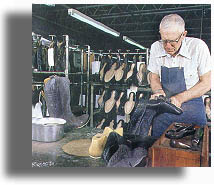
Nocona Boots
This
time honored boot maker is loved and respected in Nocona. The
factory displays boot-making tools from the 1890's.
The City Park offers picnicking, playground facilities, and
adjoins an 18-hole municipal golf course.
Nearby Lake Nocona offers water sports and camping facilities.
A self-guided historical tour is available from the Nocona Chamber
of Commerce. --
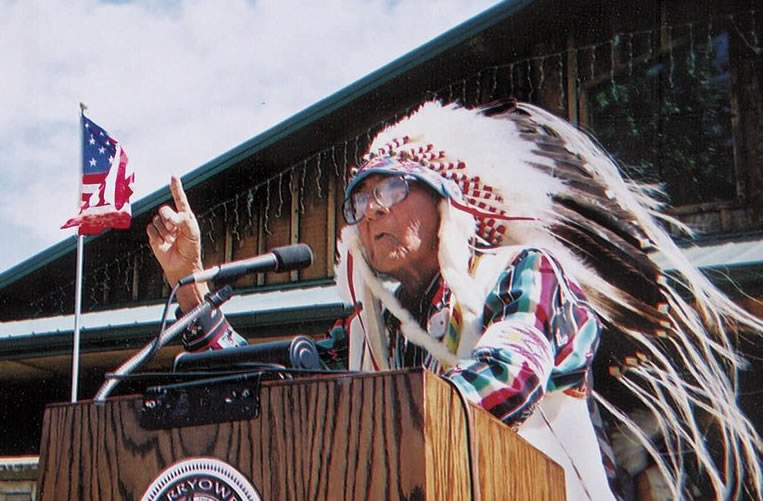
Chief Joseph Medicine Crow
October 27, 1913 – April 3, 2016 See More.
Chief's ancestors fought with Gen. George A. Custer.