ARE YOU A GENUINE OPTICIAN
OR AN EYEGLASS MERCHANT?


POINTS
TO PONDER
"It's time to shift your thinking.
It's time to get your shift together.
It's time for eyewear professionals
to become agents of change going forward;
it's time to return to the days of providing full service;
to improve our hands-on craftsmanship skills; it's time
for those who know to teach those who do not know; and
it's time for those who do not know to surrender their ego."
"Opticianry is defined by how well the eyewear makes contact with the patient.
All Opticianry is local. Eyeglass consumers need and deserve the following:
a) Optician-assisted, in-depth lifestyle interview;
b) Optician-assisted, design and selection;
c) Handcrafted, form-fitting eyewear;
d) Free lifetime adjustments and
minor repair services, none of
which are available online."
OpticalGuidelines.com
"Service is an intrinsic value, not a value to be added."
"What do dentists, manicurists, hairstylists and
opticians all have in common? They have to make direct,
tactile contact with consumers while dispensing services."
"When
Opticians do not touch the consumer at the time
they dispense their
eyewear, they are acting more
as unskilled eyeglass merchants than as Opticians."
"Opticians
must exercise multi-dimensional opticianry,
i.e., full Discovery, masterful Design, and touch
and feel Delivery of prescription eyewear."
"Opticians
are vision experts who serve Patients with
comprehensive vision solutions as opposed to eyeglass
merchants who just sell Customers glasses and contact lenses."
"What
are the chances of today's eyewear consumers getting a
hands-on,
customized fitting of their prescription eyewear? If you
answered this question correctly, you know why they buy online."
"The manager of a nationwide retail optical dispensary
advised a staff member who attempted to customize a
frame as seen here that they would be fired if they tried to
fit another 'customer' with such an ugly looking adjustment."
"After many years of failing to provide the public with
hands on the patient frame-fitting services, dispensers
have suddenly discovered that consumers are flocking
to the Internet* for their eyewear, where likewise, they
are unable to acquire customized frame-fitting services.
Refusing to admit culpability, these same retailers now
blame cheap online prices and unethical practices for the
erosion of market share and the steep decline of revenues."
(See AARP's 'Your Money,' December,
2011, as example.)
"More
and more eyewear is being purchased online.
The number one complaint of brick and mortar
patrons ...
'Nobody adjusted my glasses. They just handed
them to me.'
So, for these consumers there's little difference between the service
they receive in many of today's dispensaries and buying glasses online."
"If you will recall, Opticianry is ultimately defined by how well
the eyewear fits the Patient. So, the real issue for Opticians and
Consumers to consider, is not whether prescription eyewear can be
purchased in stores or online. The real issue is the current deficiency
in the delivery of eyewear due to the absence of the craftsmanship
and skills required to dispense form-fitting eyewear to the Consumer.
The real challenge for any Optician is to take a symmetrically, 4-point
square device and handcraft it to fit an asymmetrically shaped surface.
The answer is hands-on training, hands-on training, hands-on training.
It's time for those Opticians who know to teach those who do not know.
And it is time for any Opticians who do not know to surrender their egos.
It's been predicted that if Opticians fail to practice customizing eyewear to
fit the Patient, Opticianry will become irrelevant as a healthcare profession. "
"It is incumbent on those who know...to teach those who do not know."
"Hand
crafted multi-dimensional adjustments, including tactile, hands-on,
touch and feel procedures
such as reshaping the temple ends to make direct
and full, touching-without-pressing contact with the mastoid area behind the ears,
while simultaneously avoiding direct contact with the pressure-sensitive
ears, is
the single most important considerations for long term comfort
and wearability."
"It
is time for direct, touch and feel, handcrafted frame-fitting training to happen.
This is done by one-on-one craftsmanship training. It cannot be
learned virtually."
*This workshop meets the Florida Board of Opticianry's requirement
for Apprentices to attend a two hour Hands-On Frame-Fitting course.
Optical Workshops is Florida Board of Opticianry CE Provider #50-13776.
Click or Call  855-410-2700 to arrange for a Training Session.

'Professional Egotism'
 There are a number of conflicted forces at work within the ophthalmic dispensing industry, which keep us from making progress. The two biggest are: There are a number of conflicted forces at work within the ophthalmic dispensing industry, which keep us from making progress. The two biggest are:
 .) We have not yet effectively dealt with the reality that the majority of current dispensers are woefully under trained and extremely challenged when it comes to handcrafting prescription eyewear. For instance, I know senior Opticians who attend Optical Workshops who are unable to adequately customize eyewear directly on a Patient. (The number one complaint by prescription eyewear consumers is they are unable to acquire well-fitting eyewear.) .) We have not yet effectively dealt with the reality that the majority of current dispensers are woefully under trained and extremely challenged when it comes to handcrafting prescription eyewear. For instance, I know senior Opticians who attend Optical Workshops who are unable to adequately customize eyewear directly on a Patient. (The number one complaint by prescription eyewear consumers is they are unable to acquire well-fitting eyewear.)
 .) There's also a lot of what I call professional egotism and shaktipad (see NOTES* below), whereby many 'Opticians' are unable to admit, either through ignorance or antipathy, that they really do not know how to adjust eyewear, i.e., handcraft eyewear directly on a patient. Many only think they know and take umbrage when challenged. They have convinced themselves that they need no more training because they've been adjusting frames for years, and they see no need to change. .) There's also a lot of what I call professional egotism and shaktipad (see NOTES* below), whereby many 'Opticians' are unable to admit, either through ignorance or antipathy, that they really do not know how to adjust eyewear, i.e., handcraft eyewear directly on a patient. Many only think they know and take umbrage when challenged. They have convinced themselves that they need no more training because they've been adjusting frames for years, and they see no need to change.
Regarding this 'professional egoism' issue, we suggest that we ask this question of those dispensers who claim they already know how to fit eyewear, and those who claim that they have been working as an Optician for several years. "Have you had any formal training in handcrafting eyewear directly on the consumer?"
The problem is that many folks are self-taught, and most of those who came up as apprentices were taught by dispensers who have had no formalized hands-on the consumer, frame-adjustment training.
This decades-old history is the main reason, not price, that Opticianry as a profession has lost, and continues to lose market share.
Therefore it is incumbent on those who know to teach those who do not know. And it is incumbent on those who do not know to surrender their ego. OpticalGuidelines.com OpticalGuidelines.com
*NOTES:
EGOTISM is the feeling or belief that one is better, more important, more talented, etc., than other people.
SHAKTIPAD is a state of egotism in which an optical dispenser is far less experienced, knows far less than they think they know, and who fails to acknowledge it. The worst case scenario is the optician who falls into the trap of convincing themselves and others that only they know the best way, and that the old ways need to change. Beware of the 'tiger's bite'! Shaktipad is a consequence of 'riding the tiger' of pride. One must ever be alert to the signs of shaktipad in order to take appropriate action. In the case of an optical dispenser in the state of shaktipad, the remedy is to seek out practical training with the attitude of a perpetual student, i.e., one who surrenders their ego, realizes that learning never stops, and that one can always improve their skills. See Ego Eradicator. |
BEFORE WE GET STARTED
Let's look at why this training is so important.

TESTIMONIALS
 These are just a couple of interesting consumer reports we've recently received from Patients who reported their experiences while attempting to acquire what every consumer is owed, skillfully handcrafted, form-fitting, prescription eyewear.
.) "This message is for Hari Singh Bird, Optician. I believe we spoke by phone about 8 years ago. I have not had a good fitting pair of glasses for 42 years. I am now 62 and feeling ignored and kind of in a daze with the lack of interest in my case. The Ophthalmologists are there to examine and prescribe, but they disassociate themselves from the Opticians, and the Opticians simply accept the frame selection they are offered. I just spent over $300 just for trifocal lenses, but the frame I bought two years ago just doesn't work. It was the closet I could find and there still isn't anything out there, to my knowledge that will fit me. I have a mostly straight and narrow bridge, a large head, and some mastoid bone is missing behind my left ear, removed at age 23. (Note: See How To Custom Fit The Mastoid Complex.)
In addition my right ear is much further back than my left, so I require a bare minimum 150 mm temples but more likely 155 mm. I prefer plastic frames (currently wearing Anglo American) as I tried nosepieces in the past, and they just caused pain.
Speaking of pain, I used a blow dryer to adjust my temples down behind my ears so they wouldn't slide, but they still do. I changed the angle of my frame front so they would not touch my cheek, but they still do and by changing the angle the bar of the keyhole bridge now touches the top of my nose and leaves a red mark.
I read your biblical quote by Luke, "Ask, it will be given to you; seek and you will find; knock and the door will be opened to you. For everyone who asks receives; he who seeks finds; and to him who knocks, the door will be opened. Luke 11: 9-10," and I have to say I have knocked on a lot of doors that only opened to take my money, and left me to repeat the process again and again. Here is my quote: "Hell is living with ill-fitting glasses and being branded a complainer when questioning Opticians and Ophthalmologists."
If you have knowledge of any referrals in the Park Forest-Chicago area that might be able to help me, please forward me their contact information. By the way, I only have a short time to return my lenses for a remake. My Ophthalmologist suggested progressive lenses after I complained about the distance for reading books, and my office computer screens (2) with my trifocals. I am willing to do that, but I need to find a proper fitting frame.
Here's an e-mail from just one of too many consumers. This one from a long-time Patient of ours who is now living out of state. She was handed her new eyewear at a large retail
optical outlet by an assistant dispenser (not an Optician), whereupon no adjustments to the frame
were made, and she was forced to seek appropriate
service elsewhere. She reflected on feeling fortunate to have subsequently found independent Opticians like ourselves, who had
the skills and experience to relieve her discomfort, after having spent a considerable
amount of time searching. She further commented about her previous experiences at the hands of one of our staff.
.) Having
you fit my glasses on my face, ears, nose with care and attention to detail, making minute but
essential adjustments, was the best experience I have ever had
of having glasses fitted during my lifetime of wearing
glasses. The first time you did my glasses, and your wife suggested
to me that I also have my lenses tinted to gently soften the
lines around my eyes, was a memorable experience. I have
shared the story of that day, in your dispensary very often,
whenever I get ‘new’ glasses. Most Opticians
are surprised to hear the story and also amazed that having
such care and attention to detail as a part of having glasses
fit properly made such a difference in my life. Having my glasses
not hurt, and having them fit properly was an incredible blessing.
Having my glasses fit gracefully and painlessly is nothing short of a Godsend. I can honestly say
that no other Optician ever did such an impeccable job as you
did.
Unfortunately, I once tried to get new lenses in the glasses that you had adjusted
for me. I came back to pick up the glasses and someone said
to me that the Optician had straightened out the bent side pieces!
I was so upset! I made the Optician come out and I explained
what you had done for me, why you had done it and what a terrible
disservice he had done by ‘straightening’ my side
pieces and that he had to re-bend the side pieces back to where
they had been. Needless to say, those glasses never fit the
same again! After that I never changed lenses without speaking
directly to the person making the lenses and making sure they
knew not to change or adjust the side pieces. If you lived where
I could get my glasses adjusted properly, that is where I would
go...
QUESTION

Today's consumers are asking: Is there really a difference
in quality and service between buying prescription eyewear in a brick and mortar store and buying online? Yes, there are important differences. See GlassesOnlineWarning.com and The Danger Independent Opticians Face.
INTRODUCTION

This
Workshop is for those apprentices and-or
more recently licensed Opticians who wish to either learn new
techniques or otherwise improve their current skills, and it will
fulfill 2-hours of continuing education requirements. (Also see Advanced Workshop.) This Workshop has been accredited by ABO, the American Board of
Opticianry and approved by the Florida Board of Opticianry. This
Workshop meets all accreditation requirements by providing
participants a) Practical experience in the Visual and Tactile
Assessment and the Handcrafted Alignment and Adjustment of eyewear for the purpose of correcting the most obvious misalignments of
the Patient's eyewear, while in-place, and on the face, b) Practical experience in the Final Fitting,* i.e., the
application of the More Subtle
Adjustments using more artfully handcrafted Touch
and Feel frame-fitting
skills in order to maximize the Patient's visual comfort and long term
wearability. See DispensingGuidelines.com.
*This
last topic, Final-Fitting, is addressed with special emphasis on the necessity
for the qualitative dispensing of eyewear using 1) Visual-tactile, in-place, on the face assessment, and 2) Highly evolved handcrafted, 'touch
and feel' techniques of frame-fitting. See example below.
Also see Custom Frame-Fitting, Up
Close and Personal.
IMPORTANT Beginning May 1, 2013, attendance at a minimum 2-hour State Board Approved Hands-on Handcrafted Frame-Fitting Workshop is
required of ALL applicants prior to licensure in Florida. See Letter To Eye Care Professionals.
Beginning May 1, 2013, attendance at a minimum 2-hour State Board Approved Hands-on Handcrafted Frame-Fitting Workshop is
required of ALL applicants prior to licensure in Florida. See Letter To Eye Care Professionals.
OLD FASHIONED MULTI-DIMENSION
HANDCRAFTED ON THE PATIENT CRAFTSMANSHIP
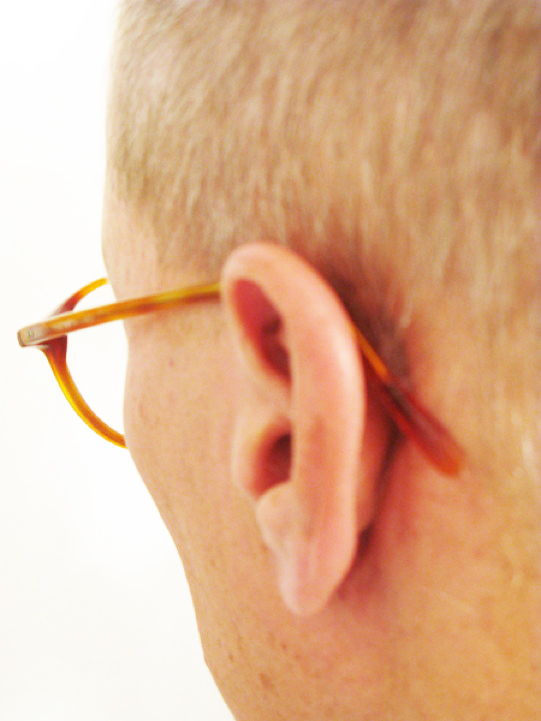
Note big gap between skull and temple-end.
THE
NO TOUCH - NO HOLD PRINCIPLE
"Where
there's no touch, there can be no hold.
Temple-ends must fully contact the mastoid complex.
Temple-ends cannot hold eyewear in place for long-term
comfort if they do not make full contact with the mastoid.
Full contact does not mean pressure. Touch only is necessary."

Form-fitting the
Mastoid Complex
With Handcrafted Mastoid Dip and Wrap
Every
Patient deserves sufficiently handcrafted,
multi-dimension, form-fitting frame adjustments, e.g.,
gaps and spaces are removed from between the frame's
temples and the skull behind the ears, in order to enhance
comfort, stability, and long term wearability. Full contact
with
a light touch of the skull, NOT THE EARS, is the primary means
by which the frame should be held in place for long-term comfort.
Note: If you're able to teach this skill, contact me at LinkedIn.com. 

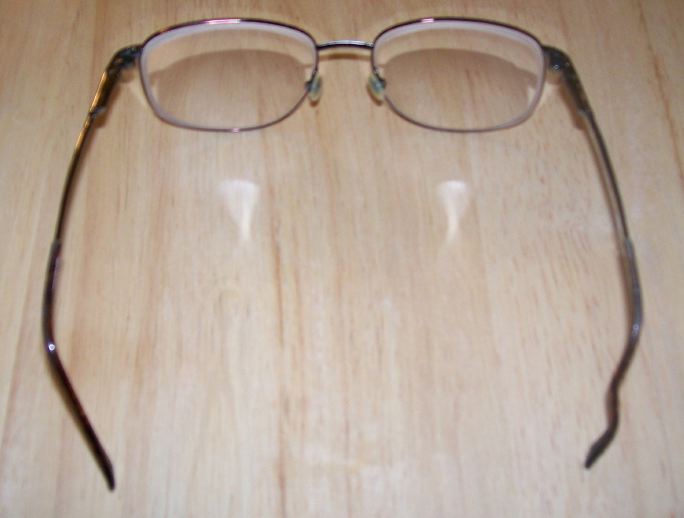

BEFORE temple-end is in out-of-the-box condition,
i.e., it doesn't make contact with the Patient's
skull,
whereas the AFTER temple has been form-fitted with
an added handcrafted mastoid dip and mastoid wrap.
It now fits the mastoid bone like a glove since it has
been
shaped to make full, direct contact with this Patient's
skull.
Custom-fitted by hand temples become invisible when worn
and the
resultant fit avoids pressure and is extremely comfortable.
Note: This skill cannot be learned virtually, i.e., via lecture or online.
This skill is acquired only by handcrafting the eyewear using direct, face
to face, on the Patient, tactile, touch and feel contact with the Patient. The
availability, knowledge and skilled use of related handcrafting tools is essential.
Also, keep in mind that online merchants are incapable of providing this service.
OBJECTIVES
"Successful
dispensing requires the careful and thoughtful
process of Discovery, Design, and Delivery of eyewear
without bias concerning sales quotas, profit margin or
other subjective and unrelated considerations."
Although
the Full Discovery and Disclosure Interview, and Frame-Fitting
Techniques are not the only aspects of what is called Ophthalmic
Dispensing, today these are much underrated, even subordinated
skills. The Frame-Fitting skill set, which can be acquired only
through direct, practical experience, must include 1) Visual and
tactile, touch and feel,
hands-on assessment of
the eyewear in-place, on the face, 2) Basic
Frame Alignment, i.e., correcting the most obvious misalignments,
and 3) Application of more Subtle
Frame and Temple Adjustments, i.e., the personalized, handcrafted,
multi-dimensional adaptations such as form-fittng the temple-ends
relative to the skull and mastoid complex, and then 90 degrees relative
to the ears, are the most important considerations for long term
visual comfort and wearability. Not only is a poorly fitted
frame likely to cause discomfort and inconvenience to the Patient,
but in cases of higher lens powers and high astigmatic corrections
it can even adversely effect the prescription, thus creating additional
visual issues. See example above. See Shift Happens.
Upon
completion of this workshop the Eye Care Professional will:
 Be more familiar
with the Lifestyle Interview and Full Discovery and Disclosure procedure
with regard to the Patient's vocational and-or avocational lifestyle,
which precedes any design of the lenses, and the final selection
of a frame.
Be more familiar
with the Lifestyle Interview and Full Discovery and Disclosure procedure
with regard to the Patient's vocational and-or avocational lifestyle,
which precedes any design of the lenses, and the final selection
of a frame.
Be more familiar
with the basic parts of the ophthalmic frame and its measurement
criteria.
Appreciate
the various frame styles, nose piece-bridge designs, and types
of temples currently available, and their purposeful applications.
Appreciate
the importance of providing the Patient with unbiased assistance
as to their choices of price and quality in the selection of
their frame size and style, and lens design.
Be more familiar
and sensitive with regard to the proper frame selection using
the shape of the face and head, placement and anomalies of the
eyes, ears, and mastoid complex, and the nature of the prescription
as criteria, with emphasis on the adverse consequences of a
poorly designed and-or poorly fitting frame.
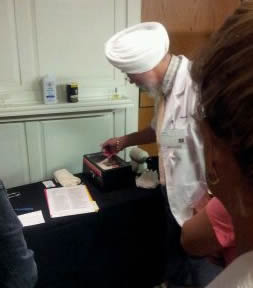
Optician heats a temple in order to demonstrate
the custom form-fitting of the mastoid complex.
Appreciate
the qualitative aspects of dispensing corrective eyewear using
tactile, hands-on, in-place, on the face visual-tactile eyewear
assessment, and the touch and feel aspects of time honored frame-fitting
techniques.
Observe and
experience direct, hands-on, in-place, on the face, touch and feel frame-fitting
techniques whereby comfort, prescription integrity, and long term frame
wearability are achieved and sustained.
Be more familiar
with the tools and conditions that are necessary for the application
of handcrafted frame-fitting skills, i.e., proper type and placement
of tools and instruments, ergonomic design of dispensing table,
etc.
Experience
and appreciate the difference between Basic Frame Alignment,
and Subtle Frame Adjustments. See
example.
Be able to
serve Patients more quickly with handcrafted, personalized,
custom fitted eyewear, frame repairs and adjustments.
Directly
experience and thereby appreciate the distinction between an
Eye Care Professional's custom fitting of corrective eyewear
directly on a Patient versus an unskilled eyeglass merchant
casually delivering one-size-fits-all merchandise to a Customer.
See Enough With The Talking Points.








 Teaches the dispensing of handcrafted form-fitting eyewear,
  Improved job security for prescription Eyewear Professionals