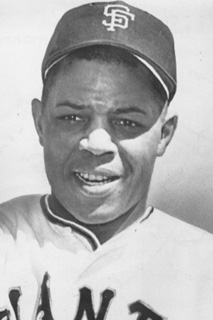
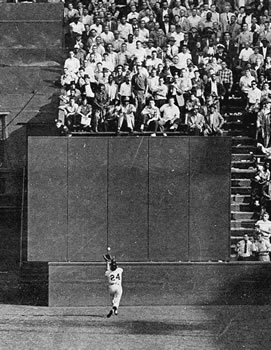
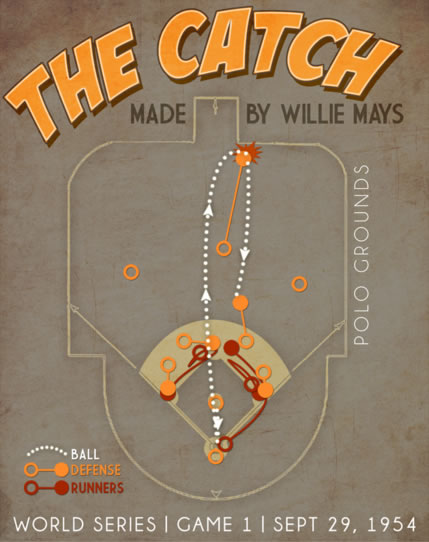
NEW YORK, World Series, Game 1, September 29, 1954 -- The Catch refers to a memorable defensive baseball play by Willie Mays on September 29, 1954, during Game 1 of the 1954 World Series between the New York Giants and the Cleveland Indians at the Polo Grounds in New York on a ball hit by Vic Wertz. The score was tied 2-2 in the top of the eighth inning. Starting pitcher Sal Maglie walked Larry Doby and gave up a single to Al Rosen. With runners on first and second, Giants manager Leo Durocher summoned left-handed relief pitcher Don Liddle to replace Maglie and pitch to Cleveland's Wertz, also a left-hander.
Wertz worked the count to two balls and a strike before crushing Liddle's fourth pitch approximately 420 feet to deep center field. In many stadiums the hit would have been a home run and given the Indians a 5-2 lead. However, this was the spacious Polo Grounds, and Giants center fielder Willie Mays, who was playing in shallow center field, made an on-the-run over-the-shoulder catch on the warning track to make the out.
Having caught the ball, he immediately spun and threw the ball, losing his hat in characteristic style. Doby, the runner on second, might have been able to score the go-ahead run had he tagged at the moment the ball was caught; but as it was, he ran when the ball was hit, and then had to scramble back to retag and only got as far as third base. (Rosen stayed at first on this play.) Liddle was then relieved by Marv Grissom, to whom he supposedly remarked "Well, I got my man!" (The next batter walked to load the bases, but the next 2 batters were retired to end this half-inning with no runs scored.)
Did you catch the part where it said he caught it around four hundred and twenty feet? That's outstanding, but that's only part of the beauty. Yes, it's the distance, but it's also the over-the-head-catch, it's the recovery, it's the throw to the cut-off man. It's the fact that Mays never believed it was his greatest play, much less the greatest in baseball history. -- Source.
LOS
ANGELES, Saturday, April 22, 2006 -- Rick Monday never tires
of answering questions about that memorable day 30 years ago,
when he performed his own Patriot Act and unwittingly became
an icon to millions of American war heroes and their loved ones.
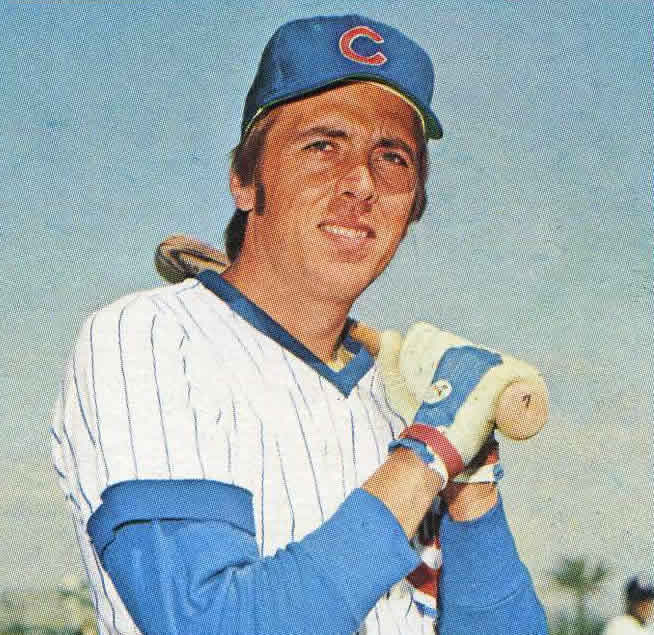
Monday was playing center field for the Chicago Cubs on April
25, 1976, at Dodger Stadium when he noticed two protesters kneeling
on the grass in left-center, intending to burn the American
flag. He immediately bolted toward them and snatched it away.
"I was angry when I saw them start to do something to the
flag, and I'm glad that I happened to be geographically close
enough to do something about it," said Monday, now in his
13th season as a Dodgers broadcaster.
"What those people were doing, and their concept of what
they were trying to do was wrong. That feeling was very strongly
reinforced by six years in the United States Marine Corps Reserves.
I still think it's wrong to do that."
Back in '76, Monday was presented with the flag in a ceremony
at Wrigley Field by Dodgers executive Al Campanis. It hung in
his home in Vero Beach, Fla., until a couple of years ago, when
the house sustained severe damage from a hurricane. Now it's
in a safety deposit box.
Monday wouldn't say how much the flag is insured for, but "you'd
have to add a lot of zeros.
People have offered an outrageous amount of money for it --
not that it's for sale."
The Baseball Hall of Fame recently named Monday's quick-thinking
act as one of the 100 Classic Moments in the history of the
game.
"Whatever their protest was about, what they were attempting
to do to the flag -- which represents a lot of rights and freedoms
that we all have -- was wrong for a lot of reasons," Monday
said. "Not only does it desecrate the flag, but it also
desecrates the effort and the lives that have been laid down
to protect those rights and freedoms for all of us."
In Peter Golenbock's 1996 book, "Wrigleyville: A Magical
History Tour of the Chicago Cubs," former Cubs reliever
Darold Knowles recalled what happened in the aftermath of Monday's
flag-saving effort.
"That put Rick on the map," said Knowles, a teammate
of Monday's for two seasons in Chicago and one in Oakland. "Rick
got more recognition out of the flag incident than he got as
a player. He was getting letters from all over the country,
all the time -- from VFWs (Veterans of Foreign Wars) and American
Legions organizations. Every place we'd go, somebody would honor
him with a plaque. He let us read some of the letters (from)
people thanking him."
Along with the flag, Monday has a copy of the 16-mm footage
taken by a fan who was at the game, as well as Dodgers broadcaster
Vin Scully's play-by-play of the incident. Also among his souvenirs
is a copy of the now-famous photo by James Roarke of Monday
just as he grabbed the flag.
Monday hit a career-high 32 home runs that season before the
Dodgers acquired him from the Cubs with reliever Mike Garman,
in exchange for outfielder Bill Buckner and backup shortstop
Ivan DeJesus. Monday spent the final eight seasons of his career
with Los Angeles, helping the Dodgers win three pennants in
a five-year span.
He was the first player chosen in the very first draft back
in 1965 after leading Arizona State to a College World Series
title. The two-time All-Star put up some impressive numbers
during his 19 major league seasons. His ninth-inning home run
in the fifth and deciding game of the 1981 NL Championship Series
at Montreal catapulted the Dodgers into the World Series, where
they beat the Yankees in six games.
"I know the people were very pleased to see Monday take
the flag away from those guys," recalled Manny Mota, Monday's
teammate that season and now a Dodgers coach. "I know Rick
has done a lot of good things as a player and as a person. But
what he did for his country, he will be remembered for the rest
of his life as an American hero." -- Source.
Send us your favorite video for
posting on this Web site. Click
here.