|
"Well
aware that Almighty God hath created the mind free; that all attempts
to influence it by temporal punishments or burdens, or by civil incapacitations,
tend only to beget habits of hypocrisy and meanness, and are a departure
from the plan of the Holy Author of our religion, who being Lord both
of body and mind, yet chose not to propagate it by coercions on either,
as was in his Almighty power to do; that the impious presumption of
legislators and rulers, civil as well as ecclesiastical, who, being
themselves but fallible and uninspired men, have assumed dominion
over the faith of others, setting up their own opinions and modes
of thinking as the only true and infallible, and as such endeavoring
to impose them on others, hath established and maintained false religions
over the greatest part of the world, and through all time; that to
compel a man to furnish contributions of money for the propagation
of opinions which he disbelieves, is sinful and tyrannical; that even
the forcing him to support this or that teacher of his own religious
persuasion, is depriving him of the comfortable liberty of giving
his contributions to the particular pastor whose morals he would make
his pattern, and whose powers he feels most persuasive to righteousness,
and is withdrawing from the ministry those temporal rewards, which
proceeding from an approbation of their personal conduct, are an additional
incitement to earnest and unremitting labors for the instruction of
mankind; that our civil rights have no dependence on our religious
opinions, more than our opinions in physics or geometry; that, therefore,
the proscribing any citizen as unworthy the public confidence by laying
upon him an incapacity of being called to the offices of trust and
emolument, unless he profess or renounce this or that religious opinion,
is depriving him injuriously of those privileges and advantages to
which in common with his fellow citizens he has a natural right; that
it tends also to corrupt the principles of that very religion it is
meant to encourage, by bribing, with a monopoly of worldly honors
and emoluments, those who will externally profess and conform to it;
that though indeed these are criminal who do not withstand such temptation,
yet neither are those innocent who lay the bait in their way; that
to suffer the civil magistrate to intrude his powers into the field
of opinion and to restrain the profession or propagation of principles,
on the supposition of their ill tendency, is a dangerous fallacy,
which at once destroys all religious liberty, because he being of
course judge of that tendency, will make his opinions the rule of
judgment, and approve or condemn the sentiments of others only as
they shall square with or differ from his own; that it is time enough
for the rightful purposes of civil government, for its officers to
interfere when principles break out into overt acts against peace
and good order; and finally, that truth is great and will prevail
if left to herself, that she is the proper and sufficient antagonist
to error, and has nothing to fear from the conflict, unless by human
interposition disarmed of her natural weapons, free argument and debate,
errors ceasing to be dangerous when it is permitted freely to contradict
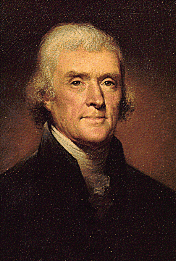
them. Thomas Jefferson The Declaration of Independence The first Thanksgiving Day Prayer Whatever happened to the DOI Signers Life is like a gift they say...wrapped up for you everyday
 More Web sites by KhalsaWebMasters.com 
|
|
ABOUT US CONTACT US DISCLAIMER HOME PAGE NEWS AND VIEWS SEARCH UNIVERSITY OF DIVERSITY |