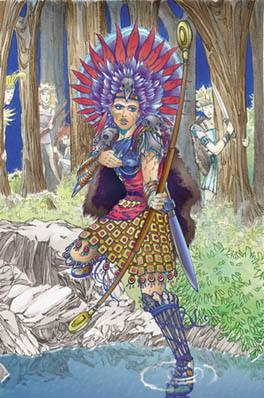
Aella
During the Greeks' attempt to take Hippolyta's golden belt, Heracles
slew the Amazon Aella ("whirlwind") who was known for
wielding a labrys (double-ax).
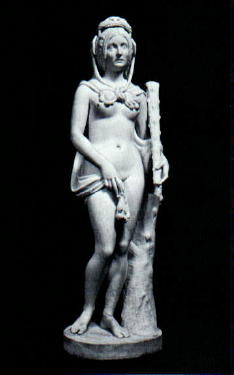
Queen Antiope
Antiope
The Amazon queen Antiope was kidnapped by Heracles from her homeland,
brought to Athens and presented to Theseus, the mythical king of
Athens. Theseus took her as his wife and she bore him a son named
Hippolytus after Antiope's sister Hippolyta. She is the only Amazon
known to have married. Fighting by her husband's side during an
Amazon attack on Athens, one of her Amazon sisters, Molpadia, ran
her through with a spear.
Hippo
Hippo's name means "horse," a word found in many Amazon
names. She was one of the queens who helped found the cities of
Ephesus, Smyrna, Cyrene, and Myrina. After conquering Asia Minor
and Syria, the warrior woman set up a wooden image of Artemis near
a beech tree in Ephesus. There the Amazons would perform a shield
dance with rattling quivers, beating the ground in unison to the
accompaniment of pipes playing a wild, warlike melody.
Hippolyta
Hippolyta was one of the greatest queens of the Amazons and one
of the most beautiful and strongest women of her time. She wore
the golden girdle of Amazonian queenship, a gift from her father,
Ares. This royal belt became the object of Heracles' ninth labor.
Hippolyta
was attracted to Heracles and was ready to give him the girdle until
Hera, Heracles' nemesis, disguised herself as an Amazon and spread
the rumor that the queen had been robbed by him. The Amazons rose
to assist their queen and a fight ensued. In the battle, Heracles,
believing Hippolyta plotted against him, killed her, took the girdle
and left.
Lysippe
In Greek legend, the Amazon queen Lysippe had a son, Tanais, who
offended Aphrodite by his scorn of marriage and his devotion to
war. In revenge Aphrodite caused him to fall in love with his mother.
He
was so shamed by this that he flung himself into a river, drowning
himself. Lysippe lost her sorrow in work, consolidating her queendom,
building the city of Themiscyra and raising temples to worship Artemis.
It is said she led a force of women that were the first to use calvary
in battle.
Marpesia
One of the great military queens, Marpesia began a victorious campaign
at the Black Sea and soon conquered Thrace and Syria. Then, with
Queen Hippo she marched through Ephesus and Cyrene, finally reaching
the Aegean Sea. After settling down to rule her empire, she was
called back to the battlefield to defend it from the uprising of
her subjects and lost her life in the process.
Omphale
The Amazon queen Omphale was said to have ruled the southern empire
of Libya. Omphale bought Heracles in a sale of slaves and had him
weave, spin and card wool as well as many other duties. If he made
mistakes she would beat him with a golden sandal. Eventually growing
bored with him, Omphale sent Heracles back to his homeland.
Otrere
Otrere meaning "nimble" was the name given in some tales
to the ancestral goddess of the Amazons. It was also a title of
distinction bestowed upon women leaders.
Pantariste
Pantariste killed the Greek messenger Tiamides, who was on his way
to alert his countrymen about the Amazonian revolt against the Greeks'
attempt to steal Queen Hippolyta's belt.
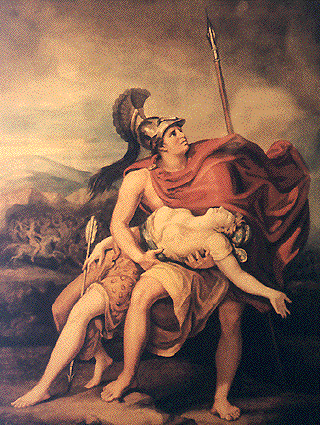
Penthesilea
One of the greatest Amazon warriors, Penthesilea led a troop to
Troy to fight the Greeks. There she engaged Achilles in single combat
that was a close combat but was finally killed. Achilles mourned
her death when he tore off her helmet and saw her beauty. Thersites,
reputed to be the ugliest Greek at Troy, jeered at Achilles' grief
and accused him of unnatural lust, whereupon Achilles killed him.
This enraged some of the Greeks and Diomeds, a cousin of Thersites,
threw Penthesiliea's corpse into the River Scamander.
Thalestris
The Amazon queen Thalestris visited Alexander the Great (356-323
B.C.) during one of his Asian campaigns, wishing to have a daughter
by such a famous general. She stayed with him for 13 days before
returning to her own country. Writing more than 400 years later,
Plutarch lists no less than 14 authorities who mention this tale,
though nine of them, he says, dismissed it as 'complete fiction',
and it was laughed at after Alexander's death by his successor in
Thrace, Lysismachus.
Following
is from A Midsummer Night's Dream, Act I Scene 1, Theseus to Hippolyta.
In
some accounts, Hippolyta and Antiope may have been the same person
rather than being sisters. This is why Theseus is addressing Hippolyta
rather than Antiope.
"Hippolyta,
I woo'd thee with my sword, and won thy love, doing thee injuries;
But I will wed thee in another key, with pomp, with triumph and
with revelling."